

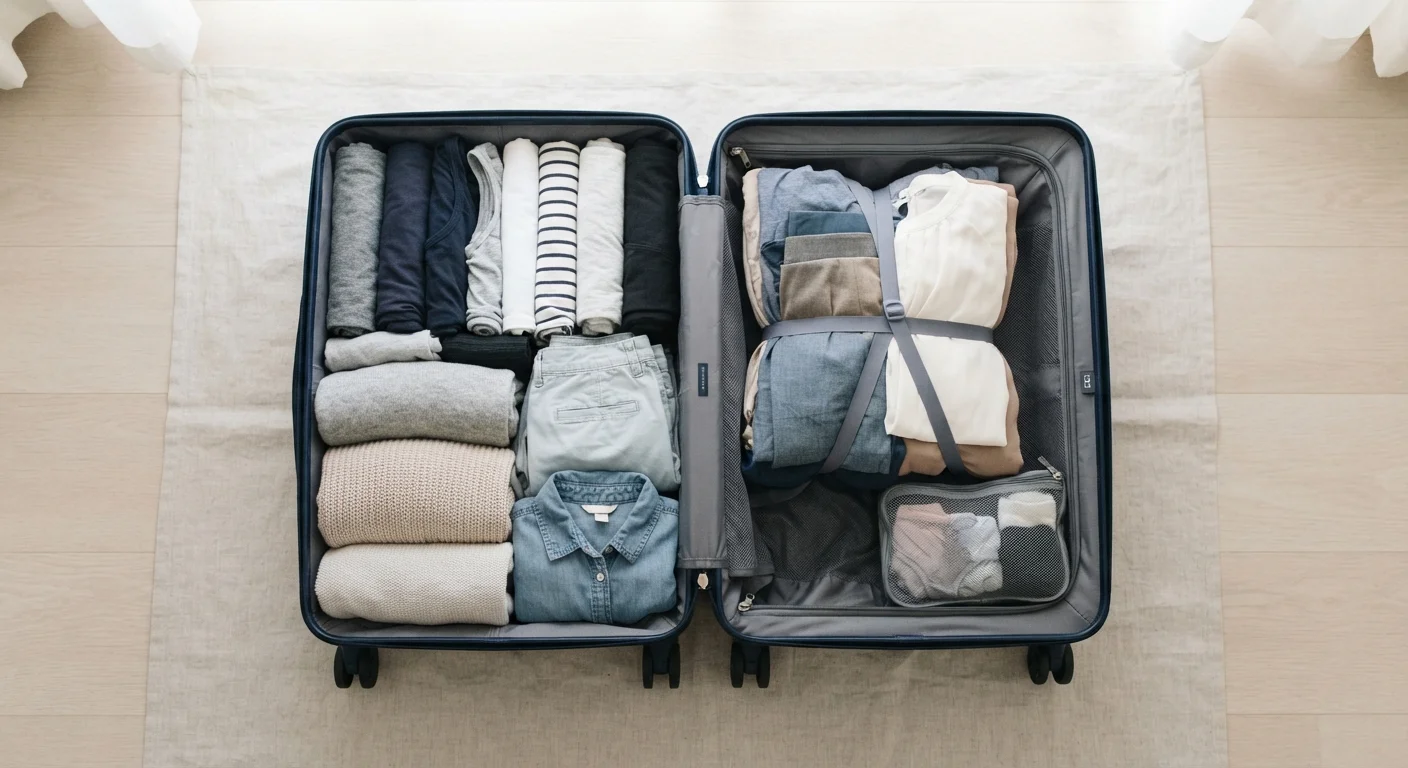
Key Takeaways
- Rolling saves space and works well for casual, wrinkle-tolerant clothing like t-shirts and jeans.
- Folding is better for structured or delicate garments that need to hold their shape.
- Bundle wrapping minimizes wrinkles across an entire outfit but requires more planning upfront.
- No single method beats all others — trip type and clothing type should drive your choice.
- Combining methods within one bag is a practical approach most experienced travelers use.
Our Verdict
Rolling is the most versatile everyday method and works well for most casual trips. Folding remains the right call for structured or formal clothing. Bundle wrapping rewards travelers willing to invest extra prep time in exchange for nearly wrinkle-free results. Most travelers will get the best outcome by mixing all three based on what they're packing.
| Best for | Recommended |
|---|---|
| Casual trips, weekend getaways, and backpack travelers | Rolling |
| Business travel or packing blazers, dress shirts, and structured items | Folding |
| Multi-day trips where wrinkle-free clothes matter and planning time is available | Bundle Wrapping |
| Mixed itineraries with both casual and formal needs | Combination approach |
Why Packing Method Actually Matters
Most travelers focus on what to pack and ignore how they pack it. That's a mistake. Your packing method affects how much fits in your bag, how wrinkled your clothes arrive, and how quickly you can find what you need mid-trip. If you're trying to travel with just a carry-on — a goal worth pursuing, as explored in our carry-on only mindset guide — efficient packing technique becomes even more consequential.
The three most common methods are rolling, folding, and bundle wrapping. Each has a distinct logic, and each performs differently depending on your clothing, your bag, and your trip type.
Rolling: Compact and Accessible
Rolling involves tightly coiling each garment into a cylinder before placing it in your bag. It's the most widely recommended method for casual travelers, and for good reason.
Where it works: Rolling is excellent for soft, flexible fabrics — t-shirts, underwear, socks, lightweight pants, and knitwear. It compresses air out of garments and lets you stack items efficiently, especially in a cylindrical or rectangular bag compartment. Rolled items are also easy to grab individually without disrupting the rest of your bag.
Where it falls short: Rolling can leave crease lines along the edges of dress shirts, blazers, or any structured garment. It also doesn't work as well for thicker fabrics like denim or wool — they resist tight rolling and take up more space than folded alternatives.
Match Your Rolling Technique to Fabric Weight
For thin fabrics like t-shirts and underwear, roll as tightly as possible to maximize compression. For slightly heavier items like chinos, a looser roll prevents stubborn crease lines along the fabric edge. Test the tightness before packing a full bag — if a garment springs open after rolling, it's resisting the method and may do better folded flat.
For travelers using packing cubes alongside rolling, the combination is particularly effective — cubes keep rolled garments upright and compressed. Our packing cubes explainer breaks down exactly how that pairing works.
Folding: Reliable for Structure
Folding is the default method most people learn at home, and it holds its place for specific garment types. Done correctly — using flat, aligned folds that match the garment's natural lines — folding keeps collars intact, preserves shoulder structure in blazers, and stacks predictably in a suitcase.
Where it works: Dress shirts, trousers, structured jackets, and formal wear all respond better to folding than rolling. If you're packing for business travel or any occasion where presentation matters the moment you unpack, folding reduces the chance of irregular crease patterns.
Where it falls short: Folded clothes take up more surface area and create more dead air space than rolled ones. In a soft-sided bag or backpack, a suitcase full of folded items can shift and rumple during transit. Folding also works best in a hard-sided or semi-rigid bag where layers stay flat.
| Rolling | Folding | Bundle Wrapping | |
|---|---|---|---|
| Space efficiency | High — compresses soft items well | Moderate — more dead air space | High — minimal wasted space |
| Wrinkle prevention | Moderate — edge creases possible | Moderate — depends on technique | High — fewest fold lines |
| Best fabric types | Soft knits, casual wear | Structured, formal garments | Lightweight, wrinkle-prone fabrics |
| Ease of access mid-trip | Easy — grab individual items | Easy — items are layered flat | Difficult — must unwrap bundle |
| Setup time | Low — fast and intuitive | Low — familiar method | High — requires pre-planning |
| Works best in | Backpacks, soft bags | Hard-sided suitcases | Any bag with open main compartment |
Bundle Wrapping: Maximum Wrinkle Reduction
Bundle wrapping — sometimes called the interleaving method — is the least familiar technique but arguably the most effective for wrinkle prevention. The approach involves building a layered bundle: you place each garment one on top of another, alternating direction, then wrap them all around a central core object (usually a pouch or a rolled soft item). The result is a single compact bundle where each garment supports the others.
Where it works: Bundle wrapping excels when your entire packing list needs to arrive looking presentable. Because garments aren't individually folded or creased — they curve gently around the bundle — there are almost no sharp fold lines. It's particularly effective for lightweight fabrics like linen, rayon, and synthetic blends that wrinkle easily but travel well in a bundle.
Where it falls short: The method requires planning your entire outfit list before you pack, since all garments go in together. Accessing a single item mid-trip means unwrapping the entire bundle. It's impractical for weekend trips where you're pulling items in and out, and it doesn't work well in bags with internal dividers or frames. If you're packing for cold weather, thick layers also resist bundling effectively.
Bundle Wrapping Requires a Committed Packing List
If you're the type to pull items in and out of your bag throughout a trip, bundle wrapping will frustrate you. Once you unwrap the bundle to access one garment, you'll need to re-wrap everything to maintain the wrinkle-prevention benefit. Reserve this method for trips where your outfit plan is fixed and your bag stays largely sealed between arrival and departure.
How to Combine Methods for Real Trips
Most experienced travelers don't commit to a single method — they mix all three based on what they're packing. A practical approach: roll casual and soft items, fold structured pieces, and bundle a core set of going-out or business outfits. This is especially useful for longer trips where your itinerary shifts between casual days and more formal occasions.
If you're building a longer-term system — a capsule packing system that works across multiple trips — choosing fabrics that respond well to multiple methods gives you the most flexibility. Merino wool, for instance, can be rolled, folded, or bundled without significant wrinkling.
For anyone new to thinking systematically about packing, the first-timer packing guide covers the full process from bag selection to final zip — a useful companion to the method-level decisions covered here.