

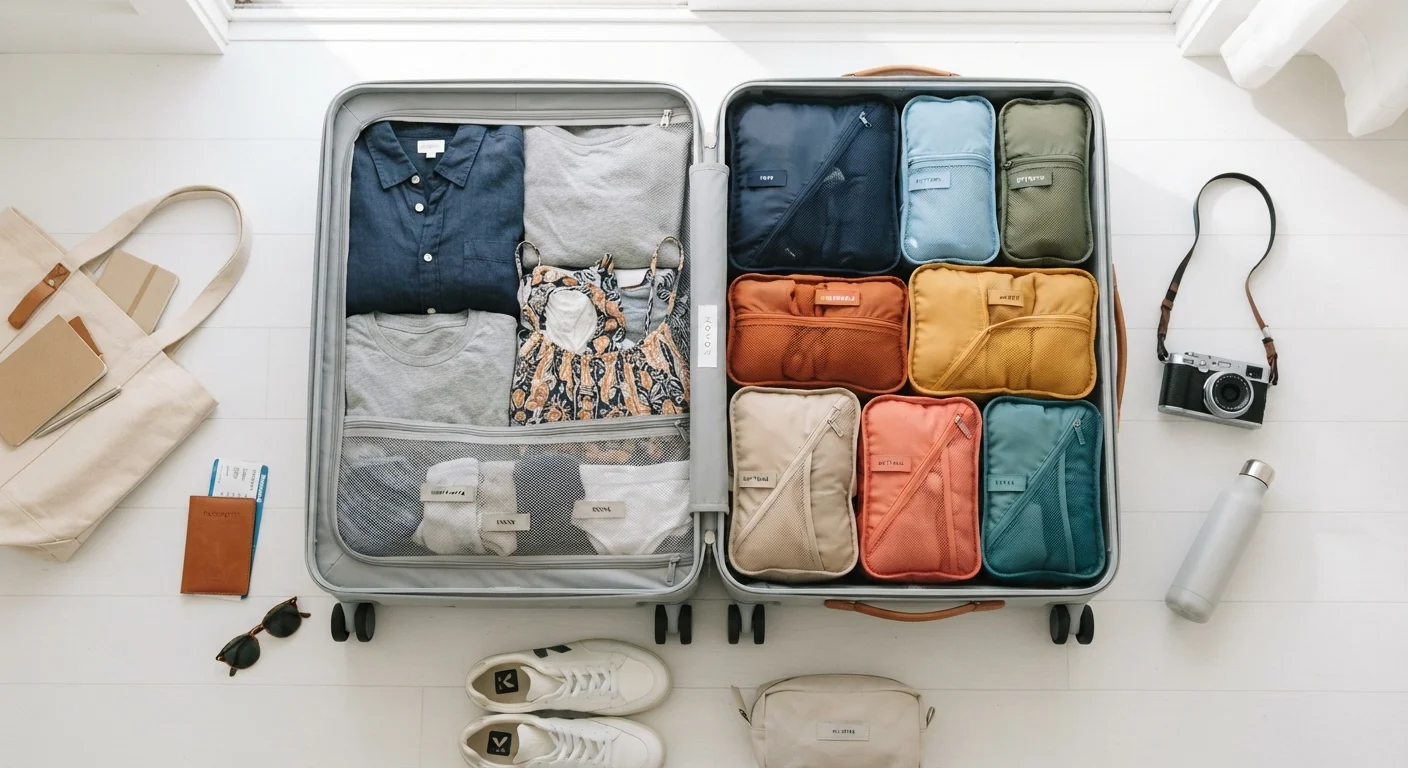
Key Takeaways
- Standard packing cubes organize your bag but do not meaningfully reduce how much space your clothes take up.
- Compression cubes can reduce clothing volume, but only work well with compressible fabrics like cotton and synthetics.
- The real value of packing cubes is faster airport security, easier repacking mid-trip, and less rummaging.
- Cubes work best when combined with a deliberate packing method like rolling or bundle wrapping.
- Using too many cubes can actually waste space by leaving air gaps between rigid-edged pouches.
Packing Cubes
Packing cubes are rectangular fabric pouches with zippered closures used to group clothing and soft items inside a bag. They come in various sizes — typically small, medium, and large — and are designed to keep contents sorted by category, day, or outfit. Most are made from lightweight nylon or mesh.
Compression packing cubes add a second zip that cinches the pouch thinner by forcing air out through mesh panels, offering a measurable reduction in packed volume compared to standard cubes.
What Packing Cubes Actually Do
The honest answer to whether packing cubes save space is: it depends on which type you're using. Standard packing cubes are organizational tools, not compression devices. They divide your bag into zones, keeping shirts with shirts, socks with socks, and clean clothes separate from worn ones. What they don't do is make your clothes physically smaller.
Think of them as filing folders for your suitcase. The folders don't shrink your documents — they just make retrieval faster. If you pack the same volume of clothes with or without cubes, the total occupied space is roughly the same.
Compression cubes are a separate category. They feature a secondary zip that forces the pouch flatter by expelling trapped air through mesh or perforated panels. For compressible fabrics — cotton tees, lightweight fleece, merino wool — this can noticeably reduce thickness. For denim, blazers, or rigid items, the effect is limited.
Compression Cubes Aren't Magic
Compression cubes reduce the air around your clothes, not the clothes themselves. Once you unpack and wear items, they return to full volume — meaning repacking mid-trip with compression cubes requires the same squeezing effort every time. Factor that in if you're a frequent unpacker on multi-stop trips.
Where Cubes Genuinely Help
Despite the space-saving myth, packing cubes offer real benefits that frequent travelers value highly.
- Mid-trip repacking: When you're moving between hotels or living out of a bag for two weeks, cubes mean you don't have to excavate everything to find one item. Pull out the cube, grab what you need, put it back.
- Security screening: A bag organized into cubes is faster and less invasive to check. TSA agents can see grouped contents clearly, reducing the chance they'll need to fully unpack your bag.
- Dirty vs. clean separation: Designating one cube for worn clothes keeps the rest of your bag from absorbing odors — a simple but consistently useful trick on longer trips.
- Shared bags: Traveling as a couple or family sharing one checked bag? Cubes let each person claim their section without guesswork.
These practical gains are durable regardless of trip length or bag type. Carry-on-only travelers tend to benefit most, since fast access and neat repacking matter more when you're moving quickly without checked luggage.
Roll Before You Cube
Rolling clothes tightly before placing them inside a packing cube consistently fits more per cube than folding flat. For casual fabrics like cotton and jersey, it also reduces the depth of wrinkles. Reserve flat folding for structured pieces like button-downs or blazers that don't go in cubes at all.
When Cubes Work Against You
Packing cubes aren't universally helpful. A few scenarios where they add friction rather than reduce it:
- Overstuffed cubes: Forcing too much into a cube makes zipping difficult and can stress seams. A half-empty bag with tightly packed cubes often ends up less efficient than a well-folded loose bag.
- Too many small cubes: Multiple small cubes create rigid blocks that leave triangular dead space in curved bag corners. Two or three well-sized cubes usually fill a bag more efficiently than six small ones.
- Wrong fabric pairing: Compression cubes on structured, non-compressible items (think denim, a sport coat) don't compress much and add weight with no payoff.
It's also worth comparing cubes against other methods. Rolling, folding, and bundle wrapping each have real trade-offs that work independently of whether you use cubes. Cubes and technique aren't mutually exclusive — rolling into a cube tends to outperform folding into a cube for volume efficiency.
If overpacking is your main challenge, cubes won't solve it. Understanding why overpacking happens is a more foundational step than reaching for an organizer.
~15–20%
Volume reduction from compression cubes on soft fabrics
Traveler and gear testing communities generally report 15–20% volume savings when using compression cubes with compressible fabrics versus loose packing — results vary by fabric type and cube quality.
2–3
Optimal number of cubes for a standard carry-on
Experienced light packers and travel organizers commonly recommend two to three mid-size cubes as the most space-efficient configuration for a 21–22 inch carry-on bag.
How to Get the Most From Packing Cubes
If you've decided cubes are worth adding to your system, a few straightforward guidelines improve their usefulness:
- Match cube size to bag size. A 28-inch checked bag can handle large cubes. A 21-inch carry-on works better with medium and small cubes that flex around the bag's shape.
- Roll before you cube. Rolling clothes tightly before placing them in a cube maximizes how much fits while reducing wrinkle depth for casual fabrics.
- Use three categories, not ten. Tops, bottoms, and undergarments/socks is enough segmentation for most trips. Splitting further usually means more cubes, more wasted space.
- Pack cubes flat and stack them like books, not piled on top of each other. This keeps the bag's center of gravity lower and makes individual cubes easier to slide in and out.
For a deeper look at what belongs in your bag in the first place, seasoned travelers' packing lists are a practical reference — and toiletry myths that waste space is worth a read before you zip up.