

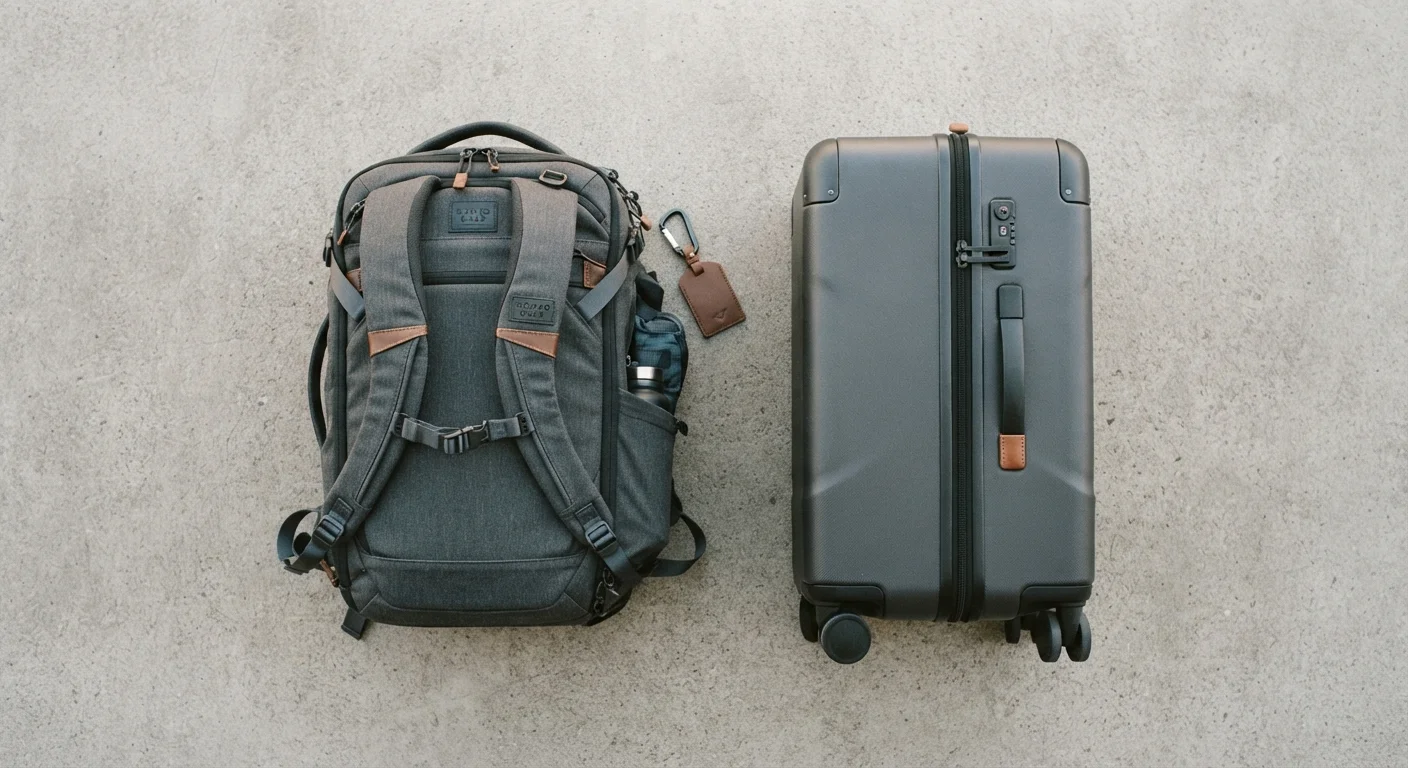
Key Takeaways
- Backpacks outperform rolling bags on uneven terrain, stairs, and crowded transit systems.
- Rolling bags make sense when you're staying in fewer places and surfaces are consistently smooth.
- Carry-on size limits apply equally to both formats — check airline restrictions before you pack.
- The trip type, not personal style, should drive your bag choice.
- Heavier loads are easier to manage rolling than carrying on your back for extended periods.
- Many experienced travelers own both and choose based on the specific itinerary.
Option A
Travel Backpack
The hands-free, go-anywhere option for active itineraries.
Best for: Travelers navigating cobblestones, public transit, hostels, or multi-city routes where mobility matters more than capacity.
Option B
Rolling Bag
The organized, effort-saving choice for predictable, comfort-first trips.
Best for: Travelers on longer stays or business trips who move between airports, hotels, and taxis on smooth, paved surfaces.
If you're hopping between multiple cities using trains, buses, or metro systems
Travel Backpack
Stairs, turnstiles, and crowded platforms are genuinely difficult with a rolling bag. A backpack keeps both hands free and keeps pace with fast-moving transit.
If you're on a business trip or leisure stay at one or two hotels
Rolling Bag
Smooth airport floors and hotel lobbies are where wheeled luggage earns its keep. You can pack more without straining your back.
If you're doing outdoor travel, hiking, or rural destinations
Travel Backpack
Wheels are useless on gravel, trails, or unpaved village streets. A backpack distributes weight properly and handles real terrain.
If you tend to overpack or need to carry medications, devices, or fragile items
Rolling Bag
Rolling bags typically offer more structured compartments and greater total volume, making it easier to organize and protect sensitive items.
If you want to travel carry-on only and move fast through airports
Travel Backpack
A well-fitted carry-on backpack fits overhead bins and under seats, skips baggage claim entirely, and works on virtually any airline.
Why the Bag Format Is a Trip Decision, Not a Style Decision
Most packing debates focus on what to bring. The more foundational question is what to bring it in. Your bag format shapes every part of the travel day — how fast you move, how tired you get, what you can access, and whether you pay checked-bag fees.
The backpack vs. rolling bag question doesn't have a universal answer. It has a situational one. The same traveler might reach for a backpack on a two-week Europe rail pass and a rolling bag for a four-day conference trip to Chicago. If you're newer to this kind of thinking, our guide for first-time packers walks through the full decision from the beginning.
The goal here is straightforward: match the bag to the journey, not the other way around.
| Criterion | Travel Backpack | Rolling Bag |
|---|---|---|
| Best terrain | Stairs, cobblestones, trails | Smooth floors, paved surfaces |
| Mobility | Hands-free, highly maneuverable | Easy rolling, requires one hand |
| Weight distribution | Carried on body (back/hips) | Wheeled, minimal body strain |
| Packing organization | Variable; depends on design | Often more structured compartments |
| Typical carry-on fit | Usually fits overhead or under seat | Fits overhead if carry-on sized |
| Ideal trip length | Weekend to multi-week travel | Multi-day to extended stays |
| Ideal trip type | Multi-city, outdoor, transit-heavy | Business, resort, single-destination |
| Physical effort | Higher on long days | Lower on smooth surfaces |
Where Backpacks Have a Real Advantage
A backpack's core strength is mobility on imperfect terrain. Cobblestones, staircases, train platforms, hostel dormitories, steep hills — these are environments where wheels become a liability rather than a convenience. You end up carrying the rolling bag anyway, and it's awkward to carry by design.
Backpacks also leave both hands free, which matters when you're navigating an unfamiliar city, holding a map or phone, or boarding a bus. On transit-heavy itineraries, this is a meaningful practical advantage.
For carry-on-only travel specifically, a well-sized backpack (typically 40–45 liters for most airline overhead bins, though this varies — always check your airline's current size policy) lets you board first, skip baggage claim on the way out, and avoid checked-bag fees. The one-bag travel approach is almost always backpack-based for exactly these reasons.
The trade-off is physical load. Even a well-designed backpack with a hip belt transfers weight to your body. On longer travel days, that matters — especially if you're covering distances on foot.
40–45L
Typical carry-on backpack volume range
Most major airlines allow carry-on bags up to roughly 45 liters, though size policies vary — always verify with your specific carrier before travel.
2–4 lbs
Typical empty weight of a travel backpack
Lightweight travel backpacks generally weigh between 2 and 4 pounds empty, leaving more of the airline's weight allowance for your actual gear.
22" x 14" x 9"
Common US domestic carry-on size limit
Many major US carriers use this guideline, but limits differ by airline and aircraft type — confirm before packing.
Where Rolling Bags Make More Sense
Rolling bags earn their place when the terrain is predictable. Airport terminals, hotel lobbies, convention centers, and city sidewalks are built for wheels. On those surfaces, a rolling bag lets you move meaningful weight — clothing for a longer stay, work gear, shoes — without straining your back or shoulders.
Organization is another area where rolling bags often have an edge. Many offer structured compartments, separate shoe pockets, and flat-packing layouts that make it easier to find things and keep clothes wrinkle-free. If you're traveling for business or need to arrive looking put-together, that structure has real value.
Longer trips where you're unpacking and staying put for several days also favor rolling bags. You're not moving the bag constantly — you're living out of it. Capacity and organization matter more than portability in that scenario.
For a deeper look at how bag specs like volume, weight, and fabric affect real-world performance, this breakdown of key bag specs is worth reading before you buy. You might also want to consider whether soft-sided or hard-shell construction fits your needs — that comparison covers the trade-offs directly.
The Practical Checklist: How to Decide
Run your planned trip through these questions before committing to a bag format:
- How many places are you stopping? More destinations usually favor a backpack. One or two favor a rolling bag.
- What are the surfaces like? If you'll be on cobblestones, stairs, trails, or rural roads, wheels won't help.
- Are you checking a bag or going carry-on only? Carry-on-only strategies work with both formats, but backpacks tend to be more airline-flexible.
- How long is each travel day? A backpack on a 14-hour day with multiple transit legs is a different experience than one short airport run.
- What are you actually bringing? Heavy gear and formal clothes pack better in a structured rolling bag.
Once you've settled on a format, how you pack it matters almost as much as what you put in it. Different packing methods — rolling, folding, bundle wrapping — suit different bag types and trip lengths. And if you want end-to-end guidance on the full packing process, the complete packing and gear guide covers every trip type in detail.
Airline Policies Vary — Always Check
Carry-on size and weight limits are not standardized across airlines. A bag that qualifies as carry-on on one carrier may be flagged on another, particularly on budget or regional routes. Before your trip, check the specific size and weight rules for every airline segment on your itinerary. This applies to both backpacks and rolling bags.