

Key Takeaways
- Your owner's manual contains the definitive maintenance schedule for your specific vehicle.
- Service intervals are measured in miles, months, or both - whichever comes first.
- Skipping scheduled maintenance can void warranties and lead to significantly higher repair bills.
- Driving conditions (city vs. highway, extreme temperatures) can shorten recommended intervals.
- Dashboard warning lights are not a substitute for proactive scheduled maintenance.
Car Maintenance Schedule
A car maintenance schedule is a manufacturer-recommended timeline of routine service tasks - such as oil changes, filter replacements, and fluid checks - organized by mileage or time intervals. It tells you what needs attention at each stage of your vehicle's life, helping prevent breakdowns and costly repairs. Most schedules are printed in your owner's manual and may also appear on a sticker inside your driver's door jamb.
Modern vehicles often use an onboard Maintenance Minder or Service Indicator system that calculates service needs algorithmically, based on driving conditions rather than fixed mileage alone.
What a Maintenance Schedule Actually Tells You
Think of a maintenance schedule as your car's personalized health calendar. Rather than waiting for something to break, it maps out preventive actions - oil changes, tire rotations, belt inspections - at defined intervals so small issues never become major failures.
Intervals are expressed in two ways: mileage (e.g., every 5,000 miles) and time (e.g., every 6 months). The rule of thumb is to follow whichever comes first. A car driven rarely still ages - rubber seals dry out, fluids absorb moisture, and lubricants degrade - so the time-based interval protects low-mileage drivers just as much as the mileage figure protects high-mileage ones.
For a broader look at what keeping up with this schedule actually prevents, see our article on routine maintenance tasks that prevent expensive repairs.
~$1,200
Average annual vehicle maintenance cost per U.S. driver
According to AAA's annual Your Driving Costs study, routine maintenance and tires account for a significant share of typical ownership expenses.
5,000-10,000 mi
Typical synthetic oil change interval for modern vehicles
Most manufacturers specify this range for full synthetic oil in current model vehicles, replacing the older 3,000-mile guideline.
1 in 3
U.S. vehicles with significantly overdue oil changes
Industry service data regularly indicates that a large share of vehicles on the road are operating with degraded engine oil past the recommended change interval.
Key Milestones and What They Cover
Most schedules follow a tiered structure of minor and major service points. Here's what typically appears at common intervals:
- Every 3,000-7,500 miles: Oil and oil filter change (interval depends on oil type and manufacturer spec), tire pressure check, visual fluid inspection.
- Every 15,000-30,000 miles: Air filter replacement, cabin air filter, brake fluid check, tire rotation, battery inspection.
- Every 30,000-60,000 miles: Spark plug replacement, transmission fluid, coolant flush, power steering fluid, drive belt inspection.
- Every 60,000-100,000 miles: Timing belt or chain inspection (critical - failure can destroy an engine), major brake component inspection, suspension check.
These are general reference points. Your owner's manual will carry the exact intervals for your make, model, and engine type - those figures always take precedence.
Normal vs. Severe Driving Conditions
Manufacturers typically publish two sets of intervals: one for normal driving and one for severe conditions. Severe conditions include:
- Frequent short trips under five miles
- Stop-and-go city driving
- Towing or hauling heavy loads
- Operating in extreme heat or cold
- Driving on dusty, unpaved roads
If any of these describe your typical driving, you likely fall into the severe-use category and should follow the shorter intervals. Many drivers underestimate how demanding city commutes are on engine oil and brakes compared to steady highway travel.
For a complete picture of how to manage your vehicle at every stage of ownership, the guide to managing a car through every stage of its life offers helpful context.
Using Your Dashboard and Owner's Manual Together
Modern vehicles often display a Maintenance Required or Oil Life indicator on the dashboard. These systems monitor driving data to estimate when service is due - a useful prompt, but not a replacement for checking your manual. Some lights indicate a set mileage countdown; others use algorithms. Either way, they signal that service is approaching, not that you can ignore earlier items on the schedule.
If a warning light appears outside of a scheduled service window, treat it as a separate issue requiring prompt attention. Our guide to reading dashboard warning lights explains what each light signals and how urgent it is.
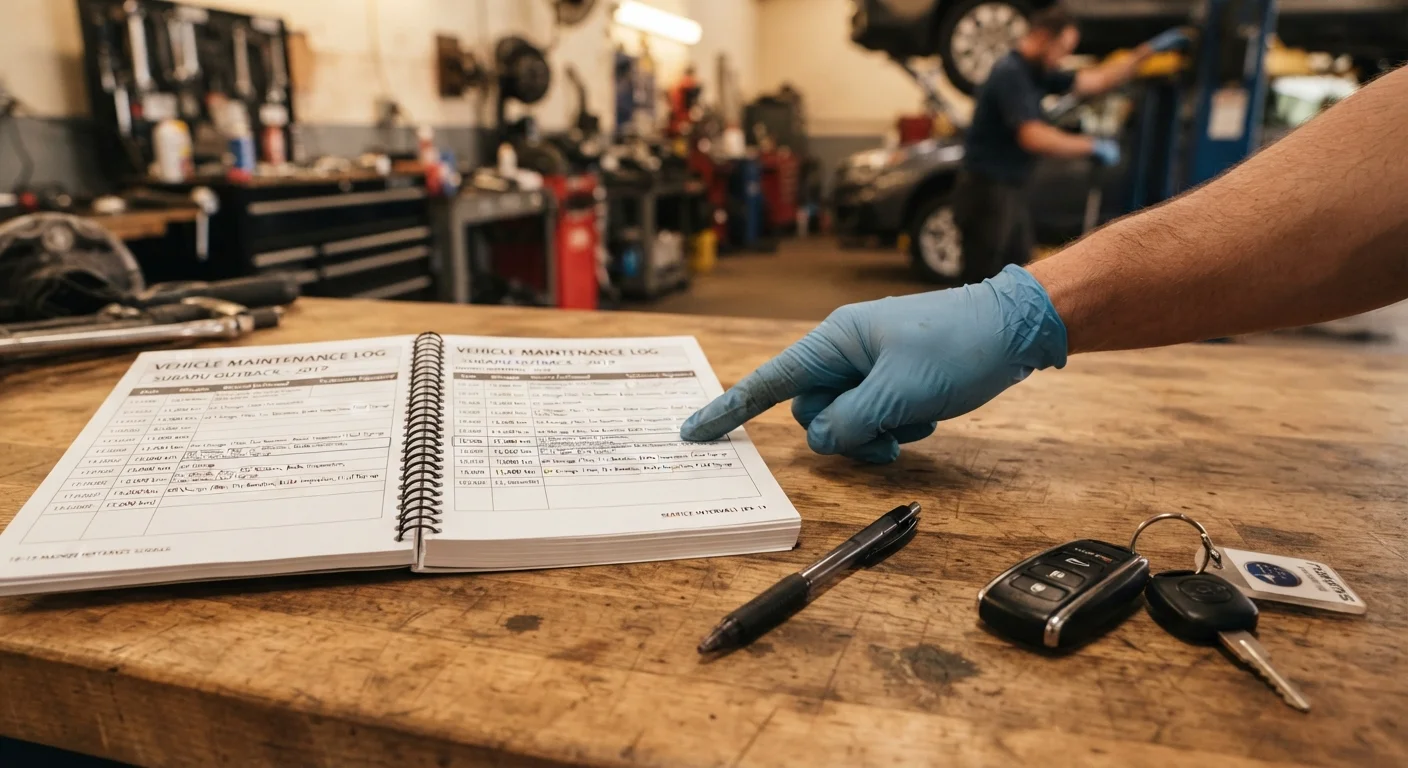
Keeping a simple log - date, mileage, and service performed - makes it easy to track where you are in the schedule. Many drivers use a notepad in the glove box or a free spreadsheet for this purpose.
Keep a Simple Service Log
Write down the date, odometer reading, and service performed every time maintenance is completed. A small notepad in the glove compartment works perfectly. This record protects your warranty claims, helps mechanics diagnose issues faster, and adds documented value if you ever sell the vehicle.
Getting Started If You're New to This
If you've never engaged with your car's maintenance schedule before, the best starting point is straightforward: locate your owner's manual, find the maintenance section, and identify where your current mileage falls. Note anything overdue and prioritize those items first.
From there, build a simple recurring reminder - on your phone or a paper calendar - for your next expected service interval. Consistency matters more than perfection. A service performed a few hundred miles late is far better than one skipped entirely.
For drivers who are just beginning to take ownership of their vehicle's upkeep, our car maintenance guide for complete beginners provides a plain-English foundation. And for a comprehensive end-to-end reference, The Complete Guide to Car Maintenance covers every major task in depth.