

Key Takeaways
- Stopping distance has two components: reaction distance and braking distance.
- Doubling your speed quadruples the braking distance due to kinetic energy physics.
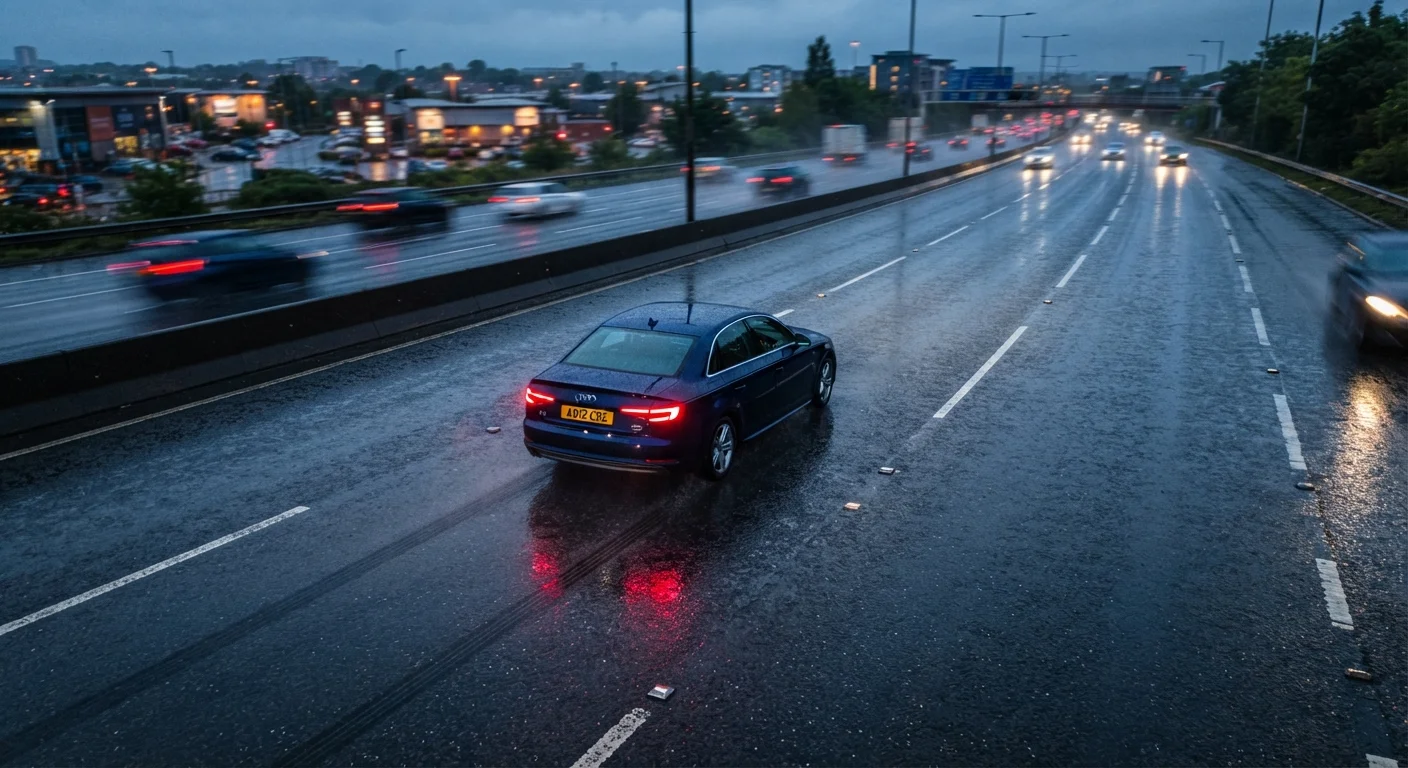
- Wet or icy roads can dramatically extend braking distance beyond dry-road estimates.
- An average driver's reaction time is roughly 1.5 seconds, covering significant ground at highway speeds.
- Maintaining proper following distance is the most practical way to account for stopping distance.
Stopping Distance
Stopping distance is the total distance a vehicle travels from the moment a driver perceives a hazard to the point the vehicle comes to a complete stop. It is made up of two parts: the distance covered during the driver's reaction time, and the distance covered while the brakes are actually working. Both parts are influenced by speed, road conditions, tire quality, and driver alertness.
In physics terms, braking distance is determined by the vehicle's kinetic energy (½mv²), which means doubling your speed quadruples the braking distance - not merely doubles it.
Two Distances, One Outcome
Every time a driver hits the brakes in an emergency, two distinct phases determine how far the car travels before it stops. Understanding both is essential for anyone who wants to drive safely.
Reaction distance is the ground your vehicle covers from the moment you see a hazard to the moment your foot reaches the brake pedal. At an average reaction time of about 1.5 seconds, a car traveling at 60 mph covers roughly 132 feet before braking even begins - nearly half the length of a football field.
Braking distance is what happens next. Once the brakes engage, friction between the tires and road surface works against the car's momentum. The faster you're going, the more kinetic energy must be dissipated, and the longer this phase takes.
Add them together and you have total stopping distance - the figure that really matters in a crash-avoidance situation. For new drivers, this concept is explored in depth as part of foundational safe driving principles.
132 ft
Distance covered during average reaction time at 60 mph
Based on an average reaction time of 1.5 seconds - before the brakes even engage.
4×
Increase in braking distance when speed doubles
A direct result of kinetic energy scaling with the square of velocity, a well-established physics principle.
2×
Approximate increase in stopping distance on wet roads
Wet pavement significantly reduces the tire-to-road friction coefficient compared to dry conditions.
Why Speed Is the Dominant Factor
The relationship between speed and stopping distance is not proportional - it's exponential. This is one of the most important and least intuitive facts in driving safety.
A vehicle's kinetic energy is calculated as ½ × mass × velocity². Because speed is squared in this formula, doubling your speed quadruples the kinetic energy your brakes must overcome. In practical terms:
- At 30 mph, a typical car requires approximately 75 feet of total stopping distance on dry pavement.
- At 60 mph, that figure rises to around 240 feet - not 150 feet as a simple doubling would suggest.
- At 70 mph, it can exceed 315 feet under the same conditions.
These are approximations that vary by vehicle, tire condition, and road surface - but the underlying physics is consistent. Speed reductions even of 5-10 mph in high-risk zones meaningfully reduce crash severity and stopping distance. This principle is central to understanding how safe behaviour differs between motorways and urban roads.
“Speed is the single biggest factor in crash severity. The laws of physics don't negotiate - every mile per hour matters when it comes to stopping distance and impact force.”
— Road Safety Research Community, General consensus among traffic safety researchers and highway engineers
How Road Conditions Change the Equation
Braking distance calculations assume dry, well-maintained asphalt. Real-world roads rarely offer those ideal conditions. Friction between tire and road - called the coefficient of friction - drops significantly when surfaces are wet, icy, or contaminated with gravel or debris.
On wet pavement, braking distance can roughly double. On packed ice or snow, it can extend by a factor of five to ten or more, depending on temperature and surface texture. This is why speed limits are enforced more strictly near schools, crossings, and in adverse weather zones.
Tire condition plays a critical role too. Worn tread reduces the tire's ability to channel water away from the contact patch, increasing the risk of hydroplaning - where the tire rides on a film of water rather than gripping the road. Even a few millimeters of tread depth can make a measurable difference in wet stopping performance.
For a comprehensive look at how rain, fog, and ice alter vehicle behavior overall, see our guide on driving in rain, fog, and ice.
Check Your Tire Tread Regularly
Place a quarter into your tire's tread groove with the top of the coin facing down. If you can see the top of the head clearly, tread depth may be insufficient for safe wet-weather braking. Most tire manufacturers and safety organizations recommend replacing tires before they reach the legal minimum tread depth, not just when they hit it.
Reaction Time: The Human Variable
Unlike braking distance, which is largely governed by physics and vehicle mechanics, reaction time is a human variable - and it fluctuates considerably based on alertness, distraction, and impairment.
The commonly cited average of 1.5 seconds is measured under controlled, alert conditions. In reality, fatigue can push reaction time beyond 2 seconds. Glancing at a phone for even 2 seconds at 55 mph means traveling over 160 feet without looking at the road - more than the car's full braking distance in those conditions.
Distraction, intoxication, and drowsiness all extend reaction time, effectively adding invisible distance to the total stopping equation. This is one reason defensive driving techniques emphasize anticipating hazards early - skilled drivers reduce the need for emergency braking by reading the road further ahead.
Following too closely compounds the problem. If you're already inside another vehicle's stopping distance, your reaction time alone may not be enough to prevent a collision. Our article on why tailgating is more dangerous than most drivers realise explores this in detail.