

Key Takeaways
- Defensive driving is an anticipatory mindset, not just a set of reactive maneuvers.
- Scanning far ahead and checking mirrors regularly gives drivers critical extra seconds to respond.
- Maintaining adequate following distance is one of the most effective collision-reduction habits.
- Managing speed to match conditions - not just posted limits - is a core professional technique.
- Minimising distractions and managing fatigue are non-negotiable elements of safe driving.
What Separates Professional-Level Driving
Most drivers consider themselves competent behind the wheel - yet collision rates remain stubbornly high across US roads. The gap between adequate and genuinely skilled driving usually comes down to one thing: anticipation. Professional and advanced drivers don't simply react faster; they structure their attention so that hazards rarely catch them off guard in the first place.
Defensive driving - as defined by organisations like the National Safety Council - is the practice of operating a vehicle in a way that accounts for the actions of other road users and adverse conditions, even when others behave unpredictably. The techniques below are drawn from that framework and from advanced driver training curricula. They are habits, not reflexes, meaning anyone willing to practise them can meaningfully reduce their collision risk.
For related context on how different road environments demand different approaches, see our guide to motorway versus urban driving.
Scan far ahead, not just at the car in front
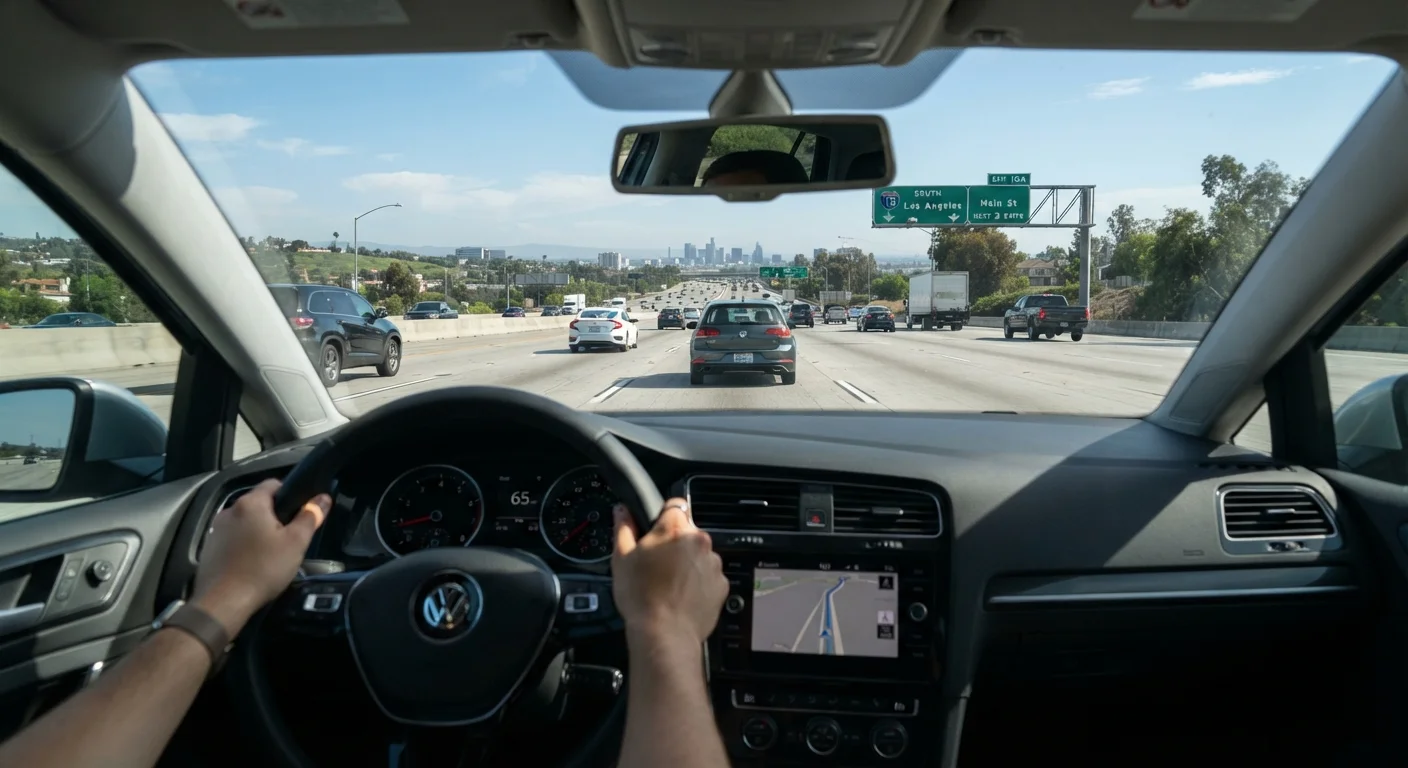
Experienced drivers train their eyes to look 12-15 seconds down the road - roughly a quarter mile at highway speeds. This horizon-scanning habit gives the brain time to process developing situations: brake lights two cars ahead, a pedestrian about to step off a curb, or a merging vehicle that hasn't yet fully entered the lane.
In practice, this means resisting the urge to fix your gaze on the vehicle immediately in front of you. Instead, track the flow of traffic further ahead while letting your peripheral vision monitor what's close. Regularly glance at mirrors every 5-8 seconds to maintain a full picture of your surroundings - front, sides, and rear.
Scanning 12-15 seconds ahead gives your brain time to plan, not just react.
Manage your following distance deliberately
The standard guidance taught in most US driver education programs is a minimum three-second following gap under normal conditions - measured by watching when the vehicle ahead passes a fixed point and counting until you reach it. Professional drivers typically extend this to four or five seconds, and significantly more in adverse weather.
Why does it matter so much? Stopping distance is not just about brakes - it includes perception time and reaction time before braking even begins. Our breakdown of stopping distances explains how speed, road surface, and reaction time compound. A larger gap is essentially free insurance against rear-end collisions, which account for a substantial share of US crashes each year.
For more on the specific risks of following too closely, see our article on why tailgating is more dangerous than most drivers realise.
A larger following gap costs nothing but seconds - and prevents a large share of crashes.
Match speed to conditions, not just the posted limit
Posted speed limits represent the legal maximum under ideal conditions - dry pavement, good visibility, normal traffic. Professional drivers treat them as a ceiling, not a target. In rain, fog, or ice, the appropriate speed may be considerably lower than what's posted.
Reduced traction and limited visibility mean that both stopping distances and steering response change dramatically in poor conditions. Our guide to driving in rain, fog, and ice details how each condition alters vehicle behaviour and what specific adjustments help. The core principle is simple: slow down enough that you can stop within the distance you can clearly see.
Speed limits assume ideal conditions; your speed should reflect actual ones.
Eliminate blind spot assumptions
Many drivers believe their mirrors provide complete coverage of the space around their vehicle. In practice, every car has zones that mirrors cannot see - particularly the rear-quarter areas beside and slightly behind each door. Professionals combine regular mirror checks with deliberate head checks (glancing over the shoulder) before any lateral movement.
Equally important is avoiding extended time in another driver's blind spots. When travelling on multi-lane roads, move through adjacent vehicles' blind zones purposefully rather than cruising in them. Our article on everything drivers get wrong about blind spots addresses common mirror myths and correct head-check technique in detail.
Mirrors alone never eliminate blind spots - deliberate head checks are non-negotiable.
Identify and plan escape routes
One habit that distinguishes advanced drivers is consciously maintaining an "out" - a clear path to steer toward if the situation directly ahead deteriorates suddenly. This means avoiding extended travel in positions where you're boxed in by vehicles on all sides, and being aware of road shoulders, gaps in adjacent lanes, and open space that could serve as an escape if needed.
This technique pairs naturally with far-ahead scanning. The moment you identify a potential hazard, you're also mentally noting where you'd go if it develops. It's a low-effort mental habit that significantly raises readiness.
Always know where you'd steer if everything ahead went wrong in the next two seconds.
Manage distractions and fatigue as active risks
Professional drivers treat distraction and drowsiness with the same seriousness as mechanical failure - because cognitively, they produce similar impairments. Research consistently shows that hands-free phone use still degrades situational awareness, and fatigue-related impairment at severe levels can mirror alcohol impairment in reaction time and decision-making.
The practical application: set navigation before moving, use do-not-disturb features, and be honest about your alertness level before trips. If you're driving with passengers, the social dynamics can also shift your attention in subtle ways - something our article on how passenger dynamics affect driver risk explores in more depth. No destination is worth driving impaired by fatigue or distraction.
Distraction and fatigue are hazards you introduce - and can prevent before you start driving.
Putting It All Together
Defensive driving is less about any single technique and more about building a consistent mental framework every time you get behind the wheel. The professionals who demonstrate these habits aren't doing anything extraordinary - they're simply applying deliberate attention to tasks most drivers perform on autopilot.
Practice One Technique at a Time
Trying to adopt all defensive driving habits simultaneously can feel overwhelming and may not stick. Instead, focus on a single technique - such as far-ahead scanning or consistent mirror checks - for a week of regular driving before adding another. Gradual integration tends to build more durable habits than attempting a complete overhaul at once.
If you want to deepen these skills beyond self-study, structured training can help. Our comparison of advanced driving courses versus standard licence training explains what formal instruction adds and whether it might suit your goals. Safe driving is a skill that can always be refined - and the effort pays dividends every trip.