

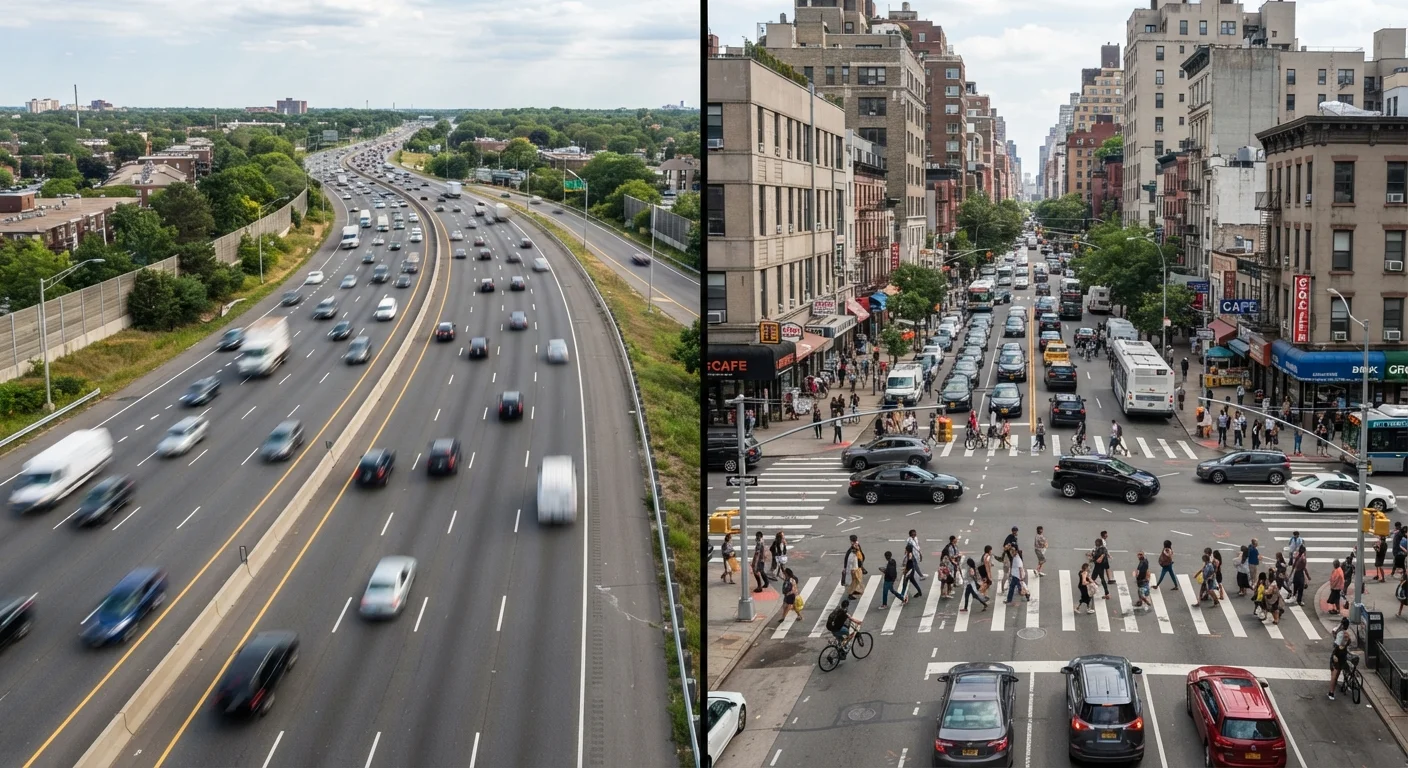
Key Takeaways
- Motorways demand longer following distances and fatigue management due to sustained high speeds.
- Urban driving requires constant hazard scanning for pedestrians, cyclists, and frequent road users.
- Speed limits alone don't define risk - context and road environment matter just as much.
- Both environments reward anticipatory driving and disciplined mirror-checking routines.
- Stopping distances increase dramatically at motorway speeds compared to urban speeds.
Option A
Motorway Driving
High-speed, structured, and demanding sustained concentration.
Best for: Covering long distances efficiently, but requires careful speed management, following distances, and fatigue awareness.
Option B
Urban Road Driving
Lower speeds, but far more unpredictable hazards at every turn.
Best for: Navigating complex, mixed-use environments where pedestrians, cyclists, and frequent stops demand constant vigilance.
If you primarily drive long-distance routes on high-speed roads
Motorway Driving
Focus your training on managing following distances, lane discipline, and fatigue - the primary risk factors at sustained high speeds.
If most of your daily driving is in towns or cities
Urban Road Driving
Prioritise hazard perception, junction awareness, and pedestrian anticipation, which are the dominant safety challenges in urban environments.
If you drive in both environments regularly
Motorway Driving
Adapting your mindset when transitioning from urban to motorway (and back) is a critical skill - motorway complacency after a long drive is a well-documented risk factor.
Why the Two Environments Demand Different Thinking
Most drivers move between motorways and urban roads without much conscious thought about how their behaviour needs to shift. But the two environments are fundamentally different in terms of hazard type, decision pace, and the consequences of error.
On a motorway, the threat is primarily speed - or more precisely, the gap between your speed and your ability to react to what happens ahead. On urban roads, the threat is unpredictability: pedestrians stepping off kerbs, cyclists filtering through traffic, parked cars opening doors, and junctions where right-of-way is frequently misread.
Understanding these structural differences is the first step toward adapting your approach appropriately. See our introduction to road safety fundamentals for a solid grounding before reading on.
| Criterion | Motorway Driving | Urban Road Driving |
|---|---|---|
| Typical speed range | 55-70+ mph | 15-35 mph |
| Primary hazard type | Speed, fatigue, tailgating | Pedestrians, cyclists, junctions |
| Decision pace | Slower, sustained concentration | Rapid, frequent decisions |
| Following distance needed | 3+ seconds (more in wet) | 2 seconds minimum |
| Fatigue risk | High (monotony and speed) | Lower (frequent stops) |
| Lane discipline complexity | Moderate (merging, overtaking) | High (multi-lane junctions) |
| Vulnerable road user exposure | Very low | Very high |
| Speed perception accuracy | Can feel slower after fast travel | Generally accurate |
Motorway-Specific Safety Habits
Motorway driving operates at speeds where small errors carry large consequences. At 70 mph, your vehicle covers roughly 31 metres every second - meaning a two-second lapse in attention translates to over 60 metres of travel with no corrective action.
Following distance is the single most important motorway habit. The standard guidance in the US is the three-second rule - pick a fixed point, and ensure at least three seconds pass between the vehicle ahead passing it and your vehicle reaching it. In wet or reduced-visibility conditions, that gap should double. Our explainer on stopping distances covers exactly why this matters at speed.
Fatigue is a motorway-specific risk that urban driving rarely triggers in the same way. The monotony of sustained high-speed travel can induce microsleeps - brief, involuntary lapses of consciousness lasting a second or two. On a motorway, that's enough to cause a serious collision. Taking a break every two hours of motorway travel is a widely recommended guideline.
Lane discipline matters too. Keeping to the right lane only for overtaking (in countries where this applies) reduces weaving and maintains traffic flow, which lowers collision risk for all road users.
Urban Road-Specific Safety Habits
Urban driving is slower but cognitively busier. The density of information - signs, signals, pedestrians, parked vehicles, cyclists, road markings - demands near-constant processing. Research in road safety consistently shows that urban environments account for a disproportionate share of pedestrian and cyclist casualties precisely because of this complexity.
Hazard anticipation is the core urban skill. This means reading the environment ahead rather than simply reacting to it. A ball rolling into the road is a signal that a child may follow. A bus pulling away from a stop means passengers may cross from the front. Gaps between parked cars are potential pedestrian crossing points. These cues require active scanning, not passive observation.
Speed management in urban areas isn't just about staying under the posted limit - it's about adjusting speed to match the actual risk level. A 30 mph zone in a quiet residential street at midday carries different hazard density than the same zone outside a school at 3:30 pm. Slowing below the limit in higher-risk moments is sound judgment, not overcaution.
Junction behaviour is where many urban collisions occur. Our article on roundabouts, merges, and lane changes breaks down correct positioning and right-of-way in detail.
~65%
Urban share of pedestrian road fatalities
According to the NHTSA, the large majority of pedestrian traffic fatalities in the US occur on urban roads, reflecting the density of foot traffic in city environments.
3 sec
Recommended motorway following gap
The three-second rule is the standard guidance for maintaining a safe following distance at highway speeds under normal conditions.
2 hrs
Maximum recommended motorway drive before a break
Road safety organisations broadly recommend taking a rest stop at least every two hours on long motorway journeys to reduce fatigue-related risk.
Transitioning Between Environments Safely
One of the least-discussed driving challenges is the transition between environments - particularly after a long motorway journey when drivers enter urban roads. After extended high-speed travel, 30 mph can subjectively feel very slow, which can lead drivers to unconsciously travel faster than they realise. This speed perception distortion is a documented phenomenon sometimes called "motorway hypnosis" or velocity aftereffect.
A practical approach: when exiting a motorway, consciously check your speedometer rather than relying on how fast the car feels. Give yourself a mental reset before entering an urban environment.
Weather further complicates transitions. Rain or fog that is manageable on an open motorway becomes significantly more hazardous on a narrow urban street where stopping distances already leave less margin. Our guide to driving in rain, fog, and ice covers how conditions alter vehicle behaviour in both settings.
Defensive driving techniques - specifically, maintaining a buffer zone and reading traffic patterns well ahead - apply in both environments. Experienced drivers apply these principles regardless of road type. See our overview of defensive driving techniques used by professionals for a deeper look at the anticipatory mindset that underpins safe driving on any road.
New or Returning Drivers: Build Experience Gradually
If you have limited motorway experience, consider building confidence during off-peak hours before tackling high-traffic periods. Some drivers also find structured advanced driving instruction helpful for gaining confidence in both environments. Always ensure your vehicle is roadworthy before any long journey - tyre condition and pressure in particular have a measurable effect on handling at speed.