
Advanced Driving Courses vs. Standard Licence Training: What's the Difference?

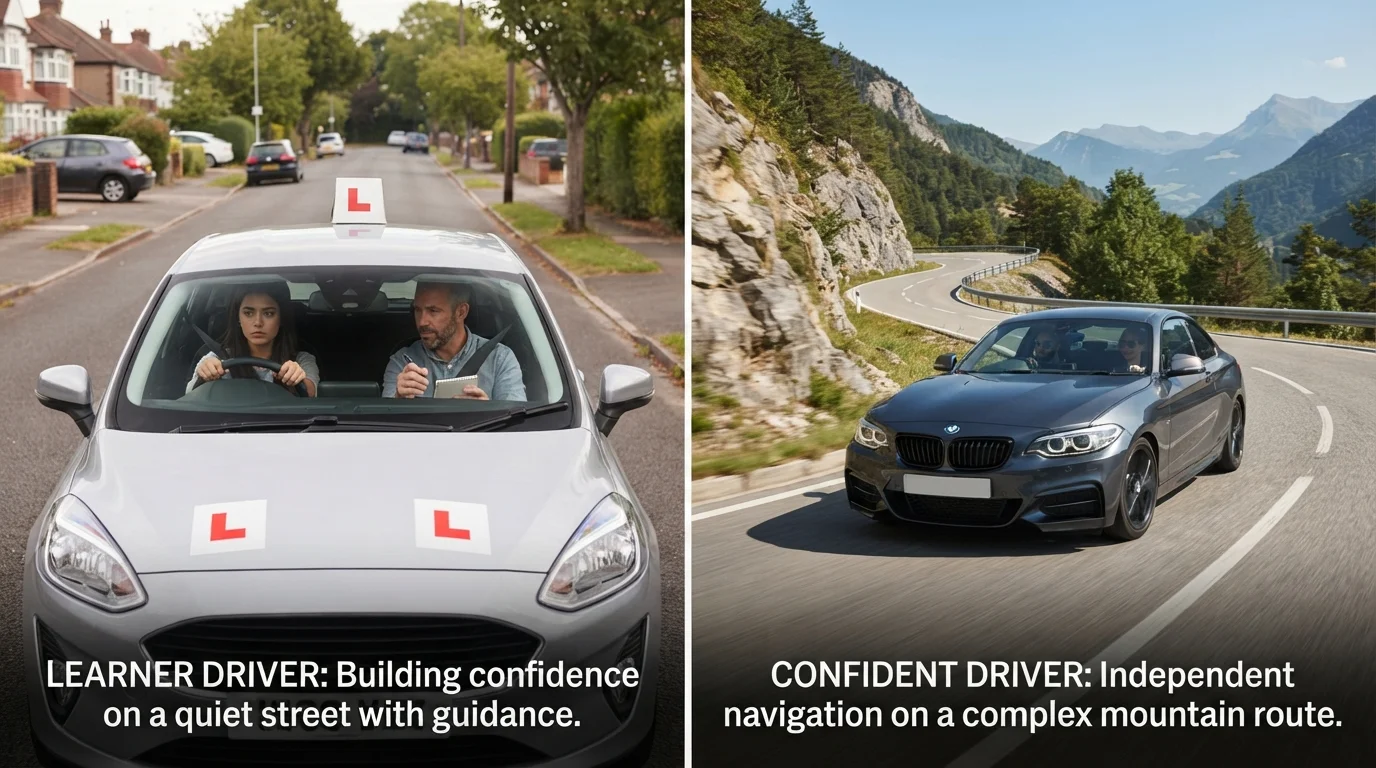
Key Takeaways
- Standard licence training meets the legal minimum to drive safely on public roads.
- Advanced driving courses build on that foundation with hazard perception, smoother control, and systematic observation techniques.
- Advanced training is voluntary but can meaningfully reduce collision risk over a driving lifetime.
- The two levels differ in depth, duration, assessment rigour, and the mindset they develop.
- Either level of training benefits from continued, deliberate practice after formal instruction ends.
Our Verdict
Standard licence training is the essential starting point every driver must complete, covering the rules and basic skills needed to operate a vehicle legally and safely. Advanced driving courses are a deliberate step further, training drivers to read the road more systematically, manage risk proactively, and handle a wider range of conditions with greater confidence. For drivers who want to move beyond the minimum and develop genuinely skilled habits, advanced instruction offers measurable benefits that standard training alone does not provide.
| Best for | Recommended |
|---|---|
| New or prospective drivers meeting the legal requirement to drive | Standard Licence Training |
| Experienced drivers wanting to sharpen hazard awareness and vehicle control | Advanced Driving Courses |
| Drivers who regularly cover long distances or motorway miles | Advanced Driving Courses |
| Those returning to driving after a long gap | Advanced Driving Courses |
What Standard Licence Training Covers
Standard licence training is designed around a single, defined goal: preparing a learner to pass the driving test and operate a vehicle legally on public roads. In the United States, this typically means completing a state-approved driver education programme, accumulating supervised practice hours, passing a written knowledge test, and passing an on-road skills assessment administered by the licensing authority.
The curriculum focuses on foundational skills - steering control, mirror checks, signalling, speed management, basic intersection handling, and understanding traffic laws. Learners also receive instruction in recognising road signs and following right-of-way rules. Most programmes include some instruction on hazards such as adverse weather and school zones, but coverage is necessarily broad rather than deep.
This baseline training is carefully structured, but it is also deliberately bounded. It teaches drivers what to do in common situations. It does not always teach drivers why certain techniques work, or how to adapt when conditions become unusual or demanding. For a deeper look at the habits that often go unaddressed after passing the test, see our article on safe driving habits that new licence holders often skip.
What Advanced Driving Courses Add
Advanced driving instruction begins where standard training ends. Rather than teaching a driver to pass a test, advanced courses aim to develop a genuinely skilled, self-aware driver who can manage a much wider range of conditions with reduced risk.
The core framework used in many recognised advanced programmes - often built around systematic observation, positioning, speed, and gear techniques - asks drivers to think ahead continuously, not just react. Instructors focus on smooth, deliberate vehicle control, reading the road surface and geometry well in advance, and maintaining a commentary or mental narrative about potential hazards before they develop into problems.
| Standard Licence Training | Advanced Driving Courses | |
|---|---|---|
| Primary goal | Pass the driving test and earn a licence | Develop skilled, risk-aware driving habits |
| Who it's for | Learner drivers (legally required) | Licensed drivers seeking higher competence |
| Depth of instruction | Broad coverage of road rules and basic skills | In-depth technique, hazard reading, and vehicle control |
| Assessment rigour | State licensing test (pass/fail) | Detailed observer evaluation of technique and judgment |
| Environments covered | Common urban and suburban roads | Motorways, rural roads, adverse conditions, night driving |
| Mindset developed | Compliance with traffic law | Proactive risk management and anticipation |
| Duration | Weeks to months (state-determined) | Months of guided practice with ongoing assessment |
Advanced courses also tend to address environments that standard training touches only briefly. High-speed motorway driving, rural road hazards, night driving, and wet or low-traction surfaces each receive dedicated attention. For a detailed look at how safe behaviour changes across different road types, our comparison of motorway driving versus urban roads is a useful companion read.
Assessment in advanced programmes is typically more rigorous and detailed than a standard driving test. Observers or examiners evaluate not just whether a manoeuvre was completed safely, but how it was executed - smoothness, timing, anticipation, and positioning all factor in.
Consider an Advanced Course After Major Life Changes
Drivers returning after a long break, those who have recently moved to a new driving environment (such as from urban to rural roads), or those who simply want more confidence on highways can all benefit from advanced instruction. It is not only for new drivers - experienced motorists often report that advanced training corrects long-standing habits they were not aware of.
Key Differences in Mindset and Outcomes
Perhaps the most important distinction between the two levels is the mindset they cultivate. Standard training instils compliance - follow the rules, complete the test, earn the licence. Advanced training instils responsibility - understand the risks present in every driving situation and take deliberate steps to reduce them.
This shift has practical consequences. Advanced-trained drivers tend to apply techniques such as systematic scanning of junctions, earlier hazard identification, and more consistent speed management. These are the same anticipatory habits covered in detail in our article on defensive driving techniques used by professionals.
It is worth being clear about what advanced training does not guarantee. No course can eliminate all collision risk, and skill development requires continued practice beyond any formal programme. Drivers who complete an advanced course and then revert to inattentive habits will lose much of the benefit over time. The value lies in sustained application, not the certificate alone.
For drivers who are new to independent driving and want a solid foundation before considering advanced instruction, our road safety fundamentals for new drivers article is a good starting point.