

Key Takeaways
- At 60 mph, a car travels roughly 88 feet per second - more than half a second before your foot even reaches the brake.
- The 3-second rule provides a simple, speed-adaptable method for maintaining a safe following distance.
- Tailgating is a factor in a large share of rear-end crashes, which are among the most common collision types on US roads.
- Wet or icy roads can more than double the stopping distance your vehicle needs.
- Aggressive tailgating by other drivers can be safely managed without escalating the situation.
Tailgating
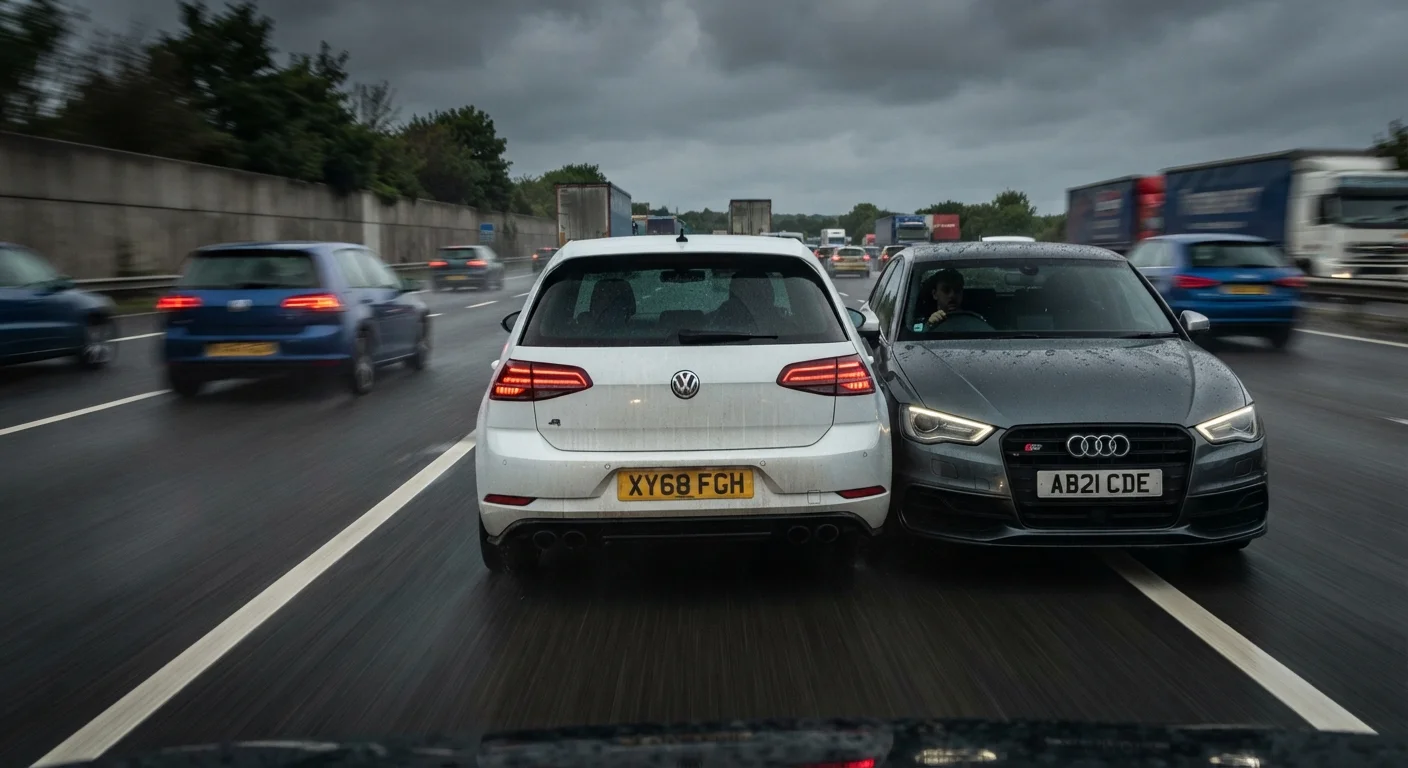
Tailgating means following another vehicle so closely that you would not have enough time or distance to stop safely if that vehicle braked suddenly. It is one of the leading contributing factors in rear-end collisions. Most drivers who tailgate do so without realising how little margin for error they've left themselves.
Traffic safety researchers define an unsafe following distance as anything less than the stopping distance required at a given speed, which accounts for both perception-reaction time (typically 1.5 seconds) and mechanical braking distance.
The Physics Behind the Problem
When drivers think about stopping, they often picture only the mechanical act of braking. What they overlook is the time that passes before the brake pedal is even pressed. Traffic safety research consistently measures perception-reaction time - the interval between seeing a hazard and responding - at around 1.5 seconds for alert drivers. At 60 mph, a vehicle covers approximately 132 feet in that window alone, before braking even begins.
Once braking starts, kinetic energy - the force your moving vehicle carries - determines how far the car travels before stopping. Because kinetic energy increases with the square of speed, stopping distances climb steeply as speed rises. A car braking from 60 mph needs roughly four times the distance it would from 30 mph. Add a wet or icy road surface, worn tires, or a loaded vehicle, and that distance grows further.
Tailgating eliminates the buffer that absorbs all of this. A driver following just one car-length behind at 65 mph has, in practical terms, no margin for error.
~29%
Share of all US crashes that are rear-end collisions
According to the National Highway Traffic Safety Administration (NHTSA), rear-end crashes consistently account for roughly a third of all reported collisions annually.
132 ft
Distance covered before braking at 60 mph
At 60 mph with a 1.5-second perception-reaction time, a vehicle travels approximately 132 feet before the brakes begin to engage - before any mechanical stopping occurs.
4×
Increase in braking distance when speed doubles
Due to the physics of kinetic energy, doubling vehicle speed quadruples the braking distance required on dry pavement under normal conditions.
Why Drivers Underestimate the Risk
Human perception is poorly calibrated for highway speeds. At 70 mph, distances appear compressed and the gap to the vehicle ahead looks larger than it is. Research in traffic psychology suggests drivers routinely misjudge closing speed, particularly when following a large vehicle like a truck or SUV that fills the visual field.
There is also a social-conformity effect: when surrounding traffic is dense and following distances are short across all lanes, drivers unconsciously mirror those gaps rather than applying an independent safety judgment. This normalises behaviour that is objectively unsafe.
Impatience is another factor. Studies on driving behaviour have found that drivers who are running late or feel frustrated are more likely to reduce following distances, even though doing so rarely meaningfully shortens journey time on congested roads.
“Drivers consistently overestimate their own reaction time and underestimate how fast the situation in front of them can change. The gap that feels comfortable at speed is almost never the gap that's actually safe.”
— Traffic Safety Research Consensus, Synthesised from published findings in driver behaviour and crash causation literature
The 3-Second Rule and How to Apply It
The 3-second rule is a practical, speed-agnostic method for gauging following distance. As the vehicle ahead passes a fixed roadside marker - a sign, a shadow line, a bridge post - begin counting: one-thousand-one, one-thousand-two, one-thousand-three. Your vehicle should not reach that same marker before you finish counting.
Three seconds is a reasonable minimum in clear, dry daytime conditions on a familiar road. Increase the gap in these situations:
- Rain or snow: Wet roads can double stopping distance; ice can increase it tenfold. Aim for 6 or more seconds.
- Following a large truck or bus: Their braking capacity differs, and their size blocks your view of hazards ahead.
- Night driving: Reduced visibility means less time to identify hazards.
- Carrying extra load: A heavier vehicle takes longer to stop.
See our guide to defensive driving techniques for how experienced drivers build gap management into a broader anticipatory approach.
Practice the 3-Second Count on Your Next Drive
Choose any fixed roadside object - a sign, a shadow, a lane marking - and count the seconds between the car ahead passing it and your vehicle reaching it. Do this a few times on a familiar stretch of road. Most drivers are surprised to find they're consistently under three seconds. With practice, maintaining adequate spacing becomes automatic.
What to Do When You're Being Tailgated
Being followed too closely by another driver puts you in a difficult position. The instinctive response - braking to signal displeasure - is one of the most dangerous things you can do, as it can trigger the exact collision the tailgater's position makes likely.
Instead, the recommended approach is to disengage safely. If you're in a multi-lane environment, signal and move to a slower lane when it's safe to do so. On a single-lane road, gently reduce speed to create space ahead of you - this gives the driver behind more room to react if you need to stop, and often encourages them to pass at the next opportunity.
Avoid eye contact, gestures, or brake-checking. These escalate the situation into road rage territory, which introduces a new and serious layer of risk. For more on managing high-pressure driving scenarios, understanding road safety fundamentals covers the core principles that apply here.
If you drive frequently with others in the car, it's worth noting that passenger dynamics can influence driver behaviour - something explored in depth in our article on how occupant dynamics affect risk.
Building the Habit of Safe Following Distance
Following distance is one of those habits that feels unnecessary until it isn't. Like seatbelts or mirror checks, it only proves its value in a crisis - by which point it's too late to start. The goal is to make adequate spacing a default, not a conscious effort.
Drivers who are newer to the road can benefit from treating following distance as part of a broader set of foundational practices. Our article on safe driving habits new drivers often skip outlines how early habits shape long-term driving behaviour.
One useful mindset shift: instead of measuring distance in car lengths - which varies depending on what's around you - measure it in time using the 3-second count. Time is consistent regardless of speed, making it a far more reliable personal standard.
This article provides general driving safety information for educational purposes. Always follow the traffic laws of your state and consult official driving guidelines for jurisdiction-specific rules.