

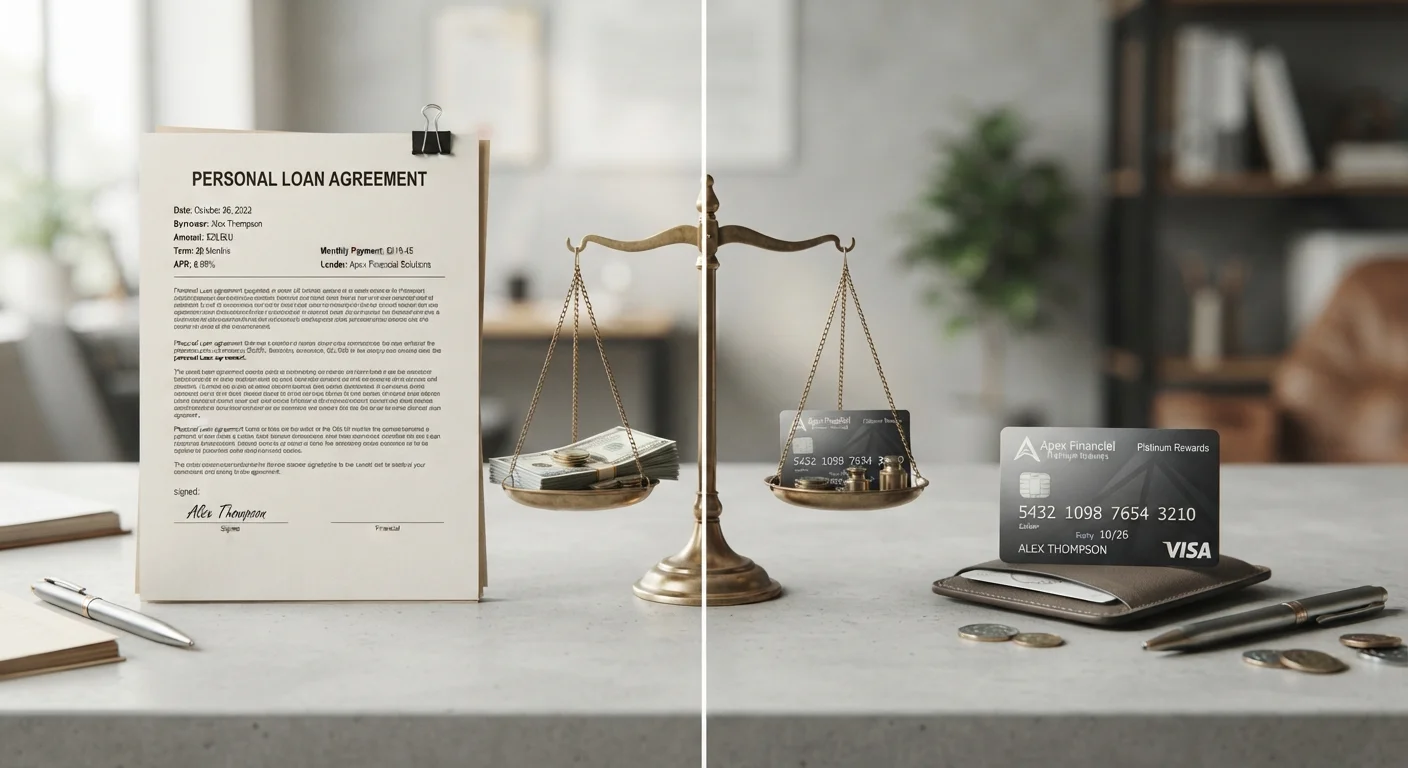
Key Takeaways
- Personal loans offer a fixed repayment schedule and typically lower interest rates than credit cards.
- Balance transfer credit cards can eliminate interest temporarily, but only if you pay off the balance before the promotional period ends.
- Your credit score, debt amount, and repayment discipline are key factors in choosing the right approach.
- Neither option erases debt - both require consistent payments to be effective.
- Consult a licensed financial professional before making significant debt management decisions.
Our Verdict
Personal loans generally suit borrowers who want predictable monthly payments and a defined payoff date, especially for larger balances. Balance transfer credit cards can be powerful for smaller debts you can realistically pay off within a promotional period. The right choice depends on your balance size, creditworthiness, and repayment habits - not a one-size-fits-all formula.
| Best for | Recommended |
|---|---|
| Those with larger balances needing structured repayment | Personal Loan |
| Those with smaller balances and strong repayment discipline | Balance Transfer Credit Card |
| Those who prefer predictable, fixed monthly payments | Personal Loan |
| Those who qualify for a 0% APR offer and can pay off debt quickly | Balance Transfer Credit Card |
The Core Question: What Are You Actually Comparing?
When people talk about using a personal loan or a credit card to pay off debt, they're usually discussing two specific strategies: a debt consolidation loan (a personal loan used to pay off multiple debts at once) and a balance transfer (moving existing credit card balances to a new card, often with a low or 0% introductory annual percentage rate, or APR).
These are both forms of debt consolidation - combining multiple obligations into one - but they work differently. Understanding those differences is what helps you make an informed choice. For a broader look at how consolidation works in general, see our full debt consolidation overview.
It's also worth understanding that neither approach eliminates your debt - they restructure it. Your repayment behavior after consolidating is what determines whether the strategy succeeds or fails.
How Personal Loans Work for Debt Payoff
A personal loan is an installment loan - you borrow a lump sum, then repay it in fixed monthly payments over a set term (commonly 24 to 60 months). The interest rate is typically fixed, meaning your payment amount doesn't change month to month.
When used for debt payoff, the loan proceeds pay off your existing balances, leaving you with one monthly payment at (ideally) a lower interest rate than your previous debts carried.
Potential advantages
- Predictable payments: A fixed schedule makes budgeting straightforward.
- Clear end date: You know exactly when you'll be debt-free if you make every payment.
- Potentially lower APR: Borrowers with good credit often qualify for rates meaningfully below typical credit card APRs.
- Works for larger balances: Personal loans are available in higher amounts than most balance transfer limits.
Potential drawbacks
- Origination fees: Some lenders charge an upfront fee (often 1%-8% of the loan amount), which reduces the net benefit.
- Credit score requirement: Competitive rates generally require good to excellent credit.
- Less flexibility: Unlike a credit card, you can't borrow again without a new application.
For context on how unsecured debt like personal loans differs from secured borrowing, see our explainer on secured vs. unsecured debt.
How Balance Transfer Credit Cards Work
A balance transfer card lets you move existing credit card balances onto a new card - often with a 0% APR promotional period lasting anywhere from 12 to 21 months. During that window, no interest accrues on the transferred balance, meaning every dollar you pay reduces principal directly.
Potential advantages
- Interest-free window: A 0% period can save significant money if you repay the balance in time.
- Simple structure: One card, one payment.
- Lower cost for smaller balances: If you can realistically pay off the debt within the promotional period, the total cost may be very low.
Potential drawbacks
- Balance transfer fee: Most cards charge 3%-5% of the transferred amount upfront.
- Revert rate risk: Once the promotional period ends, the standard APR applies - often 20% or higher. Any remaining balance becomes expensive quickly.
- Credit limit constraints: You can only transfer up to the card's approved limit, which may not cover all your debt.
- Temptation to spend: Having an open credit card can make it easier to accumulate new debt while repaying old debt.
Don't Overlook the Revert Rate
One of the most common balance transfer pitfalls is failing to pay off the full balance before the 0% promotional period expires. When the standard APR kicks in - often 20% or higher - any remaining balance starts accruing interest immediately. Before choosing this route, confirm you can realistically clear the balance within the promotional window, not just make progress on it.
Understanding how interest compounds on revolving balances is critical before choosing this route. See how compounding works on revolving debt for a detailed breakdown.
Side-by-Side: Key Differences at a Glance
The table below summarizes how the two approaches compare across several practical dimensions. Individual terms vary by lender and creditworthiness - these are general patterns, not guarantees.
| Personal Loan | Balance Transfer Card | |
|---|---|---|
| Interest rate type | Fixed APR for loan term | 0% intro, then variable standard APR |
| Typical upfront cost | Origination fee (0%-8%) | Balance transfer fee (3%-5%) |
| Repayment structure | Fixed monthly installments | Flexible minimum payments (revolving) |
| Best balance size | Larger balances ($5,000+) | Smaller balances payable in promo window |
| Payoff timeline | Set term (24-60 months) | Depends on your payment pace |
| Risk if not managed | Missed payments hurt credit | High revert APR after promo period |
| Credit score impact | Hard inquiry; new installment account | Hard inquiry; affects credit utilization |
Which Approach Fits Your Situation?
Rather than declaring one option universally superior, consider these practical scenarios:
A personal loan may be a stronger fit if:
- Your total debt is large (generally above $5,000-$10,000), making full repayment within a 0% window unlikely.
- You want a firm payoff date built into the structure.
- You're prone to minimum-payment habits on revolving credit - a fixed installment removes that temptation.
A balance transfer card may be a stronger fit if:
- Your balance is small enough that you can confidently pay it off before the promotional period ends.
- You qualify for a card with a long 0% window and a low transfer fee.
- You have the discipline to avoid adding new purchases to the card.
Whichever path you consider, pairing it with a solid repayment strategy matters. Compare structured approaches in our debt avalanche vs. debt snowball comparison. And grounding debt repayment in a working monthly budget improves your odds of success - our budgeting basics hub is a useful starting point.
Check the Total Cost, Not Just the Rate
Before committing to either option, calculate the full cost: add origination or transfer fees to total interest paid over the repayment period. A 0% balance transfer with a 5% fee may cost more than a personal loan with a modest APR if you need 36 months to repay. Running the numbers for your specific balance and timeline gives you a clearer picture than comparing headline rates alone.
This article is for general informational and educational purposes only. It is not personalized financial advice. Consult a licensed financial professional before making decisions about debt management based on your specific situation.