

Key Takeaways
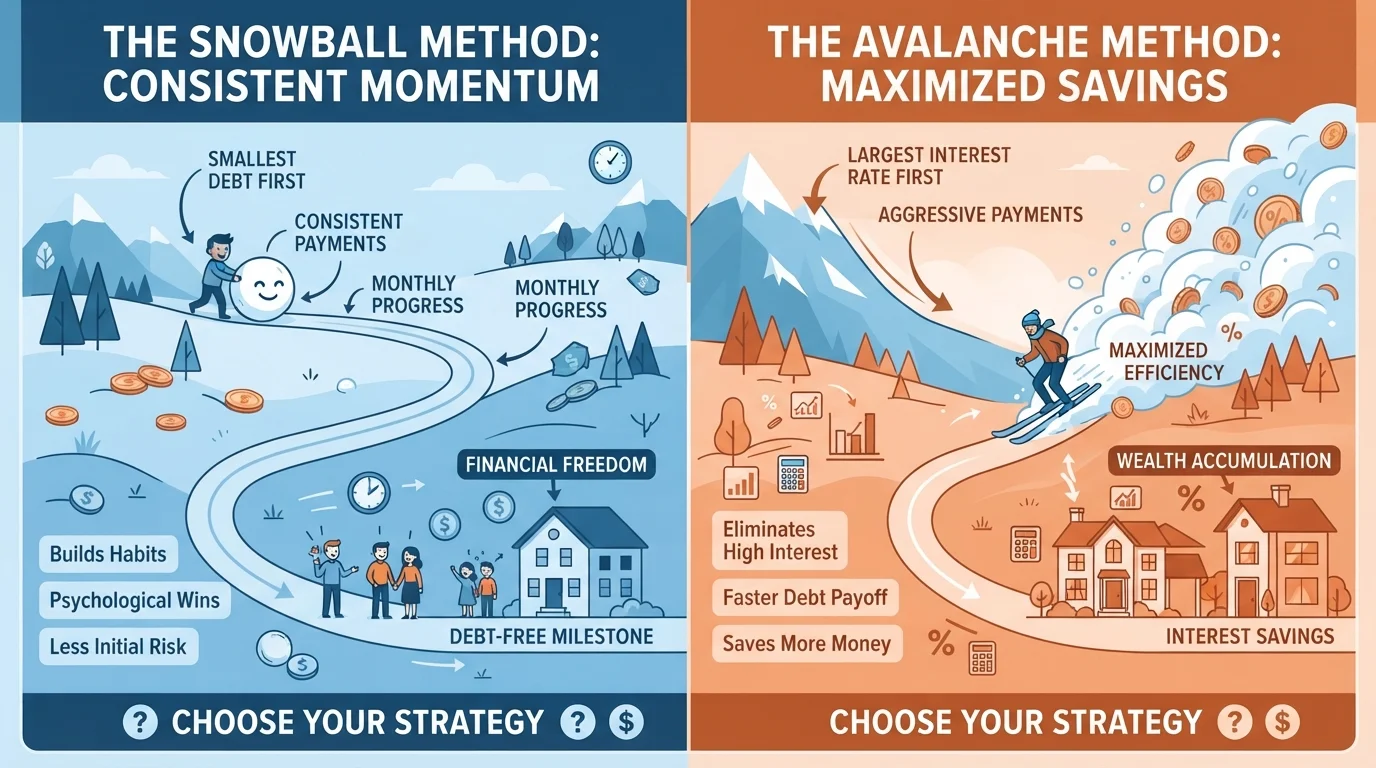
- The debt avalanche targets your highest-interest debt first, minimizing total interest paid over time.
- The debt snowball pays off the smallest balance first, delivering faster early wins to sustain motivation.
- Both methods require paying more than the minimum on at least one debt while maintaining minimums on all others.
- Research suggests the snowball method may lead to higher completion rates due to its psychological benefits.
- The best strategy is the one you will actually stick with - consistency matters more than theoretical optimization.
- Consulting a licensed financial professional can help you choose the right approach for your specific situation.
Option A
Debt Avalanche
The mathematically efficient, interest-minimizing approach.
Best for: People who want to pay the least total interest and are comfortable staying motivated without early wins.
Option B
Debt Snowball
The momentum-building, psychologically rewarding approach.
Best for: People who need early wins to stay on track and find motivation more important than maximum interest savings.
If you want to minimize total interest paid
Debt Avalanche
By attacking the highest-interest debt first, the avalanche method mathematically reduces the total cost of your debt over time.
If you need early motivation to stay committed
Debt Snowball
Eliminating smaller balances quickly creates a sense of progress that research links to higher long-term follow-through.
If your debts carry similar interest rates
Debt Snowball
When interest rates are close, the mathematical advantage of the avalanche shrinks, making the motivational boost of the snowball more valuable.
If you have one very high-rate debt dominating your finances
Debt Avalanche
A single high-APR account can cost significantly more over time; eliminating it first limits compounding damage most effectively.
If you are new to structured debt repayment
Debt Snowball
The quick wins from paying off smaller balances help build the habit of disciplined repayment before tackling larger, longer-term debts.
How Each Method Works
Both strategies share the same foundational mechanic: pay the minimum on every debt each month, then direct any extra money toward one targeted account. Where they diverge is in how they rank which debt gets that extra payment first.
Debt Avalanche: List all your debts by annual percentage rate (APR - the yearly cost of borrowing, including interest and fees) from highest to lowest. Put every spare dollar toward the highest-rate debt. Once that balance reaches zero, redirect its payment to the next-highest-rate account, and repeat. Understanding how interest compounds on revolving balances makes the avalanche logic clearer - see our explainer on compounding revolving debt for the mechanics.
Debt Snowball: List all your debts by outstanding balance from smallest to largest, ignoring interest rates entirely. Direct extra payments to the smallest balance. When it's gone, roll that freed-up payment into the next-smallest account. The growing payment applied to each successive debt is the "snowball" effect.
Neither method changes how much money you have available to repay debt - they only change the order in which you eliminate individual accounts.
| Criterion | Debt Avalanche | Debt Snowball |
|---|---|---|
| Repayment order | Highest interest rate first | Smallest balance first |
| Total interest paid | Lower (mathematically optimal) | Potentially higher |
| Time to first payoff | Longer (if high-rate debt is large) | Faster early wins |
| Motivational structure | Delayed gratification | Frequent milestones |
| Complexity | Slightly more tracking required | Simple and intuitive |
| Best when | Rates vary widely across debts | Rates are similar; motivation is key |
The Real Cost Difference: Interest vs. Motivation
The avalanche method wins on pure arithmetic. Because high-APR balances accumulate interest fastest, neutralizing them early reduces the total interest that compounds across your debt portfolio. The gap in savings can be modest or substantial depending on the spread between your highest and lowest interest rates and how long repayment takes.
The snowball method trades some of that savings for a psychological dividend. Behavioral finance research, including work published by the Harvard Business Review, has suggested that people who eliminate individual accounts - regardless of size - experience a stronger sense of progress and are more likely to continue their repayment plan. A strategy that keeps you engaged for years may ultimately outperform a theoretically superior plan you abandon after six months.
~$1,000+
Potential interest savings with avalanche method
Estimates vary widely by debt mix; the Consumer Financial Protection Bureau notes that payment order can significantly affect total interest on multi-debt portfolios.
Higher
Completion likelihood with snowball method
Behavioral research, including studies cited by the Harvard Business Review, associates account-elimination milestones with improved debt-repayment follow-through.
2-4 years
Typical credit card payoff timeline on minimum payments
According to the CFPB, paying only the minimum on a moderate credit card balance can extend repayment by years and multiply total interest costs.
It is also worth noting that the actual dollar difference between the two methods depends heavily on your specific debt mix. If your balances are small and your rates are clustered close together, the avalanche's advantage may amount to only a few dollars. If you carry a large balance at a very high rate alongside several small low-rate accounts, the difference could be meaningful.
For a broader look at how debt types interact with repayment strategies, our guide to secured vs. unsecured debt explains how lenders structure different kinds of borrowing.
Putting a Strategy Into Practice
Regardless of which method you choose, the setup is straightforward:
- List all debts. Record every balance, minimum payment, and interest rate.
- Rank them. Avalanche: highest APR first. Snowball: lowest balance first.
- Find extra money. Review your monthly budget to identify any funds beyond minimum payments. Even $25-$50 per month accelerates repayment meaningfully. The Budgeting Basics hub offers practical frameworks for finding that room.
- Automate minimums. Set up automatic payments for every account so you never miss one while focusing on your target debt.
- Redirect freed payments. When a balance reaches zero, immediately apply its former payment to the next target - do not absorb it into general spending.
Some people find a hybrid approach useful: starting with the snowball to build confidence, then switching to the avalanche once habits are established. There is no rule requiring you to commit to one method forever.
If you are weighing other repayment tools alongside these strategies - such as consolidating multiple debts into a single account - our overview of debt consolidation and personal loans vs. credit cards comparison cover those trade-offs in detail.
This article is for general informational purposes only and does not constitute personalized financial advice. For guidance tailored to your specific circumstances, consult a licensed financial professional.