
How Interest Compounds on Revolving Debt - and Why the Minimum Payment Trap Is Real

Key Takeaways
- Credit card interest compounds daily in most cases, meaning unpaid interest is added to your balance and begins earning interest itself.
- Paying only the minimum each month satisfies the issuer's requirement but leaves the majority of the balance accruing interest.
- On a high-APR card, minimum payments can stretch repayment to a decade or more - far longer than most cardholders realize.
- Paying even a modest amount above the minimum each month can dramatically cut total interest paid and repayment time.
- Understanding how your card calculates interest is the first step toward using revolving credit without falling into the minimum payment trap.
Revolving Debt & Compound Interest
Revolving debt is a type of credit - most commonly a credit card - where you can borrow, repay, and borrow again up to a set limit. Unlike a fixed loan with scheduled payments, interest on revolving debt is recalculated on your remaining balance each billing cycle. When that interest is added to your balance and then earns interest itself in the next cycle, the process is called compounding - and it can cause a balance to grow faster than most people expect.
Credit card issuers typically calculate interest using a Daily Periodic Rate (DPR), which is the annual percentage rate (APR) divided by 365. The DPR is applied to the average daily balance each day, and the total monthly interest charge is the sum of those daily charges.
How Revolving Credit Works - and Why It Differs from a Fixed Loan
A revolving credit account - most commonly a credit card - gives you a credit limit you can draw from repeatedly. Unlike an installment loan, where you borrow a fixed sum and repay it on a set schedule, revolving credit has no fixed end date. You can carry a balance from month to month, make new purchases, and repay as much or as little as you choose, as long as you meet the minimum payment.
That flexibility is also the source of risk. Because there is no predetermined payoff date and no required full repayment, cardholders can carry balances indefinitely. The issuer earns interest on every dollar not repaid - and that interest is calculated in a way that accelerates the cost of carrying a balance. For a plain-language breakdown of terms like APR and credit utilization, see our credit and debt glossary.
The Mechanics of Daily Compounding Interest
Most credit card issuers do not calculate interest once a month - they calculate it every single day. Here is how it works in practice:
- APR to Daily Periodic Rate: Your annual percentage rate is divided by 365 to produce a daily rate. A card with a 24% APR carries a daily rate of approximately 0.066%.
- Applied to average daily balance: Each day, that rate is multiplied by the balance on your account that day. These daily charges accumulate across the billing cycle.
- Added to the balance: At cycle close, the total interest charge is added to your balance. If you do not pay it off, that interest now becomes part of the principal - and earns interest in the next cycle.
This is compounding: interest charged on previously charged interest. It is gradual at first, but at a high APR with a growing balance, the effect becomes substantial over time.
~15+ years
Time to pay off $3,000 at 22% APR on minimums
A general illustration based on standard minimum payment formulas (2% of balance), showing how slowly minimum-only repayment reduces revolving debt.
20%+
Average credit card APR in recent years (U.S.)
The Federal Reserve tracks average credit card interest rates; rates above 20% have been common for accounts assessed interest in recent periods.
1-2%
Typical minimum payment as a share of balance
Most major card issuers set minimum payments at 1-2% of the outstanding balance or a flat dollar floor - whichever is greater - per their cardholder agreements.
The Minimum Payment Trap Explained
Credit card issuers set minimum payments low - typically 1-2% of the outstanding balance, or a small flat dollar amount, whichever is higher. Meeting the minimum keeps your account current and avoids late fees, but it does very little to reduce what you owe.
Consider a $3,000 balance at 22% APR. If the minimum payment is calculated as 2% of the balance, your first payment would be about $60. Of that, roughly $55 covers the monthly interest charge, leaving only $5 applied to the principal. As the balance decreases slightly, so does the minimum - meaning payments shrink over time rather than accelerating payoff. At that pace, retiring the balance could take more than 15 years and cost over $4,000 in interest.
This is the minimum payment trap: a structure that is technically compliant but financially costly for anyone who relies on it as a long-term strategy.
Use Your Statement to Do the Math
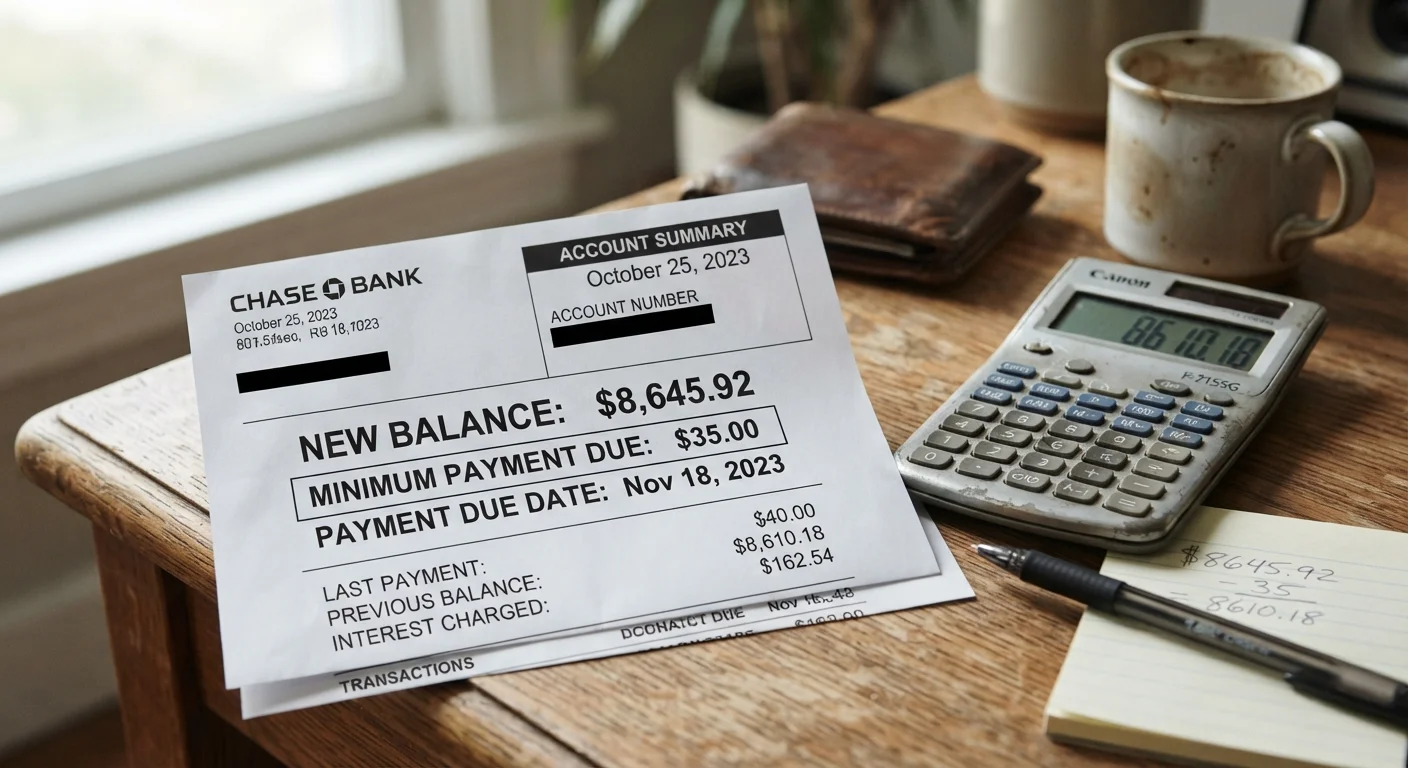
Federal law requires credit card statements to include a minimum payment warning - showing how long it would take to pay off the current balance making only minimum payments, and the total interest cost. Review this section of your statement each month. It translates the abstract mechanics of compounding into a concrete dollar figure specific to your account.
What Paying More Can Actually Do
The mathematics of compounding work against you when you carry a balance - but they also mean that every extra dollar applied to principal reduces the base on which future interest is calculated. The impact compounds in reverse.
Using the same $3,000 balance at 22% APR: paying a fixed $150 per month instead of the declining minimum could retire the debt in roughly 24 months and cut total interest paid by more than half. Paying $200 per month compresses the timeline further still.
The key insight is that you do not need to double your payment to see a meaningful difference. Consistent incremental increases above the minimum - redirected from discretionary spending - can materially change the outcome. If you are weighing whether a personal loan might offer a lower-cost path to paying off existing credit card debt, comparing personal loans and credit cards can help clarify the trade-offs. Debt consolidation is another avenue worth understanding - our overview of how debt consolidation works lays out both the potential benefits and the risks.
“The power of compounding is the most important concept in personal finance. On debt, it works against you with the same mathematical force that makes it so valuable in investing.”
— Personal Finance Editorial Team, Editorial analysis based on widely recognized financial principles
Practical Steps to Avoid Getting Trapped
Understanding the mechanics is useful only if it leads to action. A few consistent habits can significantly reduce the cost of carrying revolving debt:
- Pay more than the minimum every cycle. Even a fixed amount slightly above the minimum prevents your payments from declining with the balance.
- Make payments earlier in the billing cycle. Because interest is calculated daily, reducing your balance sooner - even mid-cycle - lowers the average daily balance and shrinks the interest charge.
- Request a lower APR. Cardholders with strong payment histories sometimes qualify for a rate reduction. It is worth asking your issuer directly.
- Track your interest charge each statement. Seeing the actual dollar cost of carrying the balance each month makes the abstract mechanics concrete - and often motivates faster repayment.
It is also worth understanding what happens if payments are missed entirely. Missing a payment triggers late fees, potential penalty APRs, and credit score damage - all of which compound the financial impact beyond interest alone.
This article is for general informational and educational purposes only and does not constitute personalized financial or legal advice. Consult a qualified financial professional regarding your specific situation.