

Key Takeaways
- The correct tyre pressure for your vehicle is found on a sticker inside the driver's door jamb or in the owner's manual - not on the tyre sidewall.
- Under-inflation increases heat build-up and can lead to tread separation or a sudden blowout.
- Over-inflation reduces the contact patch, making braking distances longer and handling less predictable.
- Temperature changes - roughly 10°F - alter tyre pressure by about 1 PSI, so seasonal checks matter.
- Checking pressure monthly and before long trips is widely recommended by vehicle safety organisations.
- Tyre pressure monitoring systems (TPMS) alert you to significant drops but are not a substitute for manual checks.
Tyre Pressure (PSI / Bar)
Tyre pressure is the amount of air inside a tyre, measured in pounds per square inch (PSI) or bar. Every vehicle has a manufacturer-specified pressure range that keeps the tyre's contact patch - the area touching the road - at the correct size and shape. Maintaining that range is one of the simplest, most effective things a driver can do for safety.
PSI and bar are both units of pressure: 1 bar equals approximately 14.5 PSI. Specifications are always given for a cold tyre, meaning the vehicle has been stationary for at least three hours or driven fewer than one mile at low speed.
What the Numbers on Your Tyre Actually Mean
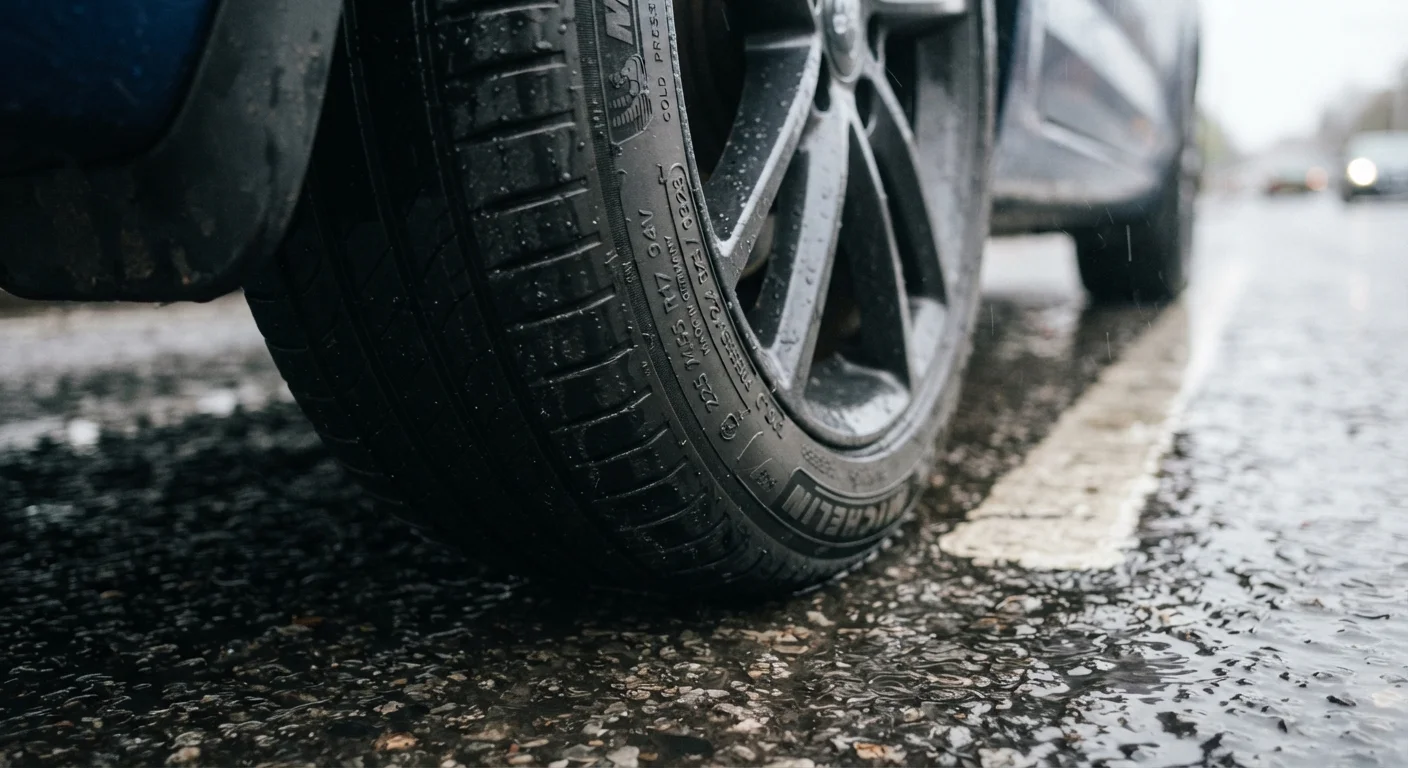
When you look at a tyre sidewall, you'll see a string of markings - something like 205/55 R16 91V - followed by a phrase such as Max. Press. 51 PSI. That maximum pressure figure is the tyre's structural ceiling, not your target. Inflating to that number would make the tyre dangerously rigid and reduce road contact.
The pressure you should actually use is set by your vehicle's manufacturer, not the tyre maker. It accounts for the car's weight distribution, suspension geometry, and intended use. You'll find it on a placard inside the driver's door jamb or in the owner's manual. Front and rear recommendations sometimes differ, and vehicles with a spare tyre often list a separate figure for that too.
Pressure is expressed in PSI (pounds per square inch) in the US, though some gauges also display bar or kPa. Converting is straightforward: 30 PSI is roughly 2.07 bar. The key habit is always checking pressure on a cold tyre - air expands as it heats, so a reading taken immediately after driving will be artificially high.
How Under-Inflation Affects Safety
An under-inflated tyre flexes more than it should with every rotation. That excess flexing generates heat within the rubber and steel cords - and heat is the primary enemy of tyre integrity. Over time, or in a single high-speed situation, it can cause tread separation or a sudden blowout.
Beyond blowout risk, the handling effects are immediate. The tyre's contact patch widens and distorts at the edges, reducing the precision with which steering inputs translate to directional change. On wet roads, where traction is already reduced, an under-inflated tyre is slower to channel water away from the contact zone, raising aquaplaning risk.
~1 PSI
Pressure change per 10°F temperature shift
This relationship is widely cited by tyre industry organisations and vehicle manufacturers as the standard guidance for seasonal inflation checks.
25%
Below-spec pressure that triggers TPMS alert
US federal safety standards require TPMS to warn when any tyre drops to 25% below the vehicle placard pressure - meaning handling is already affected before the light appears.
1 in 4
Vehicles estimated to have at least one under-inflated tyre
Surveys conducted by US tyre safety organisations have found a significant proportion of vehicles on the road have at least one tyre meaningfully below the recommended pressure.
Fuel economy also suffers: greater rolling resistance means the engine works harder to maintain speed. The cumulative cost over months of driving is measurable, though exact figures vary by vehicle and conditions.
How Over-Inflation Creates Different Problems
Over-inflated tyres suffer the opposite contact problem. Too much air pressure causes the tyre to balloon slightly, so only the central strip of tread contacts the road rather than the full designed width. That narrowed contact patch reduces grip, which lengthens braking distances and makes the vehicle more prone to skidding in corners.
The ride also becomes harsher. A rigidly over-inflated tyre transmits more road shock to the suspension and chassis, accelerating wear on steering components over time. Centre tread wear - excessive wear in the middle of the tread band - is a common indicator that a tyre has been chronically over-inflated.
Check Pressure Before Driving, Not After
Always measure tyre pressure on a cold tyre - one that hasn't been driven for at least three hours. Driving heats the air inside, raising the reading by several PSI and making it appear higher than it actually is at rest. If you must check after driving, note that the reading will be elevated and factor that in when comparing to the placard figure.
For drivers who frequently alternate between motorway runs and urban routes, correct pressure is especially important. The two environments place different demands on tyre performance, as explored in our guide to motorway versus urban driving behaviour.
Temperature, Seasons, and Pressure Changes
Air pressure inside a tyre responds to temperature. The generally accepted relationship is that pressure changes by approximately 1 PSI for every 10°F (5.6°C) change in ambient temperature. That means a tyre inflated correctly in October may read noticeably low by January without any puncture or leak.
This is why seasonal pressure checks are not optional - they're a basic safety step. If your vehicle is equipped with a Tyre Pressure Monitoring System (TPMS), remember that the warning light typically activates only when pressure has dropped around 25% below the placard recommendation. By that point, handling and blowout risk are already meaningfully affected. A manual gauge check costs almost nothing and catches gradual drops the TPMS will miss.
New drivers in particular benefit from making this a routine habit early. For a broader foundation in vehicle safety awareness, our road safety guide for new drivers covers the principles that underpin confident, prepared driving.
Checking and Maintaining Correct Pressure
Checking tyre pressure takes less than five minutes with a basic handheld gauge, available at any auto parts retailer. Digital gauges are easier to read in poor light; stick-type gauges are reliable and inexpensive. Many petrol stations provide air compressors, though it's worth having your own gauge since pump-mounted gauges can vary in accuracy.
The process is straightforward: remove the valve cap, press the gauge firmly onto the valve stem, read the pressure, and compare it to your door-jamb placard. Add air if low; release small amounts using the valve pin if over-inflated. Recheck after adjustment. Replace valve caps - they prevent moisture and debris from degrading the valve core over time.
For a more detailed look at what happens when pressure maintenance is neglected over the longer term, see what happens when you ignore tyre pressure. The consequences extend well beyond fuel economy into tyre lifespan and, ultimately, road safety.