

Key Takeaways
- Your vehicle's correct tyre pressure is on a sticker inside the driver's door jamb - not on the tyre sidewall.
- Under-inflated tyres increase fuel consumption and wear tread unevenly at the outer edges.
- Over-inflated tyres reduce the contact patch with the road, making braking distances longer.
- Tyre pressure drops roughly 1 PSI for every 10°F drop in ambient temperature.
- Check pressure when tyres are cold - driven tyres read higher and give a misleading measurement.
- Monthly checks are widely recommended by vehicle manufacturers as a minimum interval.
Tyre Pressure
Tyre pressure refers to the amount of air inside a tyre, measured in pounds per square inch (PSI) in the US. Every vehicle has a manufacturer-recommended PSI range that keeps the tyre performing safely and efficiently. Too little air (under-inflation) or too much air (over-inflation) both cause problems - affecting how the car handles, how quickly tyres wear out, and how much fuel the engine burns.
PSI stands for pounds per square inch and measures the force the air inside the tyre exerts against its walls. Some vehicles also display pressure in kPa (kilopascals) or bar; 1 bar ≈ 14.5 PSI.
Why Tyre Pressure Matters More Than Most Drivers Realise
A tyre that looks fine from the outside can be significantly under- or over-inflated. The visual difference between a tyre at 26 PSI and one at 35 PSI is subtle enough that most people won't notice it on a walk-around inspection. Yet that gap in pressure changes how the vehicle brakes, steers, and consumes fuel - every time you drive.
Tyre pressure is part of the broader ecosystem of routine maintenance tasks that quietly protect your vehicle and wallet. Unlike an oil change, checking pressure costs nothing and takes under five minutes. The cost of ignoring it - in premature tyre replacement, reduced fuel efficiency, and potential safety incidents - is considerably higher.
~1 PSI
Pressure lost per 10°F temperature drop
A commonly cited guideline from tyre safety organisations reflecting how ambient temperature affects air volume inside tyres.
25%
Under-inflation level that triggers TPMS alert
U.S. federal standards require TPMS systems to warn drivers when any tyre falls 25% or more below the vehicle's recommended pressure.
1 in 4
Vehicles with at least one significantly under-inflated tyre
Roadside tyre pressure surveys conducted by safety organisations consistently find a substantial share of vehicles running low on at least one tyre.
What Under-Inflation Actually Does to Your Vehicle
When a tyre doesn't have enough air, its sidewalls flex more than they're designed to. This extra flexing generates heat - and heat is one of the primary causes of tyre failure. The tread also deforms, causing the outer edges to carry a disproportionate load. The result is accelerated wear on those edges while the centre tread remains relatively untouched.
Under-inflated tyres also increase rolling resistance - meaning your engine works harder to move the car forward. The U.S. Department of Energy has noted that under-inflation is a measurable contributor to reduced fuel economy, though the exact impact varies by vehicle and conditions. For everyday drivers already watching the cost of ownership, this adds up over time. See our guide to vehicle running costs for a fuller picture of where those expenses accumulate.
The Risks of Over-Inflation
Over-inflation is less common but equally problematic. A tyre pumped beyond its recommended PSI becomes rigid. Instead of the full tread face making contact with the road, only the centre strip bears the vehicle's weight. This narrows the footprint, reducing the friction available for braking and cornering.
On rough roads, an over-inflated tyre transmits more impact force to the wheel and suspension rather than absorbing it. Centre-tread wear is the tell-tale sign - if the middle of your tread wears faster than the edges, over-inflation is the likely cause. For a deeper look at how pressure affects stopping distances and handling, the tyre pressure and road safety explainer covers the mechanics in detail.
How to Check Tyre Pressure Correctly
The most important rule: check pressure when the tyres are cold - meaning the vehicle has been parked for at least three hours or driven fewer than one mile. Driving heats the air inside the tyre, causing it to expand and read artificially high. A warm-tyre reading will understate how much air you actually need.
- Find your vehicle's recommended PSI on the door jamb sticker or owner's manual.
- Remove the valve cap from the tyre stem and set it somewhere safe.
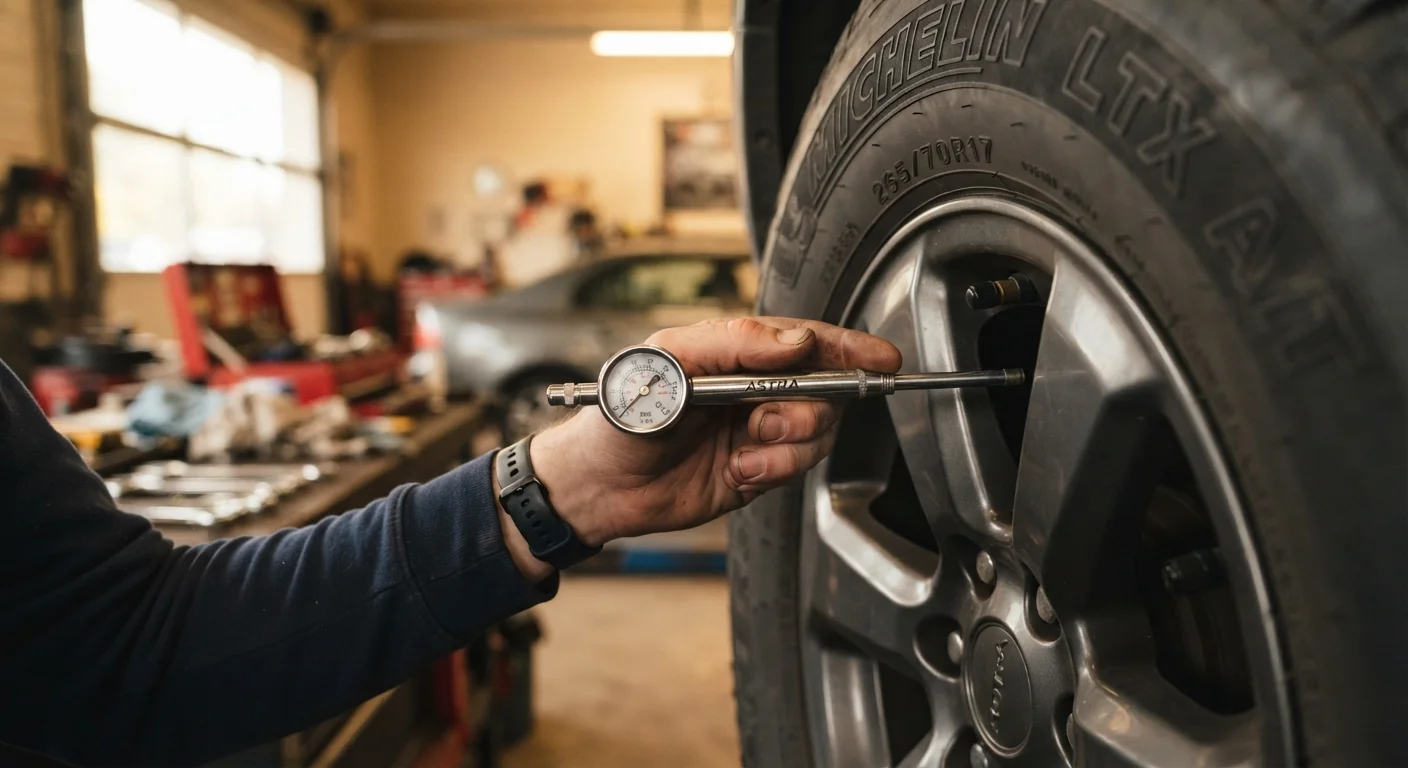
- Press your gauge firmly and squarely onto the valve stem until the hissing stops and you get a stable reading.
- Compare the reading to the recommended PSI. Add air if low; release small amounts using the gauge's bleed valve if over-inflated.
- Replace the valve cap after checking each tyre.
Don't forget the spare - a flat spare when you need it most is a common frustration that's entirely avoidable. Running through this check is also a natural part of the pre-trip vehicle checks worth doing before any long drive.
Keep a Gauge in the Glovebox
A basic digital or dial tyre pressure gauge is an inexpensive tool worth keeping in your vehicle. Petrol station gauges are convenient but often inaccurate due to heavy use and infrequent calibration. Checking with your own gauge after inflating at a station takes an extra 60 seconds and gives you a reliable reading.
Temperature, Seasons, and the 1-PSI Rule
Air contracts in cold weather and expands in heat - this is basic physics with real consequences for your tyres. As a general guideline, tyre pressure changes by roughly 1 PSI for every 10°F shift in temperature. A vehicle inflated to the correct pressure on a 70°F autumn day may read 3-4 PSI low when the first real cold snap arrives.
This is why seasonal checks matter even if you haven't driven much. Winter is the most common time for TPMS (tyre pressure monitoring system) warning lights to illuminate - not because of a leak, but simply because of temperature drop. TPMS alerts typically trigger when pressure falls 25% or more below the recommended level, which means the system may not flag a tyre that's meaningfully low but not yet at the alert threshold. Manual checks remain valuable even on vehicles with TPMS. Pressure awareness also connects directly to fuel economy habits worth understanding as a driver.