
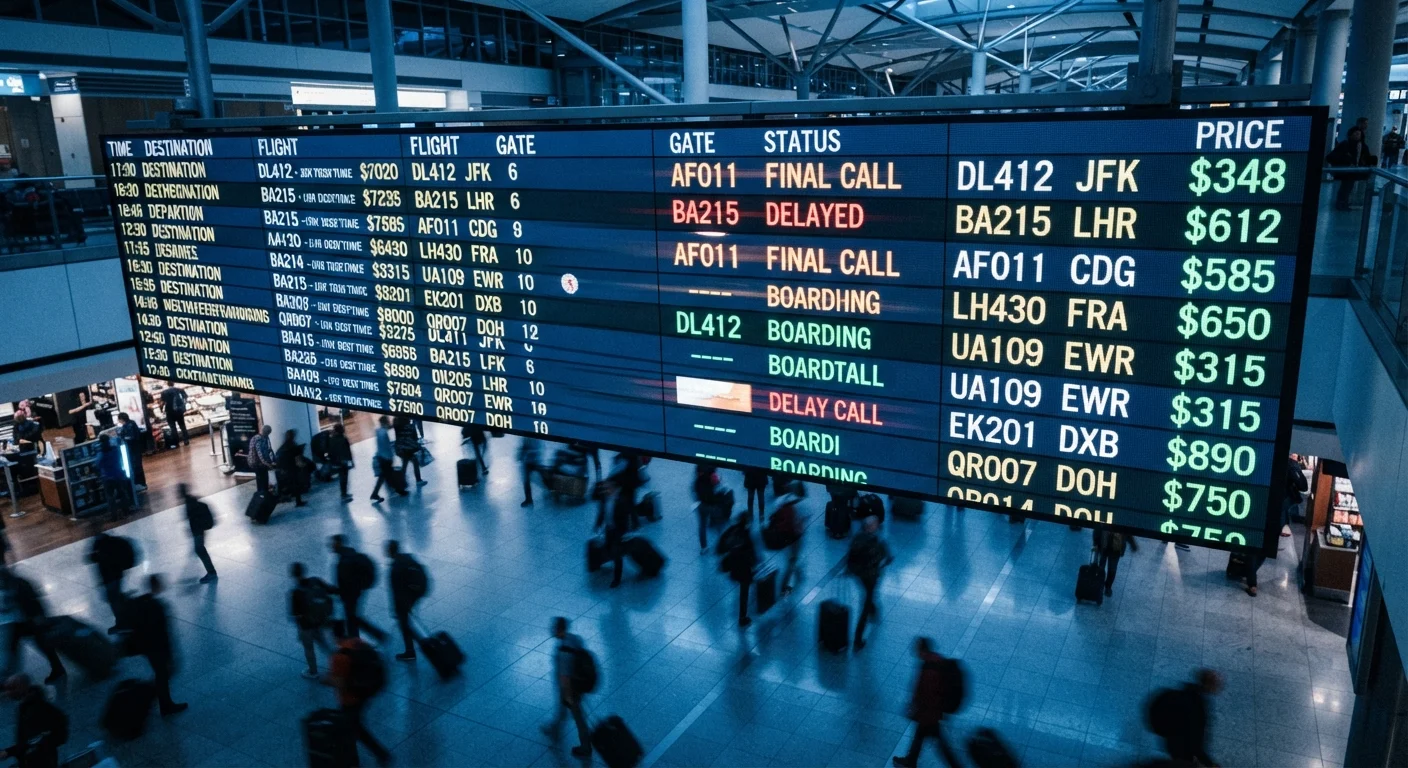
Key Takeaways
- Airfare prices are set by algorithms, not people — they respond to demand, inventory, and competition automatically.
- Each flight has multiple fare 'buckets,' each priced differently; cheaper buckets sell out first.
- Route competition, travel timing, and how far in advance you book all influence what you pay.
- The same seat can cost hundreds of dollars more or less depending purely on when you search.
- Understanding the system won't guarantee the lowest fare, but it reduces the chance of overpaying.
Dynamic Airfare Pricing
Dynamic airfare pricing is the practice by which airlines continuously adjust ticket prices based on real-time demand, available seat inventory, competition, and other factors. Unlike fixed-price goods, a single flight can have dozens of different fare levels that change multiple times per day. The price you see at any given moment reflects a snapshot of a constantly moving system.
Airlines manage this through Revenue Management Systems (RMS) — algorithmic platforms that calculate the optimal price for each remaining seat based on historical booking curves, competitor fare feeds, and current demand signals.
The Building Blocks of a Ticket Price
Strip away the mystery and a flight price is really a stack of components. The base fare — what the airline earns — is just one layer. On top sit government-imposed taxes, airport facility charges, and federal security fees. For international travel, departure and arrival country taxes add further. None of these components are negotiable, but the base fare is where almost all the variation happens.
Airlines divide their available seats into fare classes, often called buckets, each assigned an alphabetical code (Y, B, M, Q, and so on depending on the carrier). The lowest buckets — say, five or ten seats per flight — carry the cheapest base fares. When those sell, the system automatically moves buyers into the next tier. You're buying the same physical seat; you're paying for your position in the demand queue.
This is meaningfully different from how most consumer goods are priced. Unlike a retailer marking down seasonal inventory, airlines are selling a perishable product: an empty seat at departure is revenue gone forever. That urgency is baked into every pricing decision the system makes. For a broader look at how pricing works across retail categories, see how retailers set and change prices online.
What the Algorithm Is Actually Watching
Revenue Management Systems don't just count remaining seats — they compare current booking pace against historical patterns for the same route, same season, and same day of week. If a flight is selling faster than expected, the system closes lower fare buckets early. If bookings lag, it may hold cheaper fares open longer or release additional discounted inventory.
~168x
Average daily fare checks per flight by airline systems
Industry estimates suggest major airline revenue management systems reprice routes dozens to hundreds of times daily in response to demand and competitor changes.
11 months
How far in advance major carriers typically open bookings
Most large US carriers make seats available approximately 330 days before departure, though initial fares at this distance are not always the lowest.
2–3 weeks
Window when last-minute domestic fares spike sharply
Research on domestic US booking patterns consistently shows average fares rise meaningfully in the final two to three weeks before departure.
Competition matters too. When a rival carrier drops its price on a route, most airlines' systems detect that change within minutes and evaluate whether to match, undercut, or hold. On routes with many competing carriers, this dynamic keeps fares lower on average. On thin routes with limited competition, prices tend to be stickier and higher.
Demand signals the algorithm reads include: time to departure, day of week, travel season, local events at the destination, and even the mix of business versus leisure bookings on that specific flight. A conference in a mid-sized city can push fares on that route to multiples of their normal level for a single week.
Timing, Routes, and the Booking Window
The relationship between time-to-departure and price is not linear. Fares often start moderately priced when a flight first goes on sale (typically 11 months out for major carriers), dip into a mid-range window that varies by route, and then climb sharply in the final two weeks as last-minute business travelers and deadline-driven buyers absorb whatever inventory remains.
Day of week and time of day for the flight itself also factor in. Red-eye departures and midweek flights tend to attract lower demand, which typically keeps prices lower. Peak departure windows — early morning and early evening on business-heavy routes — price accordingly.
Geography shapes the equation too. Routes connecting large hub airports often have more competition and more frequency, which creates more pricing variation and more opportunities to find lower fares. Thin routes between smaller cities sometimes offer less variation simply because fewer carriers serve them. Patterns like these mirror seasonal pricing patterns seen across other consumer categories, where demand cycles predictably drive cost.
How to Use This Knowledge Practically
Understanding the mechanics won't guarantee you the lowest available fare — no approach does. But it changes how you approach the search. Knowing that cheap fare buckets are finite makes it easier to recognize when a price you're seeing is genuinely low versus just lower than yesterday's inflated quote.
Setting up fare alerts for specific routes is one of the most practical applications of this knowledge. Rather than checking prices repeatedly and hoping, alerts do the monitoring for you. Travel price alerts — how to set them up and know when to act covers the mechanics of that process in detail.
Flexibility on travel dates — even by a day or two — is one of the few genuine levers a traveler controls. Most booking tools allow date-grid searches that show price differences across adjacent days. The difference between Tuesday and Thursday departure on the same route can sometimes be substantial. Similarly, awareness of why airports charge premiums can help you sidestep predictable costs: why travelers overpay at the airport explains where those patterns consistently show up.
Use Date-Grid Search Tools
Most flight search platforms offer a calendar or date-grid view that displays fares across multiple departure dates at once. Checking adjacent days before committing to a specific date is one of the simplest ways to take advantage of the fare-bucket system — you're not searching harder, just looking at more of the existing pricing landscape.