
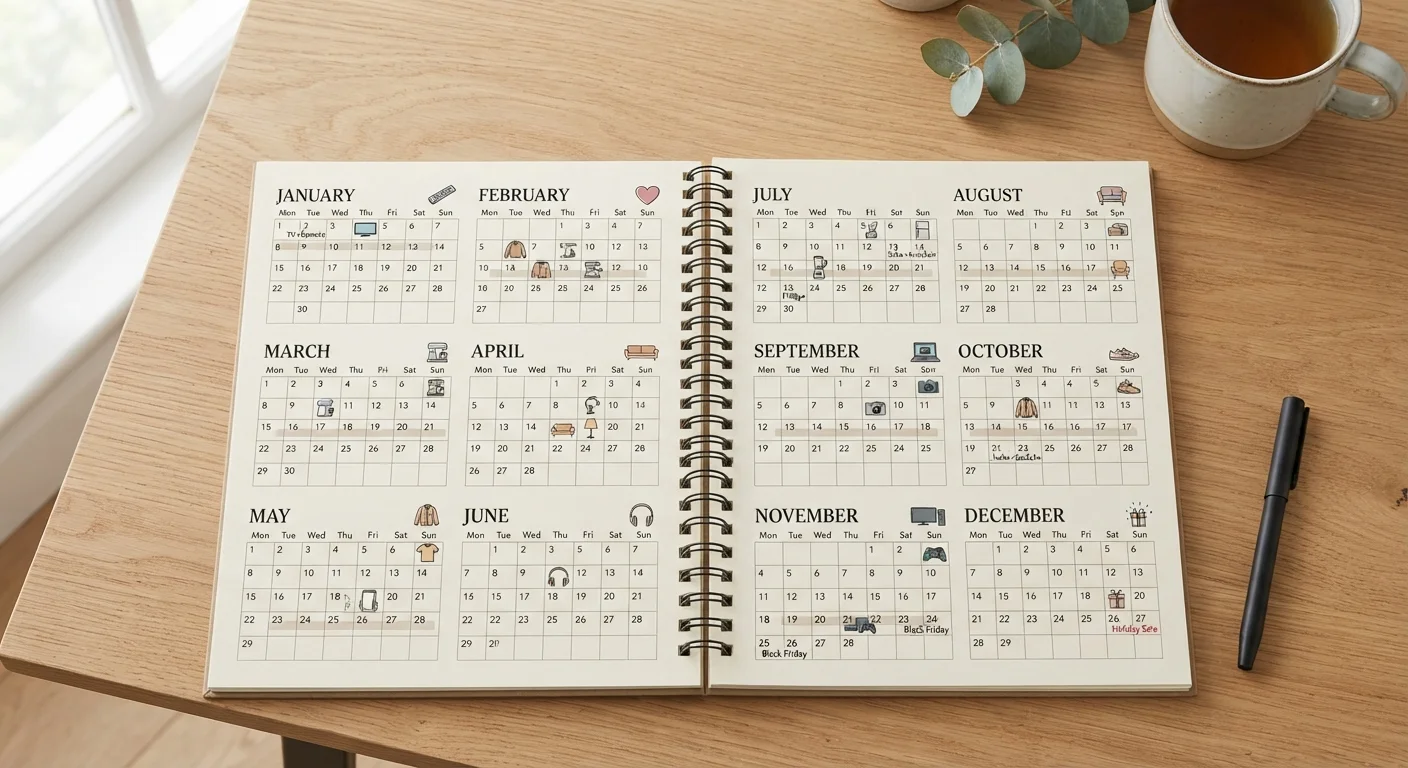
Why Product Prices Follow Seasonal Patterns
Retail pricing is not random. Most categories follow recognizable cycles driven by factors like inventory management, model-year transitions, demand peaks, and planned promotional calendars. Retailers use these cycles to clear old stock, attract traffic during slow periods, and compete for holiday spending. Understanding the mechanics behind these cycles — covered in depth in how retailers set and change prices online — gives shoppers a structural advantage.
The core principle is straightforward: prices tend to fall when supply exceeds demand or when a category is transitioning to newer inventory. Prices tend to rise when demand peaks and supply is constrained. Mapping your planned purchases to those troughs — rather than peaks — is one of the most reliable, low-effort ways to reduce spending across categories.
Category-by-Category Pricing Calendar
Each product category has its own rhythm. The patterns below reflect broad industry tendencies observed across retail; individual retailers and years will vary, so treat these as general guidance rather than guarantees.
Electronics
Consumer electronics typically see their steepest discounts in November around major retail sales events and again in January after the holiday season, as retailers clear excess inventory before new model announcements. Late summer (August–September) often brings modest discounts on prior-year models as new releases are announced. Televisions in particular tend to drop in price ahead of major sporting events.
Clothing and Apparel
Apparel follows a two-season clearance model. January–February and July–August are historically the deepest discount windows, as retailers move out winter and summer stock respectively to make room for incoming seasonal lines. Off-season shopping — buying winter coats in March or swimwear in September — typically yields the steepest savings.
Large Appliances
Major appliances (refrigerators, washers, ranges) tend to drop during September–October as manufacturers release new models and retailers discount prior inventory. Holiday weekends in May and September (such as Memorial Day and Labor Day) are also traditionally associated with appliance promotions. If a new model has just launched, ask about the prior version — it may still be available at a reduced price.
Furniture and Bedding
February and August–September are the periods most commonly associated with furniture sales, as retailers introduce new lines twice yearly. Major holidays in May and September also coincide with promotional activity in this category.
Outdoor and Garden
Lawn equipment, patio furniture, and garden supplies drop sharply in late summer (August–September) as the season winds down. Retailers holding seasonal inventory have strong incentives to clear it rather than warehouse it through winter.
Fitness Equipment
Demand for fitness equipment spikes in January driven by New Year resolutions, which temporarily keeps prices elevated. Prices tend to soften in spring and fall when demand normalizes. Shopping in March–April or October can yield better value than the resolution rush.
Using These Patterns Without Getting Caught Out
Seasonal patterns are useful guides, not guarantees. A few practical considerations help you apply them without risk:
- Verify the actual price history. A claimed discount means little without context. Price tracking tools let you see whether a current price is genuinely lower than the norm or simply labeled as a deal.
- Watch for disguised offers. Bundle deals and threshold discounts can inflate the total spend rather than reduce it. Impulse buying traps often appear during the same promotional windows where genuine discounts occur.
- Plan around need, not pattern alone. If you need a refrigerator in June, waiting until October may not be practical. Knowing the pattern lets you evaluate whether the current price is reasonable — not whether you must wait.
- Sales events are not always the best moment. Major promotional events attract attention but do not uniformly offer the deepest category discounts. Shopping during sales events explores this tradeoff in detail.
This article provides general consumer education. Pricing patterns reflect broad historical tendencies and are not a guarantee of future discounts. Always verify prices independently before purchasing.