

Key Takeaways
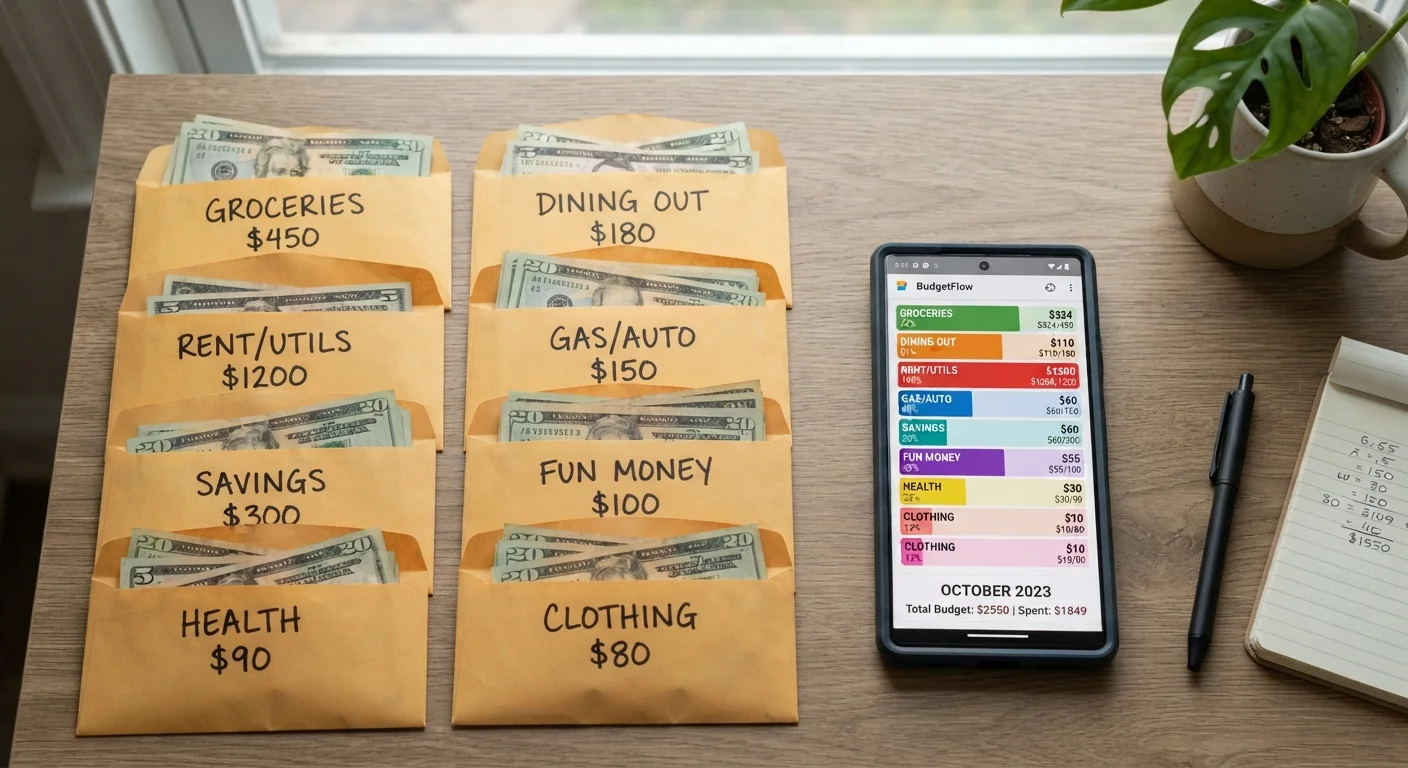
- The envelope system uses physical cash to create an absolute, tangible spending ceiling per category.
- Digital spending limits rely on app or bank tools to track and alert when a category cap is near.
- Cash envelopes eliminate card overspend but don't work well for online or subscription purchases.
- Digital limits are flexible and convenient but depend on your willingness to act on notifications.
- Both methods work best when paired with an honest monthly spending audit to set realistic caps.
- Your payment habits — mostly cash versus mostly card — are the strongest signal for which to choose.
Option A
Envelope System
The tactile, cash-based approach to hard spending limits.
Best for: People who overspend on cards and respond better to seeing physical cash disappear.
Option B
Digital Spending Limits
App or bank-set caps that automate category tracking without cash.
Best for: People who pay primarily by card or online and want real-time alerts without handling cash.
If you consistently overspend on cards and want a hard stop
Envelope System
Physical cash creates a genuine limit — when the envelope is empty, spending stops. There's no override button.
If most of your spending happens online or via card
Digital Spending Limits
Cash envelopes can't cover subscriptions, e-commerce, or tap-to-pay. App-based limits work across all payment types.
If you're new to budgeting and want to build category awareness
Envelope System
Physically sorting cash forces deliberate thinking about each category and makes abstract numbers concrete.
If you travel frequently or dislike carrying cash
Digital Spending Limits
Digital tools travel with you on your phone and cover every payment method without the security risk of cash.
If you want to combine both for maximum control
Envelope System
Use envelopes for high-impulse categories like groceries and dining, then set digital limits for recurring card spending. The hybrid approach covers most overspend scenarios.
How Each Method Actually Works
The envelope system is straightforward: at the start of each budget period, you withdraw cash and divide it into labeled envelopes — one per spending category (groceries, dining out, entertainment, and so on). Once an envelope is empty, that category is done for the period. No transfers, no exceptions. The physical constraint is the entire point.
Digital spending limits work through budgeting apps or bank-level controls. You assign a dollar cap to each category; the tool tracks transactions automatically and alerts you as you approach or exceed the limit. Some banks let you set hard blocks on certain merchant categories; most apps offer softer warnings with push notifications.
Both approaches share the same underlying logic: assign a ceiling to a category before spending happens, rather than reviewing damage afterward. Where they differ is in mechanism — tactile versus automated — and in which payment types they can actually cover. For a broader look at how these fit into a full budgeting framework, see how zero-based and 50/30/20 budgeting compare.
| Criterion | Envelope System | Digital Spending Limits |
|---|---|---|
| Spending mechanism | Physical cash only | Card, bank, or app-linked |
| Hard stop when limit reached | Yes — envelope is empty | Rarely — usually an alert only |
| Works for online purchases | No | Yes |
| Works for subscriptions | No | Yes |
| Setup effort | Weekly cash withdrawal and sorting | One-time app/bank setup |
| Real-time tracking | Manual — count remaining cash | Automatic via transaction sync |
| Security considerations | Cash loss is unrecoverable | Standard app and card security |
| Best for | Impulse overspenders, cash-preferred users | Card-heavy, digital-first spenders |
Where Each Method Struggles
The envelope system has a well-documented gap: it simply doesn't apply to digital payments. Online shopping, streaming subscriptions, and contactless card transactions all bypass the physical envelope entirely. Carrying meaningful amounts of cash also introduces a security risk and can feel impractical in an era where many retailers are moving toward card-only or tap-to-pay.
Digital limits have a different vulnerability — they depend on behavioral follow-through. A notification that you've hit 90% of your dining budget is only useful if you act on it. Apps track and alert; they rarely block. Without that willingness to pause, a soft digital cap is easy to mentally override. For an honest assessment of the envelope method's specific limitations in today's payment environment, the pros and cons of cash envelopes in a digital age covers the trade-offs in detail.
~1 in 3
US adults without a monthly budget
Surveys by the National Foundation for Credit Counseling have consistently found that a significant share of American adults do not maintain a formal monthly budget.
18%
Average overspend vs. budget estimate
Consumer financial research suggests people commonly underestimate discretionary category spending by roughly 15–20% when relying on memory rather than tracked data.
Another friction point with digital tools: setup accuracy. Limits are only as realistic as the numbers you assign. If your caps are too tight, you'll constantly bust them and stop caring. If they're too loose, they provide no real constraint. That's why both methods benefit from a prior review of your actual historical spending — not estimates. A monthly spending audit gives you the baseline numbers you need before setting any cap.
Choosing the Right Fit for Your Habits
The most reliable guide is your current payment behavior. If you predominantly pay with cash or are willing to shift certain categories to cash, the envelope method gives you the firmest possible limit. Research in behavioral economics consistently finds that spending feels more tangible when physical currency changes hands — a property that digital transactions don't replicate as strongly.
If your spending is card-dominated — especially with online purchases, recurring subscriptions, or work-related card use — digital limits are the only practical option. The key is choosing a tool that connects directly to your accounts so tracking is automatic rather than manual. Manual entry is a friction point many people abandon within weeks.
For those who overspend in some categories on impulse (say, takeout or in-store shopping) but handle online bills responsibly, a hybrid approach is worth considering: use cash envelopes for the high-impulse categories and digital limits for everything else. Envelope budgeting in the digital age explores exactly this kind of mixed-use strategy. If neither system seems to be sticking, the issue may be with the budget structure itself — recurring overspend patterns can signal the budget needs rebuilding, not just your willpower.
This article is for general informational and educational purposes only and does not constitute personalised financial advice. Consult a qualified financial professional for guidance tailored to your individual circumstances.