

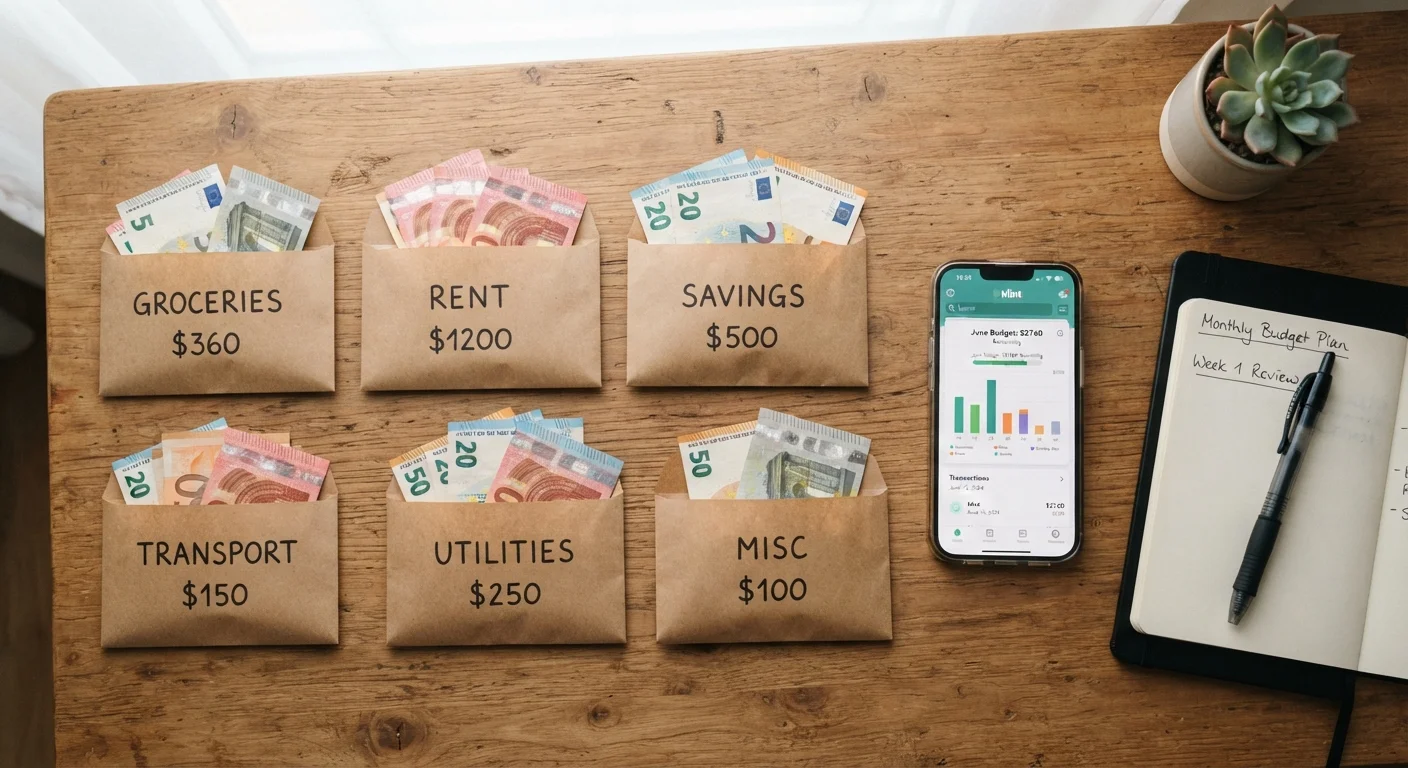
Key Takeaways
- The envelope system divides cash into labeled spending categories to prevent overspending.
- Physical cash creates a tangible spending limit that digital payments cannot replicate as naturally.
- Online purchases, direct deposits, and card-only merchants make a strict cash-only approach harder to sustain.
- Digital envelope apps can preserve the method's logic without requiring physical currency.
- The system works best for people who struggle with impulsive or hard-to-track discretionary spending.
Makes overspending physically impossible within each category
Once an envelope is empty, there is no money left to spend - no overdraft, no mental negotiation. This hard stop is more effective for many people than a soft limit logged in an app.
Heightens awareness of every individual purchase
Counting out bills makes each transaction feel concrete. Studies in consumer behavior suggest cash users tend to spend less per transaction than card users because the loss of physical currency registers more strongly.
Requires no technology or subscription to operate
The system works with envelopes, a pen, and cash - no app, no internet access, no monthly fee. This makes it accessible to anyone regardless of tech comfort level.
Builds a deliberate monthly planning habit
Allocating cash before the month begins forces a conscious conversation about priorities. That regular planning ritual helps reinforce financial awareness over time.
Naturally separates discretionary from fixed spending
The act of assigning envelopes highlights which expenses are flexible and which are committed, making it easier to identify where adjustment is possible.
Incompatible with online and card-only transactions
A growing portion of everyday spending - streaming services, online retail, utility autopay - cannot be paid in cash. A strict envelope system leaves these categories unmanaged unless supplemented by another tracking method.
Carrying and storing cash creates security risk
Physical cash is uninsured. If an envelope is lost, stolen, or damaged, that money is gone. Credit cards and bank accounts offer fraud protection and FDIC coverage that cash does not.
Inconvenient for shared or household budgets
When two people share expenses, coordinating which cash belongs to which category requires extra communication and logistics that digital shared accounts handle automatically.
Making change and exact amounts is cumbersome
Real-world purchases rarely match envelope balances precisely. Frequently transferring small amounts between envelopes can make the system feel tedious and discourages consistency.
Offers no automatic record of past spending
Cash leaves no transaction history. Reviewing spending patterns, spotting trends, or preparing taxes is significantly harder without digital statements or a manual ledger kept in parallel.
ATM access and withdrawal fees add up
Regularly withdrawing cash - especially from out-of-network ATMs - can cost several dollars per visit. Over a year, those fees represent real money that works against the system's savings goal.
Our Verdict
The envelope method's core principle - pre-allocating money to specific categories so you cannot overspend - remains genuinely sound and behaviorally effective. In a world dominated by online payments and direct deposit, a pure cash-only version creates real friction, but that same friction is often the point. A hybrid approach, using the system's categorical logic with digital tools, preserves most of the benefits while accommodating modern payment realities.
Best suited for people with variable or impulse-prone spending in discretionary categories like groceries, dining, and entertainment, especially those who find digital transactions feel abstract or easy to ignore.
What the Envelope System Actually Is
The envelope budgeting method is straightforward: at the start of a pay period, you withdraw your budgeted cash, divide it into labeled envelopes - one per spending category - and spend only what is inside each envelope. When an envelope is empty, spending in that category stops until the next pay period.
The system was popularized as a hands-on tool for people who struggled to stick to spending plans. Its power is behavioral, not mathematical. Handing over physical bills makes the cost of a purchase feel real in a way that swiping a card does not. Researchers who study consumer decision-making have consistently found that cash payments activate the brain's "pain of paying" more acutely than electronic ones - a phenomenon sometimes called the credit card effect.
Understanding the mechanics matters before weighing the trade-offs. For a broader look at how envelope budgeting compares to other structured approaches, see zero-based budgeting vs. the 50/30/20 rule.
The Real Advantages of Envelope Budgeting
The method has endured for good reasons. Below are its most defensible strengths.
Makes overspending physically impossible within each category
Once an envelope is empty, there is no money left to spend - no overdraft, no mental negotiation. This hard stop is more effective for many people than a soft limit logged in an app.
Heightens awareness of every individual purchase
Counting out bills makes each transaction feel concrete. Studies in consumer behavior suggest cash users tend to spend less per transaction than card users because the loss of physical currency registers more strongly.
Requires no technology or subscription to operate
The system works with envelopes, a pen, and cash - no app, no internet access, no monthly fee. This makes it accessible to anyone regardless of tech comfort level.
Builds a deliberate monthly planning habit
Allocating cash before the month begins forces a conscious conversation about priorities. That regular planning ritual helps reinforce financial awareness over time.
Naturally separates discretionary from fixed spending
The act of assigning envelopes highlights which expenses are flexible and which are committed, making it easier to identify where adjustment is possible.
~83%
Share of US payments made electronically
The Federal Reserve's 2022 Payments Study found that checks and cash together represent a small and declining fraction of all US consumer payments, with cards and electronic transfers dominating.
12-18%
Typical discretionary overspend without a system
Consumer financial research broadly finds that households without a defined spending plan regularly exceed their intended discretionary budgets, though exact figures vary by income and category.
Beyond these points, many users report that the physical act of sorting cash each month reinforces a planning habit that gradually becomes automatic. That mindset shift - treating a budget as a tool rather than a restriction - is something worth cultivating. The article treating your budget as a permission slip explores that emotional dimension in more depth.
Where the System Breaks Down
Honesty about limitations is just as important as recognizing strengths. The envelope method carries several practical drawbacks that have grown more pronounced as everyday commerce has shifted.
Incompatible with online and card-only transactions
A growing portion of everyday spending - streaming services, online retail, utility autopay - cannot be paid in cash. A strict envelope system leaves these categories unmanaged unless supplemented by another tracking method.
Carrying and storing cash creates security risk
Physical cash is uninsured. If an envelope is lost, stolen, or damaged, that money is gone. Credit cards and bank accounts offer fraud protection and FDIC coverage that cash does not.
Inconvenient for shared or household budgets
When two people share expenses, coordinating which cash belongs to which category requires extra communication and logistics that digital shared accounts handle automatically.
Making change and exact amounts is cumbersome
Real-world purchases rarely match envelope balances precisely. Frequently transferring small amounts between envelopes can make the system feel tedious and discourages consistency.
Offers no automatic record of past spending
Cash leaves no transaction history. Reviewing spending patterns, spotting trends, or preparing taxes is significantly harder without digital statements or a manual ledger kept in parallel.
ATM access and withdrawal fees add up
Regularly withdrawing cash - especially from out-of-network ATMs - can cost several dollars per visit. Over a year, those fees represent real money that works against the system's savings goal.
Digital Envelope Apps: A Middle Path
Several budgeting apps replicate the envelope method digitally, allowing users to create virtual spending categories and move money between them throughout the month. These tools apply the same categorical logic without requiring physical cash. They also maintain a transaction history, sync across devices, and work seamlessly with card payments - addressing several of the method's key weaknesses while preserving its core structure.
If these friction points feel familiar, it may be worth comparing how cash envelopes stack up against app-based spending limits. The piece on envelope system vs. digital spending limits examines exactly that trade-off.
Making the System Work in a Digital World
The most practical adaptation is a hybrid model. Rather than withdrawing all cash, you apply envelope logic digitally: assign specific dollar amounts to each spending category at the start of the month, track transactions against those amounts in a spreadsheet or budgeting app, and treat the category limit as if the envelope were physically empty when the number hits zero.
For categories where cash is genuinely useful - groceries, dining out, personal spending money - physical envelopes still work well. For fixed bills, online subscriptions, and card-only purchases, a digital ledger carries the same categorical discipline without the impracticality.
Whether you prefer a notebook or an app, the underlying habit is what drives results. Tracking spending by hand vs. using an app lays out the practical differences between those recording approaches so you can choose the format that matches your habits.
The envelope method is general financial education, not personalized advice. For decisions about your specific financial situation, consulting a qualified financial professional is worthwhile.
This article is for informational and educational purposes only and does not constitute personalized financial advice. Please consult a licensed financial professional for guidance tailored to your individual circumstances.