

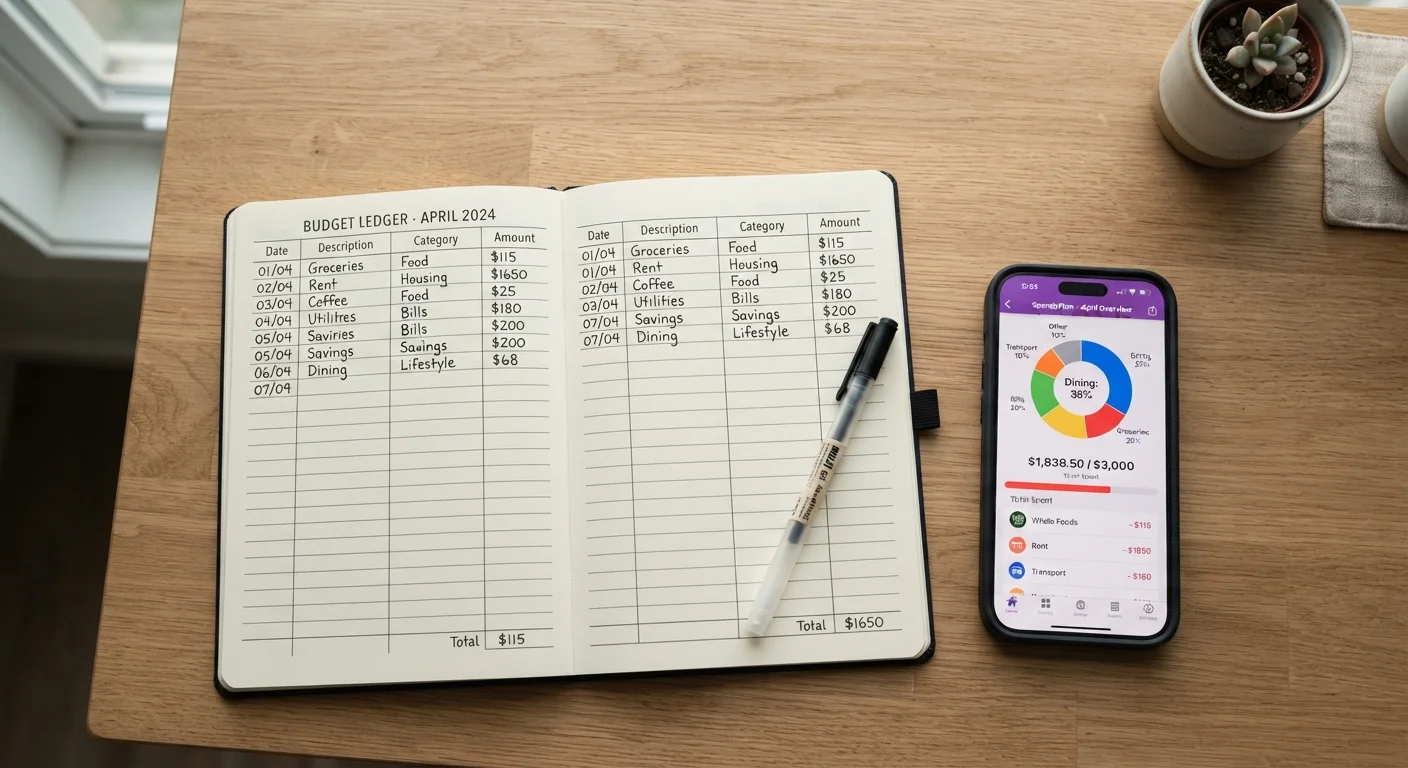
Key Takeaways
- Manual tracking increases spending awareness through the deliberate act of recording each transaction.
- Apps automate data entry but require account access permissions and ongoing category maintenance.
- Neither method guarantees better budgeting - consistency in either approach matters most.
- Privacy and data security concerns are a meaningful consideration when choosing app-based tracking.
- Both methods work better when paired with a regular spending review habit.
Option A
Tracking Spending by Hand
The deliberate, friction-heavy approach that builds awareness through effort.
Best for: People who want deep engagement with their numbers and don't mind a slower, more tactile process.
Option B
Using a Budgeting App
The automated, always-on method that reduces friction but demands trust in technology.
Best for: People with multiple accounts or cards who need fast, automated categorization and real-time visibility.
If you want to build a stronger psychological relationship with your spending
Tracking Spending by Hand
The manual act of writing each transaction reinforces awareness in a way automation cannot replicate. The friction is the feature.
If you have multiple accounts, cards, or income streams to manage
Using a Budgeting App
Apps consolidate data across sources automatically, saving hours of reconciliation that would be tedious to do by hand.
If you're uncomfortable sharing financial account credentials with third-party platforms
Tracking Spending by Hand
Manual tracking requires no account linking, keeping your banking credentials entirely private.
If you struggle to maintain a daily habit without prompts or reminders
Using a Budgeting App
Apps can send push notifications for unusual spending, low balances, or missed budget thresholds - reducing reliance on personal discipline alone.
If you're just starting out and want the simplest possible system
Tracking Spending by Hand
A notebook and pen require no setup, no subscriptions, and no learning curve - making it the fastest way to start tracking today.
The Core Difference: Friction vs. Automation
When you track spending by hand - whether in a notebook, a printed ledger, or a spreadsheet you update yourself - every entry requires a deliberate action. You sit down, recall or check a transaction, and write it down. That friction is often seen as a disadvantage, but behavioral research in personal finance suggests the opposite may be true for some people: the act of recording a purchase manually can make it feel more real and harder to ignore.
Budgeting apps work differently. Once you connect your bank accounts and cards, most apps pull transactions automatically, sort them into categories, and give you a running total. The effort drops sharply, but so does the moment of conscious engagement with each dollar spent.
This distinction - deliberate effort versus seamless automation - is the foundation of every other difference between the two methods. Neither is objectively superior; they suit different temperaments, lifestyles, and financial situations. See our step-by-step spending audit guide for a structured way to apply either method monthly.
| Criterion | Tracking by Hand | Using an App |
|---|---|---|
| Data entry effort | High - manual per transaction | Low - mostly automated |
| Spending awareness | High - each entry is deliberate | Variable - depends on review habits |
| Accuracy | Depends on diligence and memory | High for card transactions; poor for cash |
| Setup time | Minimal - pen and paper or spreadsheet | Moderate - account linking, preferences |
| Privacy risk | Very low - no third-party access | Moderate - requires account credentials |
| Customization | Unlimited - any format or category | Within the app's design constraints |
| Cost | Near zero | Free tiers available; premium plans vary |
| Best habit reinforcement | Strong - friction builds mindfulness | Relies on notification engagement |
What Changes When You Switch Methods
Accuracy and completeness. Manual tracking is only as accurate as your memory and diligence. Forgotten receipts, cash purchases, and irregular charges are common gaps. Apps close many of these holes by pulling directly from transaction data - though they can still miscategorize purchases (a hardware store charge filed under "Entertainment," for instance) and may miss cash transactions entirely.
Time investment. Hand tracking takes consistent daily or weekly time. Apps front-load the effort into setup and periodic category corrections. Over a month, app users typically spend less total time on data entry - but that time saving can come at the cost of engagement.
Privacy and security. Connecting financial accounts to a third-party app involves sharing credentials or read-only access tokens. Reputable apps use bank-level encryption, but the risk profile is meaningfully different from a paper ledger that never touches the internet. This is a legitimate concern, not an irrational one.
Customization. A hand-tracked system can be structured however you like - any category, any time period, any format. Apps offer customization within the limits of their design, which may not match your mental model of how money flows in your household.
~33%
Adults who track spending regularly
Surveys by the National Foundation for Credit Counseling have consistently found that roughly one-third of U.S. adults maintain a detailed budget or spending log.
60%+
App users who miscategorize concerns
Consumer research has indicated that a majority of budgeting app users encounter miscategorized transactions that require manual correction at some point.
What Stays the Same Regardless of Method
The tool doesn't change the underlying work of budgeting. Whether you write numbers in a notebook or review a dashboard on your phone, you still need to make decisions: What categories matter to me? Am I spending more than I planned? What adjustments will I actually follow through on?
Tracking, by itself, does not reduce spending. Awareness is a precondition for change, not a guarantee of it. A person who meticulously logs every latte in a Moleskine but never reviews the totals will see no more improvement than someone whose app cheerfully categorizes the same purchases while they scroll past the notifications.
Regularity matters far more than the method. A monthly spending review anchors both approaches and prevents data from piling up unexamined. For readers curious how spending controls fit into the larger picture of cash versus digital systems, the comparison in envelope budgeting versus digital spending limits is worth reviewing.
This article is for general informational purposes only and does not constitute personalized financial advice. Consult a qualified financial professional for guidance tailored to your individual circumstances.