

Key Takeaways
- Zero-based budgeting assigns every dollar of income a specific purpose before the month begins.
- The 50/30/20 method splits income into three broad buckets: needs, wants, and savings or debt repayment.
- Zero-based budgeting requires more time and discipline but offers tighter control over spending.
- The 50/30/20 rule is easier to maintain but may not suit irregular incomes or tight financial situations.
- Both methods are tools - the right one depends on your income stability, goals, and available time.
Option A
Zero-Based Budgeting
The meticulous, dollar-by-dollar approach to spending control.
Best for: People who want granular visibility into every spending category and are comfortable with monthly planning sessions.
Option B
The 50/30/20 Method
The streamlined, percentage-based framework for everyday budgeters.
Best for: People who want a simple, low-maintenance structure that works without tracking every individual expense.
If you have variable or irregular income each month
Zero-Based Budgeting
Rebuilding your budget from zero each month lets you adjust every category to match what you actually earned, rather than applying fixed percentages to an unpredictable figure.
If you want a low-effort system you can set up once and revisit occasionally
The 50/30/20 Method
The three-category split is easy to apply to a steady paycheck and requires far less ongoing maintenance than line-by-line budgeting.
If you are working to eliminate debt or build an emergency fund aggressively
Zero-Based Budgeting
Assigning every dollar a job makes it harder for money to leak into unplanned spending, helping you direct more toward a specific financial goal.
If you are new to budgeting and want to build the habit gradually
The 50/30/20 Method
Its simplicity lowers the barrier to entry and reduces the chance of abandoning the habit due to complexity or time demands.
If your housing or essential costs already exceed 50% of your take-home pay
Zero-Based Budgeting
Percentage-based rules can break down when fixed costs are proportionally high; zero-based planning lets you set realistic, custom limits for each category.
How Each Method Actually Works
Understanding the mechanics of each approach is the foundation for choosing between them.
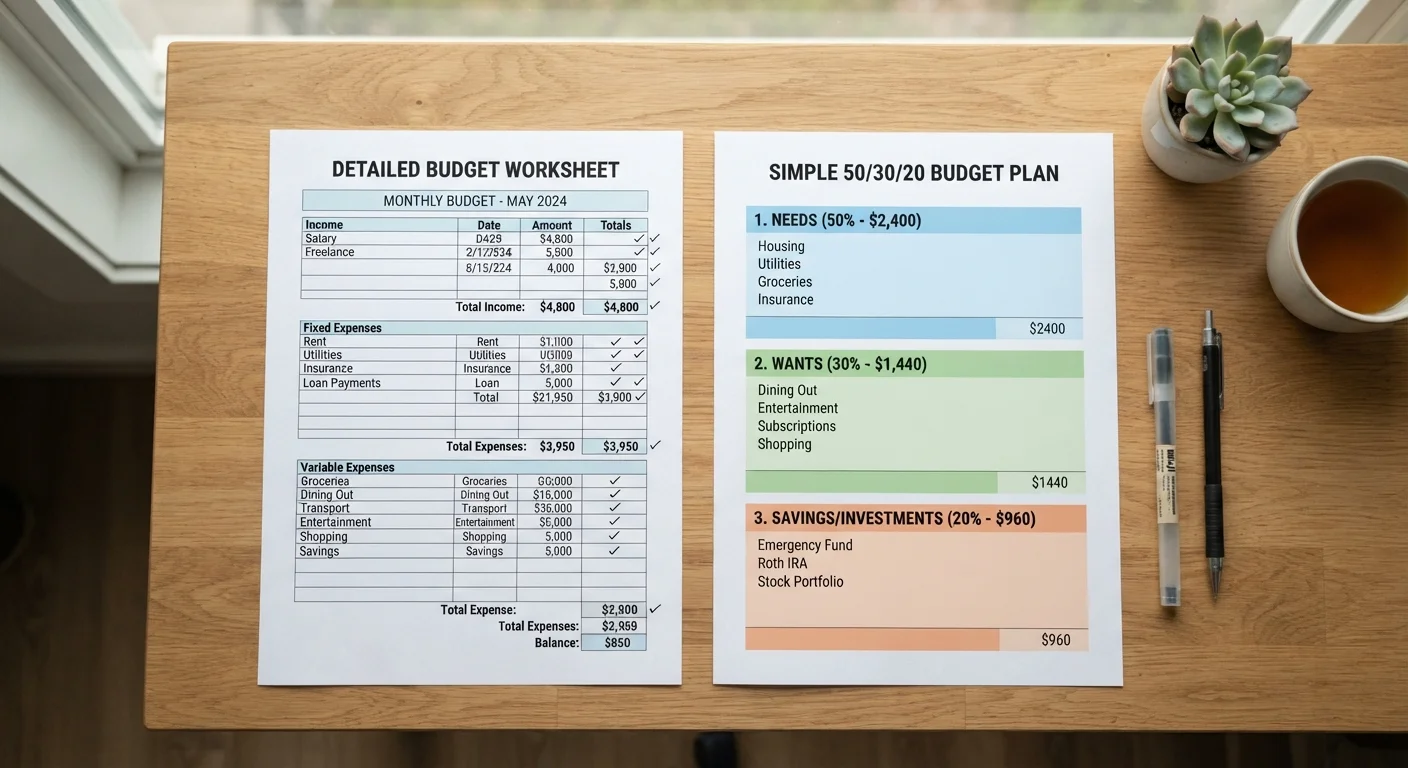
Zero-based budgeting (ZBB) starts with your total monthly income and requires you to allocate every dollar until the difference between income and planned expenses equals zero. That does not mean spending everything - savings, investments, and debt payments all count as assigned categories. The goal is intentionality: every dollar has a named job before you spend it. For a deeper walkthrough of this method, see how zero-based budgeting works in practice.
The 50/30/20 method divides your after-tax income into three percentage-based categories: 50% for needs (housing, groceries, utilities, minimum debt payments), 30% for wants (dining out, subscriptions, entertainment), and 20% for savings and additional debt repayment. Once you know your monthly take-home pay, the math is straightforward. For a full breakdown of the framework, the 50/30/20 rule explained for everyday budgeters covers each category in detail.
| Criterion | Zero-Based Budgeting | 50/30/20 Method |
|---|---|---|
| Setup time | 30-60 min per month | One-time calculation |
| Ongoing effort | High - regular tracking required | Low - periodic check-ins |
| Spending precision | Very high - every dollar assigned | Moderate - broad buckets only |
| Best income type | Variable or irregular | Stable, predictable |
| Debt payoff focus | Strong - custom allocations | Built into 20% category |
| Flexibility mid-month | Requires manual reallocation | Easier to absorb changes |
| Beginner-friendliness | Moderate learning curve | High - simple to start |
| Risk of category drift | Low - named categories limit drift | Higher within broad buckets |
The Real Trade-Offs: Time, Flexibility, and Precision
Each method makes a different trade-off between effort and control - and neither is universally superior.
Zero-based budgeting demands more time upfront. You will typically spend 30-60 minutes at the start of each month building your plan from scratch, then check in regularly to track actual spending against your allocations. This level of engagement can be a strength - it forces awareness of where money goes - but it can also feel burdensome for people with packed schedules or fluctuating motivation.
The 50/30/20 method trades precision for ease. Once you calculate your income split, the system mostly runs itself. You are not tracking every grocery run or utility bill against a named sub-category. The risk: money can drift within buckets without you noticing. If your "wants" spending quietly creeps up, the method provides no automatic alarm.
These Methods Can Work Together
Zero-based budgeting and the 50/30/20 rule are not competing absolutes. Some budgeters use the 50/30/20 split to set top-level targets, then apply zero-based allocation within each category for finer control. Experimenting with a hybrid approach for one or two months can reveal which level of detail actually helps you stay on track.
Neither method prevents overspending on its own. Both work best when paired with a regular review habit. A monthly budget audit checklist can help you catch category drift with either approach before it compounds.
Worth noting: these two methods are not mutually exclusive. Some people use the 50/30/20 framework as a starting structure, then apply zero-based logic within one or two categories - such as the "wants" bucket - where they need tighter control.
Who Each Method Fits Best
Choosing a budgeting method is less about which one is objectively better and more about which one you will actually sustain.
Zero-based budgeting tends to suit:
- People with variable or freelance income who need to replanning monthly
- Anyone in an active debt-payoff phase who wants maximum control over cash flow
- Detail-oriented individuals who find granular tracking motivating rather than draining
- Households where two or more people need a shared, explicit spending plan
The 50/30/20 method tends to suit:
- Salaried employees with predictable, consistent monthly take-home pay
- Budgeting beginners who need a low-friction entry point
- People whose essential expenses fall comfortably below 50% of income
- Anyone who wants a framework that does not require daily or weekly check-ins
If you are curious how the 50/30/20 rule stacks up against other percentage-based frameworks, comparing the 50/30/20 rule with the 60% Solution offers another angle on income-split budgeting. You might also find it useful to explore the smart budgeting hub for additional frameworks and tools.
This article is for general informational and educational purposes only and does not constitute personalized financial advice. Consider consulting a qualified financial professional for guidance tailored to your individual circumstances.