

Key Takeaways
- Cats learn through positive reinforcement - rewarding the behavior you want is more effective than punishing what you don't.
- Short, frequent training sessions of two to five minutes work better than long, infrequent ones.
- High-value food treats are the most reliable reward for most cats, but play and praise can also work.
- Cats can learn practical household cues like 'sit,' 'come,' and carrier entry alongside optional tricks.
- A cat's apparent stubbornness usually signals that the reward isn't motivating enough or the session is too long.
- Consistency across all household members is essential - conflicting cues stall progress quickly.
Cat Training
Cat training is the process of teaching a domestic cat to reliably perform certain behaviors - or to stop performing others - using consistent cues and rewards. It relies on the same learning science used with dogs and other animals, adapted to a cat's independent nature and sensory preferences. Training strengthens communication between cat and owner and can meaningfully improve a cat's wellbeing.
Cat training draws primarily on operant conditioning, particularly positive reinforcement, where a desired behavior is followed immediately by something the cat finds rewarding, increasing the likelihood of that behavior recurring.
Why the 'Cats Can't Be Trained' Myth Persists
The idea that cats are untrainable is surprisingly durable, but it has more to do with method than species. Dogs have been selectively bred for millennia to respond to human direction; cats have not. That difference in domestication history means cats are less intrinsically motivated by social approval - but they are highly motivated by food, play, and their own comfort. Training works when it speaks to those motivations directly.
Research in animal behavior confirms that cats are capable of learning through the same operant conditioning principles used with dogs, marine mammals, and birds. The gap in perceived trainability usually comes down to owners applying dog-centric methods - repeating commands louder, using physical guidance, or expecting longer sessions - that simply don't translate. Understanding how cats actually learn is the first step to making real progress. See our plain-language guide to training vocabulary for a grounding in the core concepts.
The Mechanics of Cat Training: What Actually Works
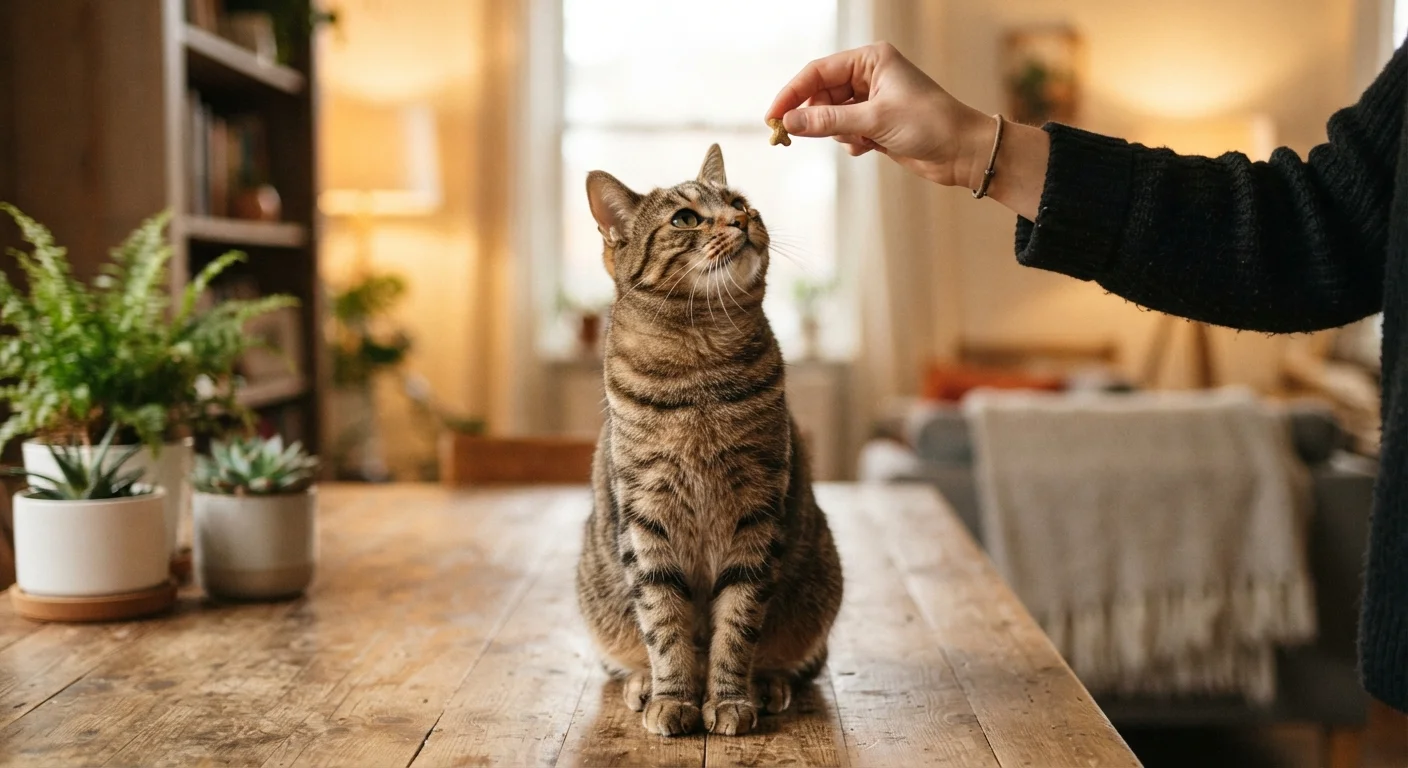
Positive reinforcement is the cornerstone of effective cat training. The process is straightforward: when your cat performs a target behavior, you immediately deliver a reward the cat values. That immediacy - within one to two seconds - is critical because cats connect cause and effect over very short windows.
Set Up for Success Before You Start
Train in a quiet room with no competing distractions - other pets, loud TVs, or foot traffic all compete for your cat's attention. Have your marker and treats within easy reach so you're not fumbling mid-session. Removing friction from setup means you're more likely to actually do the session consistently.
Shaping is a technique worth understanding early. Rather than waiting for a complete behavior to appear, you reward small steps toward it. Teaching a cat to sit, for example, might begin by rewarding any slight lowering of the hindquarters, then progressively requiring a fuller sit before the reward lands. This incremental approach keeps frustration low and progress steady.
A marker signal - either a clicker or a consistent spoken word like "yes" - bridges the gap between the behavior and the treat. The marker tells the cat precisely which action earned the reward, which dramatically speeds up learning. Before starting any training, confirm your environment and tools are ready with the pre-session readiness checklist.
2-5 min
Ideal length per cat training session
Animal behaviorists generally recommend keeping feline training sessions brief to maintain engagement and prevent frustration.
~1-2 sec
Window to deliver a reward after behavior
Research in operant conditioning shows that delaying reinforcement beyond a couple of seconds weakens the association between behavior and reward in cats.
3x
Sessions per day recommended for new skills
Multiple short daily sessions outperform single longer sessions in building durable behavioral habits in companion animals.
What Cats Can Realistically Learn
Cat training falls into two practical categories: functional behaviors and enrichment behaviors. Functional behaviors are those that improve daily life - responding to their name, sitting calmly for veterinary handling, entering a carrier willingly, or coming when called. These have direct welfare benefits and are worth prioritizing, especially since they reduce stress during vet visits and travel.
Enrichment behaviors - often called "tricks" - include things like high-five, spin, or jumping between surfaces on cue. These aren't frivolous. Training sessions provide mental stimulation, and for indoor cats in particular, that cognitive engagement supports overall wellbeing.
Problem behavior redirection is also a legitimate training goal. If a cat scratches furniture, training rewards the cat for using a scratching post instead. If a cat is reactive around handling, systematic desensitization - gradual, reward-paired exposure to the trigger - can reduce that reactivity over time. Punishment is not recommended in any of these scenarios; it introduces fear without teaching the cat what to do differently.
Building Consistent Practice Into Daily Life
Two to five minutes per session, two to three times daily, is a practical and effective rhythm for most cats. Training just before a regular mealtime takes advantage of natural hunger without requiring the cat to be underfed. End every session while the cat is still engaged - finishing on a success keeps motivation high for the next session.
Consistency across everyone in the household is non-negotiable. If one person allows the cat on the counter and another does not, the cat isn't confused - it's simply learning that the rule is person-dependent. Aligning on cues, boundaries, and reward timing makes training progress far faster. The multi-person training guide offers practical strategies for coordinating household efforts.
“The cat's reputation for being untrainable says more about our methods than about the cat. When you work with the animal's motivations rather than against them, the results can be remarkable.”
— Dr. Sophia Yin, Veterinarian and applied animal behaviorist, author of works on low-stress animal handling
Patience is the skill that separates owners who see results from those who give up. Cats learn on their own timeline, and setbacks - a session where the cat walks away, or a week where progress seems to stall - are normal. Returning to an easier step, adjusting the reward, or simply shortening the session often resolves the stall without drama.
This article is for general educational purposes. For behavioral concerns that may have a medical component, consult a veterinarian or a certified animal behavior professional.