

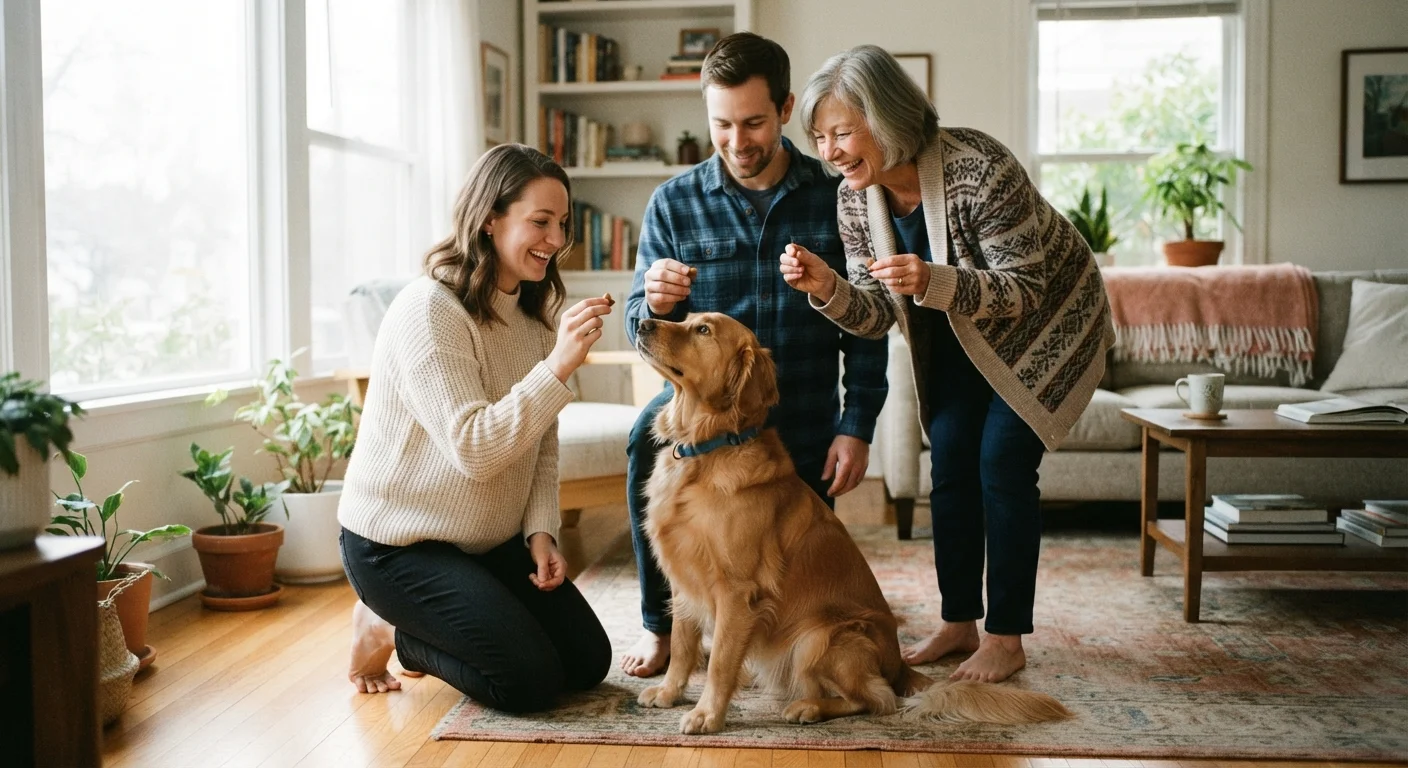
Key Takeaways
- Inconsistent cues from different people are one of the most common reasons training stalls or regresses.
- A simple household training guide - even a handwritten list - dramatically improves everyone's consistency.
- Each person who interacts with the pet needs to practice the same cues, rules, and reinforcement timing.
- Short, regular household check-ins help catch drift before it becomes a training setback.
- Children and occasional visitors also need clear, age-appropriate guidance to avoid undermining progress.
What you will need
Why Multiple Handlers Create Training Challenges
Pets do not generalize human language the way people assume they do. When your dog hears "sit" from one person and "sit down" or "sit, sit, SIT" from another - each delivered with different body language and followed by rewards at different speeds - the animal is not being trained on one behavior. It is being exposed to several slightly different experiences, none of which fully reinforce the other.
This is why multi-person households often report that their pet "only listens to one person." That person is almost always the most consistent one - not the most authoritative, not the loudest, and not the one who has spent the most time with the animal. Consistency is the active ingredient. The three pillars of effective training - consistency, timing, and rate of reinforcement - apply to every person in the household equally.
Inconsistency Is Confusing, Not Stubborn
When a pet receives different signals from different people, it is not being defiant - it is genuinely uncertain what the correct response is. Animals learn through reliable patterns of cue, behavior, and consequence. Breaking that pattern, even occasionally, slows learning and can undo weeks of progress. Every household member needs to treat the training plan as a shared commitment, not a personal preference.
The good news is that coordination is a solvable problem. It does not require everyone to become a skilled trainer. It requires agreement on a small number of clearly defined behaviors, cues, and rules - and a shared commitment to follow them in daily life, not just during formal training sessions.
What You Need Before You Start
Getting your household aligned is easier when you arrive at the conversation with some structure already in place. If you have not yet completed the groundwork for your training plan, the pre-training readiness checklist is a practical starting point that covers environment, mindset, and tools.
What you will need
Once you have confirmed these foundations, gather the practical tools your household will use consistently.
Household Cue Reference Sheet
A written list of every verbal cue, hand signal, and household rule your pet is being trained on - shared with all family members.
Training Treats or Reward Tokens
Consistent, agreed-upon rewards that every household member uses during practice sessions.
Clicker or Verbal Marker
A consistent marker signal so every person marks the correct behavior at the same moment.
Training Log or Shared Notes App
A simple record of each session - who practiced, what was worked on, and how the pet responded - so the household stays informed.
Step-by-Step: Aligning Your Household
Hold a household kickoff conversation
Before anyone begins working with your pet, bring every household member together for a brief, low-pressure conversation. The goal is not a lecture - it is alignment. Cover three things: what behaviors you are teaching, what cues you have chosen for each behavior, and what the rules are (for example, whether the pet is allowed on furniture, and under what conditions).
If you have not yet settled on your training plan, review the pre-training readiness checklist first. Coming to the household meeting with a clear starting point makes it far easier for everyone to agree.
Create a shared household cue sheet
Write down every cue your pet is learning in a single, simple document. For each behavior, record: the exact verbal cue (word and tone matter - "sit" and "sit down" are different signals to a pet), any accompanying hand signal, and what the reward looks like. Keep the language plain so any adult in the house can follow it without prior training knowledge.
Understanding why precision here matters is covered in depth in our article on consistency, timing, and rate of reinforcement - the core principles that determine whether learning actually sticks.
Post the cue sheet where everyone will see it
A cue sheet tucked in a drawer helps no one. Place it somewhere that everyone passes multiple times a day. This also makes it easy to orient guests, dog walkers, or anyone else who spends time with your pet. If your household uses a shared digital space, a note in a group chat or shared app works just as well.
Have each person practice the cues independently
Reading the cue sheet is not the same as using it fluently. Ask each adult household member to run at least one brief practice session - five minutes is sufficient - while others observe quietly. This surfaces differences in timing, tone, or physical signal before they become ingrained habits. Pay particular attention to how quickly each person delivers the reward after the pet responds correctly; reinforcement timing is one of the most common points of individual variation.
If you are using a marker such as a clicker, ensure everyone is marking the moment of correct behavior - not a second or two later. Our comparison of clicker versus verbal markers can help the household agree on which tool to standardize around.
Establish clear rules about exceptions and off-limit actions
Training breaks down most often not during formal sessions but during everyday interactions - greeting at the door, feeding, play, and cuddle time. Decide together which rules apply at all times (for example, the pet must sit before receiving its food bowl) and which are flexible. Write exceptions down too, so there is no ambiguity. If one person is allowed to let the dog on the sofa and another is not, the pet cannot learn a clear rule.
If your pet has already shown signs of confusion or regression because of inconsistent household handling, the article on common training setbacks explains what is happening and how to reset.
Brief children and regular visitors
Children can participate meaningfully in pet training, but their guidance needs to be age-appropriate and supervised. Young children should be shown the correct cue, helped to deliver it clearly, and praised for following the household rules - not left to improvise. Regular visitors such as grandparents or frequent house guests should receive a two-minute orientation: here is what we are teaching, here is what to say, here is what not to do (for example, do not feed the pet scraps at the table if the household rule is no table feeding).
Hold brief weekly check-ins to catch drift
Even well-intentioned family members drift over time - a cue word shifts slightly, a rule gets bent on a busy evening. A five-minute weekly check-in, even informal, keeps everyone calibrated. Review the training log if you are keeping one, note any behaviors that seem to be slipping, and agree on any adjustments. Catching small inconsistencies early prevents them from becoming the frustrating setbacks that feel like starting over.
If the household is struggling to align on approach and the pet's behavior is genuinely not improving, it may be worth considering professional support. Our guide to when professional trainers help outlines what situations genuinely benefit from that input.
Make Your Cue Sheet Visible
Post your household cue list somewhere everyone passes daily - the refrigerator door or a kitchen corkboard works well. Visual reminders reduce accidental drift and make it easy to quickly brief guests or babysitters before they interact with your pet.
Staying Consistent Over Time
The hardest part of household training is not the first week - it is week four, when routines feel familiar, and shortcuts start to creep in. Someone lets a behavior slide because they are tired. A cue gets shortened. A rule gets bent "just this once." These small lapses are normal and human, but they accumulate faster than most pet owners expect.
Building accountability into your household does not mean policing each other - it means creating a structure where the pet's training is a shared household value, not one person's project. If you find your pet is responding to some household members reliably and others inconsistently, that is useful diagnostic information, not a failure. The article on what causes training setbacks explains how to trace and address exactly that kind of pattern.
Avoid Correcting Other People Mid-Session
Criticizing a family member's technique in front of the pet can introduce tension and stress into the training environment, which animals pick up on quickly. Instead, hold brief, private check-ins after a session to address any inconsistencies calmly and constructively.
For households training cats rather than dogs, the principles of consistency and shared rules apply equally - though the techniques differ. Our article on what cat training actually looks like offers species-specific guidance.