

Key Takeaways
- Most people consistently underestimate how much they eat, often by 20-50% according to dietary research.
- Serving sizes on nutrition labels are reference points, not personal eating recommendations.
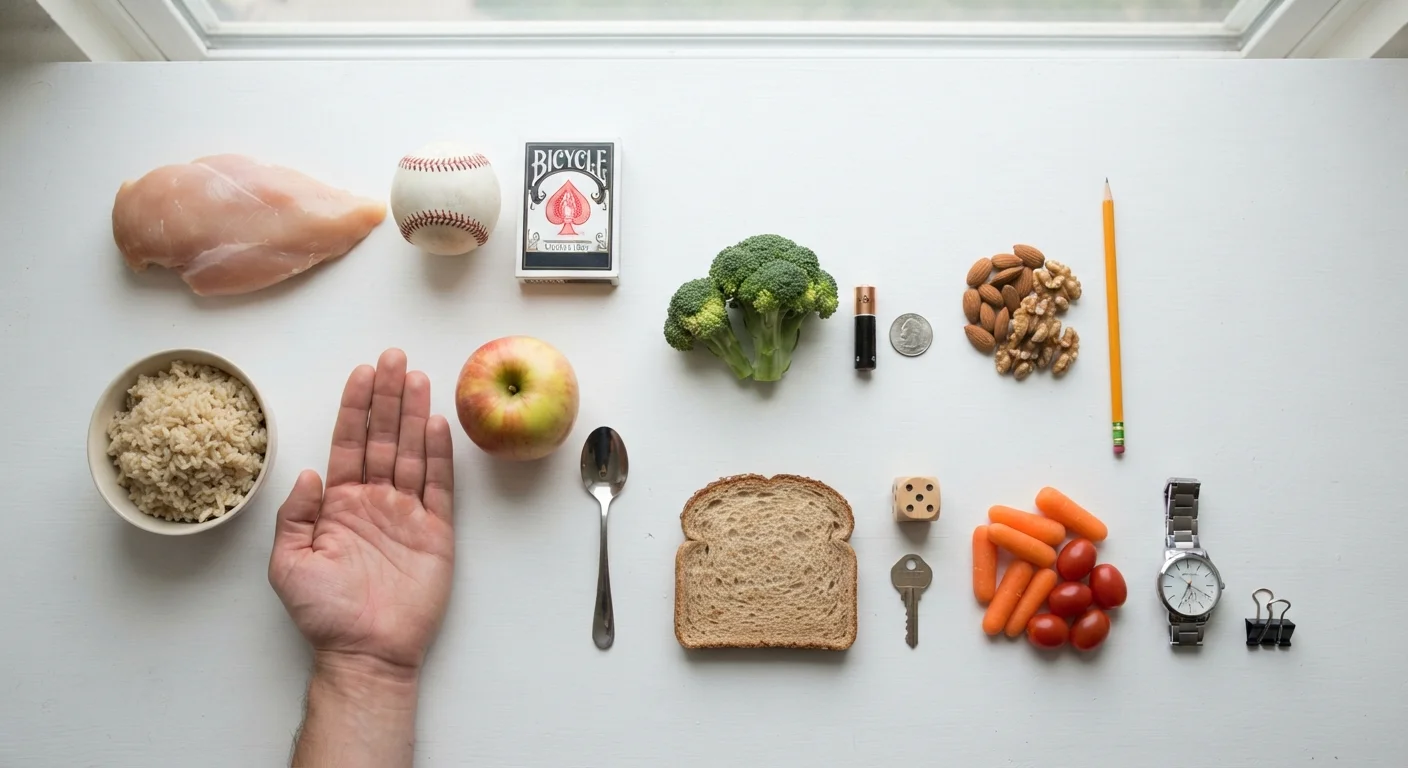
- Visual anchors - familiar objects like a deck of cards or a tennis ball - help calibrate portions without measuring tools.
- Plate size, packaging, and social context all influence how much food feels like 'enough.'
- Portion awareness is a learnable skill that supports nutritional balance without rigid calorie counting.
Portion Size vs. Serving Size
A serving size is a standardized unit printed on a food label, used as a reference point for nutritional information. A portion size is the amount a person actually chooses to eat in one sitting. The two often differ significantly, and that gap is where most unintentional overeating occurs.
The FDA sets standardized serving sizes based on reference amounts customarily consumed (RACCs), which are derived from dietary survey data - not recommendations for how much to eat.
Why Our Eyes Routinely Mislead Us
Humans are notoriously poor at estimating volume by sight. Decades of research in food psychology have documented a consistent pattern: when people are asked to recall or estimate what they've eaten, they tend to underreport - not because they are being dishonest, but because perception genuinely misleads them. Studies using doubly labeled water (a method that objectively measures calorie burn and thus intake) have found that self-reported food intake can fall 20-50% below actual consumption.
Several perceptual mechanisms drive this gap. The Delboeuf illusion causes a fixed portion to look smaller on a large plate. Tall, narrow glasses make beverages appear more voluminous than short, wide ones holding the same amount. And when food is presented in multi-serving packages, people tend to treat the entire package as a single serving, regardless of label information.
20-50%
Typical underreporting of food intake
Studies using objective measures such as doubly labeled water have consistently found that people underestimate their actual food consumption by this margin.
2x
Growth in average US restaurant portion size since 1970s
Public health researchers, including those at the National Institutes of Health, have documented substantial increases in commercial portion sizes over recent decades.
15-20 min
Delay for satiety signals to reach the brain
This physiological lag means fast eaters routinely consume more food than needed before the body registers fullness, a mechanism well established in hunger physiology research.
Understanding these biases is the first step toward recalibrating - not to obsess over numbers, but to make more intentional choices.
Serving Size Labels: What They Actually Tell You
Nutrition labels can create their own form of confusion. The serving size printed on a label is a regulatory reference unit - it reflects the amount people typically eat based on dietary surveys, not a recommendation for how much you should eat. This distinction matters practically. A bag of chips labeled "serving size: 1 oz (about 15 chips)" might contain 2.5 servings. If you eat the whole bag while watching a movie, you've consumed two and a half times the listed calories, sodium, and fat.
Reading a nutrition label without getting lost in the numbers can help you use this information more effectively. The key habit is checking the "servings per container" line before interpreting any other nutrient data on the panel.
Check Servings Per Container First
Before reading any other number on a nutrition label, look at 'servings per container.' This single piece of information tells you how to scale every other value on the panel. A food with 3 servings per container and 200 calories per serving contains 600 calories total - a detail that's easy to miss when the per-serving number dominates the label layout.
Practical Visual Anchors That Work Without Measuring Tools
Measuring every meal isn't realistic or necessary for most people. What is useful is developing a mental reference library of visual anchors - comparisons between food portions and familiar objects. Nutrition educators have long used these to make portion calibration accessible in everyday settings:
- One cup (e.g., cooked pasta, cereal, chopped fruit): roughly the size of a closed fist
- Three ounces of protein (e.g., chicken, fish, lean beef): approximately the size and thickness of a palm, without fingers
- One ounce of cheese: about the size of a pair of dice
- One tablespoon of nut butter or oil: roughly the size of a poker chip
- One teaspoon (e.g., butter, jam): about the size of a fingertip
These are approximations, not clinical measurements. But research suggests that even rough calibration reduces unconscious overeating more effectively than relying on hunger signals alone, particularly in environments with large portion norms.
Environmental Factors That Quietly Inflate Portions
Beyond individual perception, the eating environment shapes how much people consume. Larger portions have become normalized in restaurants, packaged foods, and home kitchens over recent decades - a shift that researchers associate with steady increases in average caloric intake across populations. When larger portions are presented as standard, people recalibrate their internal sense of "normal" upward.
Social eating also plays a role: people tend to mirror the portion sizes of those around them. Distracted eating - at a desk, in front of a screen - reduces awareness of satiety cues and often leads to consuming more before the brain registers fullness. The stomach's satiety signals take roughly 15-20 minutes to reach the brain, meaning fast eating reliably outpaces feedback.
Interestingly, the same principles apply across species. If you've noticed your pet eating quickly and seeming hungry again shortly after, overfeeding pets is easier than most owners realize for very similar environmental reasons.
Building Sustainable Portion Awareness
Portion awareness is not about restriction or rigid tracking - it's about developing a more accurate picture of what you're actually eating. A few practical approaches can support this without turning mealtimes into math exercises:
- Use smaller plates and bowls at home to leverage the plate-size effect in your favor.
- Pre-portion snacks from large bags into smaller containers rather than eating directly from the package.
- Eat slowly and pause mid-meal, allowing satiety signals to catch up.
- Check labels before eating, not after - note the servings per container when you open a product, not when you're deciding whether to have more.
These habits also have an indirect benefit: more accurate portioning tends to reduce food waste and can stretch a grocery budget further. Cutting grocery costs without cutting nutrition becomes more achievable when you're not inadvertently consuming more than you intended.
This article is for general informational and educational purposes only and does not constitute medical or dietary advice. Consult a registered dietitian or qualified healthcare professional for guidance tailored to your individual health needs.