

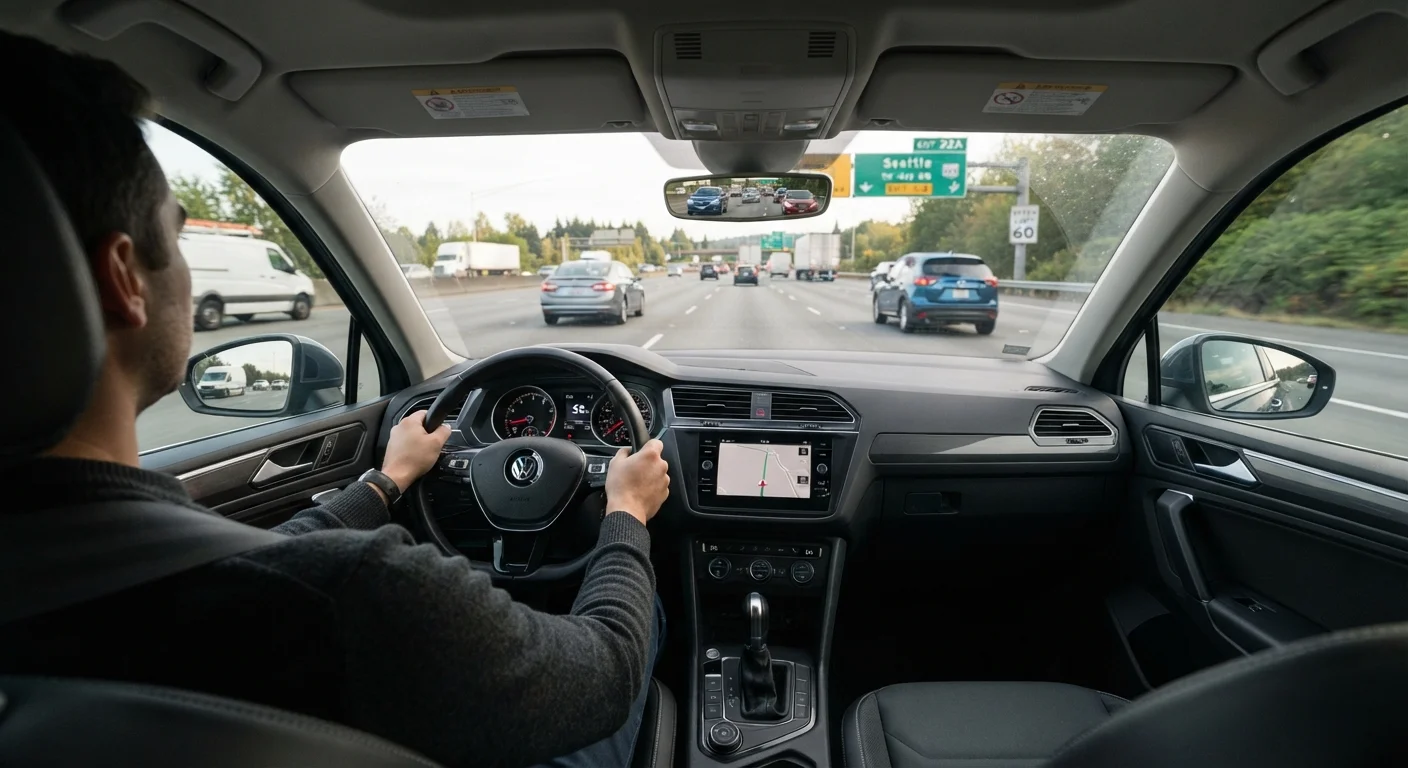
Key Takeaways
- Properly adjusted mirrors significantly reduce blind spots but cannot eliminate them entirely.
- A physical head check remains essential before any lane change, regardless of mirror quality.
- Large vehicles, cyclists, and motorcyclists are especially vulnerable to being hidden in blind spots.
- Blind spot monitoring systems are aids, not replacements for active driver awareness.
- Where you position your mirrors matters - most drivers set them incorrectly from the start.
Why Blind Spot Myths Are a Real Safety Problem
Most drivers consider themselves well-informed about their vehicle's blind spots. In practice, overconfidence about mirror coverage and head checks contributes to thousands of lane-change collisions every year in the U.S. The problem isn't just a lack of awareness - it's misinformation that gets reinforced through habit, outdated driver education, and assumptions about modern technology.
Understanding what blind spots actually are - and what they are not - is foundational to safer driving. A blind spot is any area around your vehicle that is not visible through your mirrors and cannot be seen from the normal driving position without turning your head. Every vehicle has them, though their size and location vary significantly by vehicle type.
See our guide to foundational driving habits for a broader look at the routines that protect new and experienced drivers alike.
Myth
If my mirrors are adjusted, I can see everything around my car - blind spots are basically covered.
Fact
Even correctly adjusted mirrors leave rear-quarter zones uncovered. No mirror configuration eliminates blind spots entirely.
Mirrors reflect a specific angle of view, and that angle has geometric limits. The rear-quarter zones - roughly the area beside and slightly behind your rear doors - fall outside what any standard mirror can show. Adjusting your mirrors to the widest useful angle reduces these zones considerably, but it does not close them. A physical head check over the appropriate shoulder remains the only way to directly observe what occupies that space before a lane change.
Myth
Blind spot monitoring systems mean I no longer need to do a head check before changing lanes.
Fact
Blind spot monitoring (BSM) systems have documented limitations and are designed to supplement - not replace - the driver's own scanning habits.
BSM systems use radar or camera sensors mounted in the rear of the vehicle. They can fail to detect fast-moving objects, cyclists riding close to the road edge, or objects that enter the detection zone at an awkward angle. Sensor performance can also be reduced by heavy rain, snow, mud obscuring the sensor housing, or unusual vehicle geometries. The National Highway Traffic Safety Administration (NHTSA) describes these systems as driver assistance features, not autonomous safety systems. Treating them as a substitute for head checks creates a false sense of security.
Myth
Blind spots are only an issue when changing lanes on a highway.
Fact
Blind spots create risk in parking lots, intersections, tight turns, and low-speed urban driving - not just highway lane changes.
At low speeds, pedestrians, cyclists, and children on bicycles are particularly vulnerable to blind spots along the front corners and sides of the vehicle. Wide-body SUVs and trucks have pronounced hood blind zones that can obscure a child standing immediately in front of the vehicle. In parking situations, the rear corners present risks that rear cameras help address but do not fully resolve, especially at the very edges of the camera's field of view. Blind spot awareness should be active at all speeds and in all environments.
Myth
Larger vehicles have better visibility because the driver sits higher up.
Fact
A higher seating position increases forward sightlines but often increases blind spots to the front, sides, and rear simultaneously.
While height provides a wider forward view over traffic, it also extends the area directly in front of and beside the vehicle that the driver cannot see. Full-size trucks, in particular, have some of the largest front and side blind zones of any passenger vehicle. The Insurance Institute for Highway Safety (IIHS) has documented that front-over and side-over incidents disproportionately involve larger vehicles. Drivers who upgrade to a truck or large SUV often underestimate how much their blind zone geometry has changed compared to a sedan.
Myth
Motorcycles and cyclists are easy to spot because they're constantly moving.
Fact
Motorcycles and cyclists are among the most frequently missed objects in blind spots, partly because of their narrow profile and speed variability.
A motorcycle's narrow silhouette can sit entirely within a mirror's blind zone gap, especially when approaching at highway speed. Cyclists may travel at speeds that don't match a driver's expectation of how quickly an object moves through the zone. Both groups are also more likely to be riding in positions that place them at the edge of visibility - just inside or just outside mirror coverage. NHTSA data consistently shows that motorcyclists are overrepresented in multi-vehicle crashes where the other driver failed to detect them.
Managing Blind Spots on the Road
Knowing the myths is only part of the solution. Translating that knowledge into consistent habits during real driving conditions is what actually reduces risk.
Mirror setup: Adjust your side mirrors so that your own vehicle's body is barely visible - or just out of frame - at the inner edge. This pushes your mirror coverage outward, capturing more of the adjacent lane. The goal is to minimize the gap between what your rear-view mirror shows and what each side mirror picks up.
The head check: Before changing lanes, glance over your shoulder toward the rear quarter of your vehicle - the area your mirrors are least likely to cover. This takes less than a second and can reveal motorcycles, cyclists, or vehicles that slipped into the gap.
Scanning frequency: Experienced drivers scan their mirrors every five to eight seconds during highway driving. This practice, combined with the anticipatory mindset used by professional drivers, helps keep a mental map of surrounding traffic current.
Minimizing time in others' blind spots: Pass quickly and decisively rather than cruising alongside a truck or SUV. If you can't see the driver's face in their side mirror, assume they cannot see you.
Don't Linger in a Truck's Blind Zones
Large commercial trucks have substantial blind zones on all four sides - to the front, rear, and along both sides of the trailer. A common rule of thumb: if you cannot see the truck driver's face in their mirror, they almost certainly cannot see you. Pass promptly and do not follow closely behind. Spending extended time in these zones significantly increases your collision exposure.
Lane changes and merges are where blind spot errors most commonly result in collisions. Our article on roundabouts, merges, and lane changes explains correct positioning and signalling in detail.