

Key Takeaways
- Group classes build socialization skills and cost less, but offer limited individual feedback.
- Private sessions are highly customized but come at a higher per-session cost.
- Self-guided training is the most flexible option and works well for motivated, consistent owners.
- The most effective format depends on your pet's temperament, history, and your own learning style.
- Many owners combine formats at different stages of training for the best results.
Our Verdict
No single training format is universally superior - each serves a different owner profile and pet situation. Group classes suit social learners on a budget, private sessions address complex or individualized needs, and self-guided training rewards consistency and self-direction. Matching the format to your specific circumstances will deliver better results than defaulting to any one approach.
| Best for | Recommended |
|---|---|
| Pet owners on a budget with a well-socialized, generally manageable dog | Group Classes |
| Pets with behavioral challenges, fear, or reactivity requiring tailored instruction | Private Sessions |
| Motivated owners with flexible schedules and a pet who knows basic cues | Self-Guided Training |
| Owners building foundational skills while also managing a multi-person household | Group Classes plus Self-Guided Training |
What Each Format Actually Involves
Before comparing trade-offs, it helps to be precise about what each format delivers. Before diving in, make sure you're grounded in the vocabulary - our plain-language training glossary explains key concepts like reinforcement schedules and shaping that come up across all three formats.
Group Classes
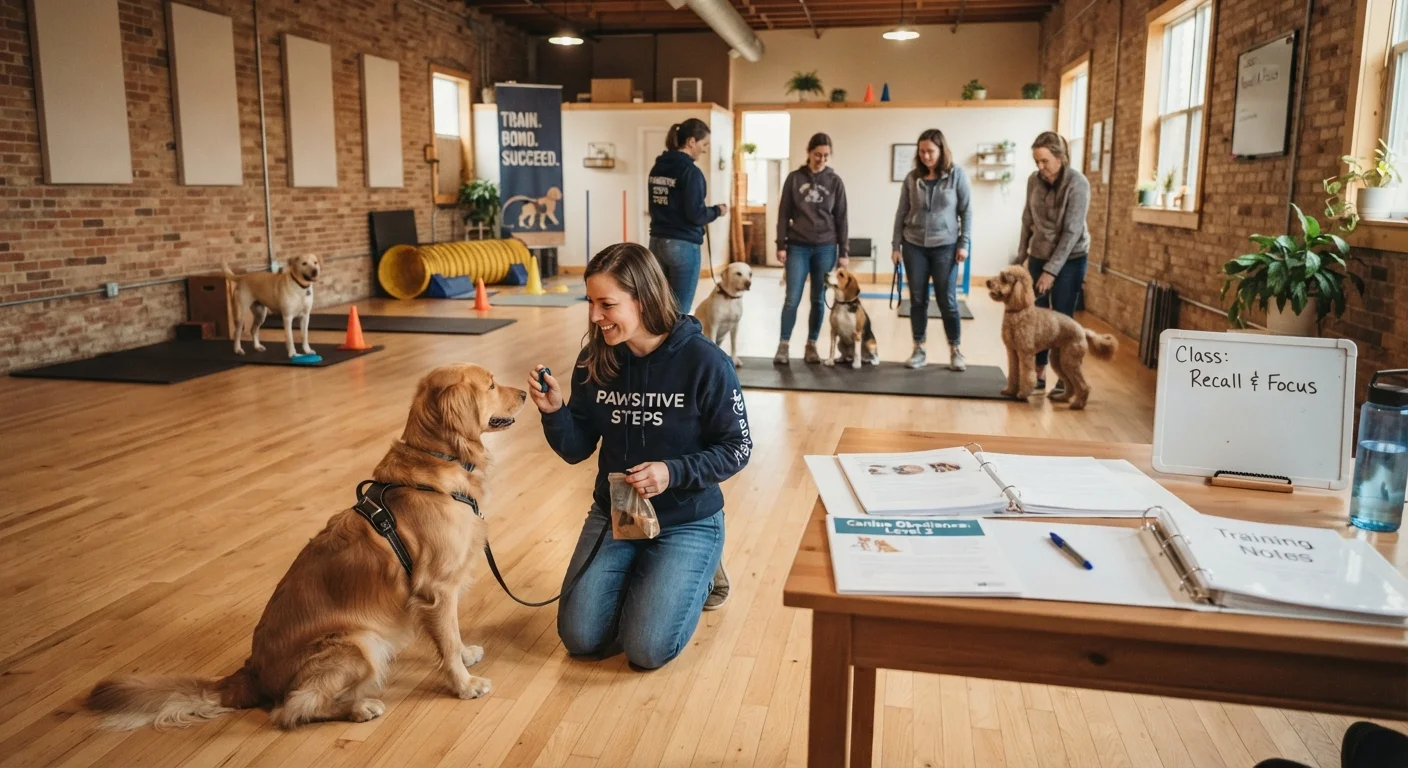
Group classes bring several pet owners and their animals together under the guidance of a qualified trainer, typically in a scheduled, multi-week series. Sessions usually run 45-60 minutes and cover foundational cues - sit, stay, recall, leash manners - in a structured curriculum. The shared environment introduces controlled distractions, which can be an asset for building real-world responsiveness.
Private Sessions
One-on-one sessions involve a trainer working exclusively with you and your pet, either in your home, at a training facility, or another relevant location. The trainer can observe your specific environment, your handling style, and your pet's unique responses, then adjust technique in real time. This format is common for addressing specific behavioral concerns or for pets who struggle in group settings.
Self-Guided Training
Self-guided training means the owner takes full responsibility for planning and delivering sessions, drawing on books, video courses, reputable online resources, or prior instruction. There is no live trainer present, so feedback is indirect - you observe your pet's responses and adjust based on your own knowledge. This format demands consistency and a willingness to troubleshoot independently.
Comparing the Three Formats
The table below maps each format against the criteria that matter most to most pet owners. Note that cost figures vary widely by region, trainer credentials, and session length - treat these as general ranges rather than fixed prices.
| Group Classes | Private Sessions | Self-Guided Training | |
|---|---|---|---|
| Typical cost | Lower per session | Higher per session | Minimal ongoing cost |
| Instructor feedback | General, shared | Direct and individualized | None (self-assessed) |
| Scheduling flexibility | Fixed class times | Appointment-based | Fully flexible |
| Socialization opportunity | High | Low | None built-in |
| Suitability for behavioral issues | Limited | High | Low without expertise |
| Owner skill required | Low to moderate | Low to moderate | Moderate to high |
| Pace of progression | Set by curriculum | Set by pet and owner | Entirely self-directed |
Understanding the trade-offs in the table is a starting point, not a final answer. Your pet's temperament, your household's schedule, and your comfort with hands-on learning all influence which format will actually produce progress.
Where Each Format Tends to Succeed - and Fall Short
Group classes are particularly effective during the early socialization and foundational stages of training. Puppies and adolescent dogs benefit from learning that good behavior is possible even when other dogs are present. The social exposure is a genuine feature, not just a side effect. The limitation is attention: a trainer managing six to ten teams cannot deliver detailed individual feedback. If your dog has significant reactivity or fear, a group setting may be too stimulating to make learning efficient.
Private sessions shine when a problem is specific, persistent, or behaviorally complex - resource guarding, leash reactivity, or separation-related distress, for example. The trainer can observe triggers in context and tailor a protocol to your pet's history. See our article on when professional guidance genuinely adds value for a clear-eyed look at which situations benefit most from expert involvement. The trade-off is cost and, sometimes, scheduling friction.
Self-guided training works best when a pet already understands basic cues and the owner wants to expand the repertoire or maintain existing skills. It is highly compatible with busy or irregular schedules. The risk is that errors in technique go unnoticed and can become habits - for both owner and pet. If progress stalls, the common causes of training setbacks can help identify what's going wrong before frustration sets in.
Combining Formats Is Often the Smartest Approach
Many experienced trainers recommend beginning with group classes to establish foundational skills and socialization, then using occasional private sessions to address specific challenges as they arise. Self-guided practice between sessions - even five to ten minutes daily - reinforces what was covered in class and accelerates progress. Think of the formats as complementary tools rather than competing choices.
Practical Considerations Before You Choose
Several factors are worth weighing before committing to a format or combination of formats.
- Your pet's baseline. A dog with no prior training is a different starting point than one who knows several cues. Beginners often benefit from at least some instructor-led experience before moving to independent practice.
- Household consistency. If multiple people interact with your pet, group or private instruction can help align everyone on cues and rules. Our guide on training with multiple household members addresses how to prevent mixed signals from undermining progress.
- Your own readiness. The pre-session readiness checklist helps confirm your environment, tools, and mindset are prepared - regardless of which format you choose.
- Training philosophy. All three formats can be delivered using reward-based or correction-based approaches. The methodology matters as much as the format. If you're unsure where you stand, what the research says about training philosophies provides a grounded overview.
There is no obligation to pick exactly one format. Many owners start with group classes to build a foundation, use a private session to address a specific challenge, and then continue progress through self-guided practice. Layering formats thoughtfully is a legitimate strategy.
This article is for general informational and educational purposes only. For pets with significant behavioral concerns, anxiety, or aggression, consult a qualified, credentialed animal behaviorist or veterinary professional for personalized guidance.