

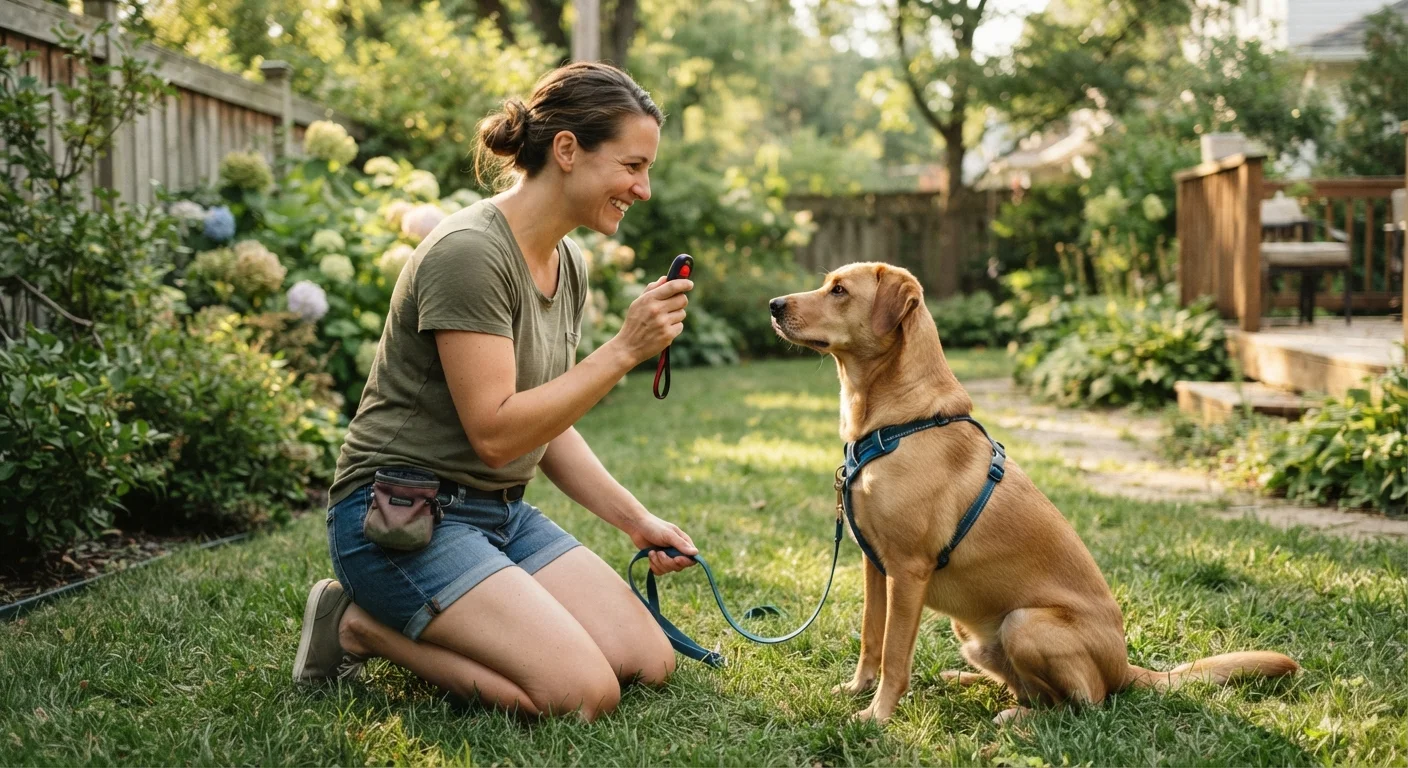
Key Takeaways
- Both clicker and verbal markers work by pinpointing the exact moment a pet performs the desired behavior.
- Clickers offer greater acoustic consistency; verbal markers are always available and require no equipment.
- Either method can produce excellent results when paired with good timing and reward delivery.
- Verbal markers can vary in tone and emotion, which may create inconsistency for some learners.
- Choose based on your pet's sensitivities, your environment, and what you can realistically maintain.
Option A
Clicker Training
The precise, consistent mechanical marker.
Best for: Trainers who want a highly distinct, emotionally neutral sound that is the same every single time.
Option B
Verbal Markers
The hands-free, always-available alternative.
Best for: Trainers who need flexibility, work with hearing-impaired pets, or prefer not to carry equipment.
If you want maximum precision during early skill-building
Clicker Training
A clicker produces a unique, emotionally neutral sound that stands apart from everyday noise, making it easier for pets to associate it reliably with reward during the critical learning window.
If your hands are often occupied or you train in public settings
Verbal Markers
A marker word like 'yes' requires no device, leaving your hands free for a leash or treats and ensuring you always have your marker available.
If you share training duties across multiple household members
Clicker Training
A clicker sounds the same regardless of who holds it, reducing the variability that can slow learning when multiple people are involved.
If your pet has noise sensitivity or anxiety around sharp sounds
Verbal Markers
Some animals find clicking sounds startling, particularly at close range. A calm, consistent verbal marker avoids triggering stress responses during training.
What Both Methods Share: The Marker Principle
Before comparing the two approaches, it helps to understand what they have in common. Both clicker training and verbal markers are forms of event marking - a technique drawn from operant conditioning. The marker (whether a click or a word) acts as a bridge between the behavior and the reward, telling the animal precisely which action earned the treat.
This is sometimes called a conditioned reinforcer: a neutral signal that gains meaning only after being paired repeatedly with something the animal values, like food. For a deeper look at the learning science underlying this process, see how positive reinforcement shapes animal behavior.
The practical implication is that neither method has an inherent advantage in terms of how learning happens. What differs is the quality, consistency, and accessibility of the signal itself.
| Criterion | Clicker Training | Verbal Markers |
|---|---|---|
| Signal consistency | Identical every time | Varies with tone and mood |
| Availability | Requires carrying a device | Always available |
| Hands required | Yes - one hand occupied | No hands needed |
| Noise sensitivity risk | Higher - sharp, distinct click | Lower - softer, familiar sound |
| Multi-person households | Highly consistent across users | Varies by individual voice |
| Learning curve | Moderate - timing mechanics | Moderate - tonal consistency |
| Cost | Small upfront device cost | No cost |
The Case for Clicker Training
A clicker produces a short, sharp sound - typically around 0.1 seconds - that is acoustically distinct from speech, ambient noise, and emotional tone. That distinctiveness is its main strength. Because the click sounds identical every time and carries no emotional charge, it is less prone to the variability that can creep into voice-based cues.
Clickers are particularly useful when shaping complex behaviors through small incremental steps, or when working with animals that are highly sensitive to subtle changes in sound. Trainers who have mastered timing and reinforcement rate often find a clicker makes those milliseconds of precision more achievable.
One practical consideration: the clicker requires a free hand and must be on your person to be useful. If you forget it, you lose access to your trained marker - which can disrupt sessions for animals that have been conditioned specifically to a click.
~0.1 sec
Typical clicker sound duration
The brief, sharp duration of a click is what makes it a precise event marker compared to drawn-out verbal cues.
3-5 sessions
Average conditioning time for a new marker
Most animals associate a novel marker with reward within a few short, consistent pairing sessions, according to general applied behavior analysis practice.
The Case for Verbal Markers
A verbal marker - a short, crisp word like yes or good - is always with you. You cannot forget it, drop it, or find it buried in a training bag. For owners who manage leashes, bags, children, and pets simultaneously, this convenience is genuinely significant.
The primary challenge is consistency. Human voices shift with mood, fatigue, and context. A warm, elongated yeeesss sounds different from a quick, clipped yes - and animals are sensitive to those acoustic differences. With practice, most people can deliver a verbal marker reliably, but it requires intentional effort.
Verbal markers are also the more practical choice for households where the clicker sound has proven aversive, or for training in environments where the click might be inaudible over background noise. Understanding how to keep signals consistent across family members is addressed in detail in training with multiple people in the household.
How to Choose - and How to Start
There is no universal answer. The right marker is the one you will use consistently, deliver with good timing, and always pair with a meaningful reward. Here are the key factors to weigh:
- Your pet's sound sensitivity: If your pet startles at sharp noises, begin with a verbal marker or a muffled clicker covered partially by your hand.
- Your typical training environment: Noisy or hands-busy contexts favor verbal markers; quiet, focused indoor sessions suit either approach equally.
- Who else trains your pet: If several household members are involved, a clicker provides a standardized signal that is harder to deliver inconsistently than a word.
- Your own learning curve: New trainers sometimes find a clicker helps them separate the marker from praise and commands, making foundational training concepts easier to apply in practice.
Whichever marker you choose, the steps are the same: pair it with high-value food repeatedly until the animal responds with visible anticipation, then use it to mark desired behaviors in real training contexts. Switching markers mid-training is possible but requires a new conditioning phase - so choose deliberately and stick with it.
Can You Use Both Methods Together?
Yes - some trainers use a clicker during precise shaping work and switch to a verbal marker for casual reinforcement throughout the day. If you take this approach, condition each marker separately so the animal recognizes both. Mixing them without clear conditioning can create confusion rather than flexibility.
This article is for general informational and educational purposes only. For guidance tailored to your specific pet's behavior or health needs, consult a certified professional animal trainer or your veterinarian.