

Key Takeaways
- Vertical growing structures can multiply usable planting area without expanding your footprint.
- Containers and raised beds let you control soil quality independently of what's beneath.
- Microclimates - even in tiny spaces - determine which plants will genuinely thrive.
- Compact edibles like herbs, greens, and dwarf varieties deliver serious harvests in limited space.
- Thoughtful layering of heights and textures creates visual depth and ecological variety.
Why Small Spaces Deserve Serious Design
There's a common assumption that meaningful gardening requires a proper backyard. A courtyard strip measuring four feet wide, a second-floor balcony, or a narrow side passage can tell a different story - if you approach the space with intention rather than resignation.
The key shift is moving from thinking about area to thinking about volume. A small footprint becomes far more generous once you account for vertical surfaces, hanging positions, and stacked tiers. Pair that with smart plant selection and an understanding of your local light and airflow patterns, and a tight space can support a genuinely productive garden. Our guide on understanding garden microclimates is particularly useful here - even a balcony has wind corridors, warm pockets, and shaded corners that reward close observation.
Below are seven design approaches that consistently deliver results in constrained outdoor environments.
Go Vertical with Wall-Mounted Planters and Trellises
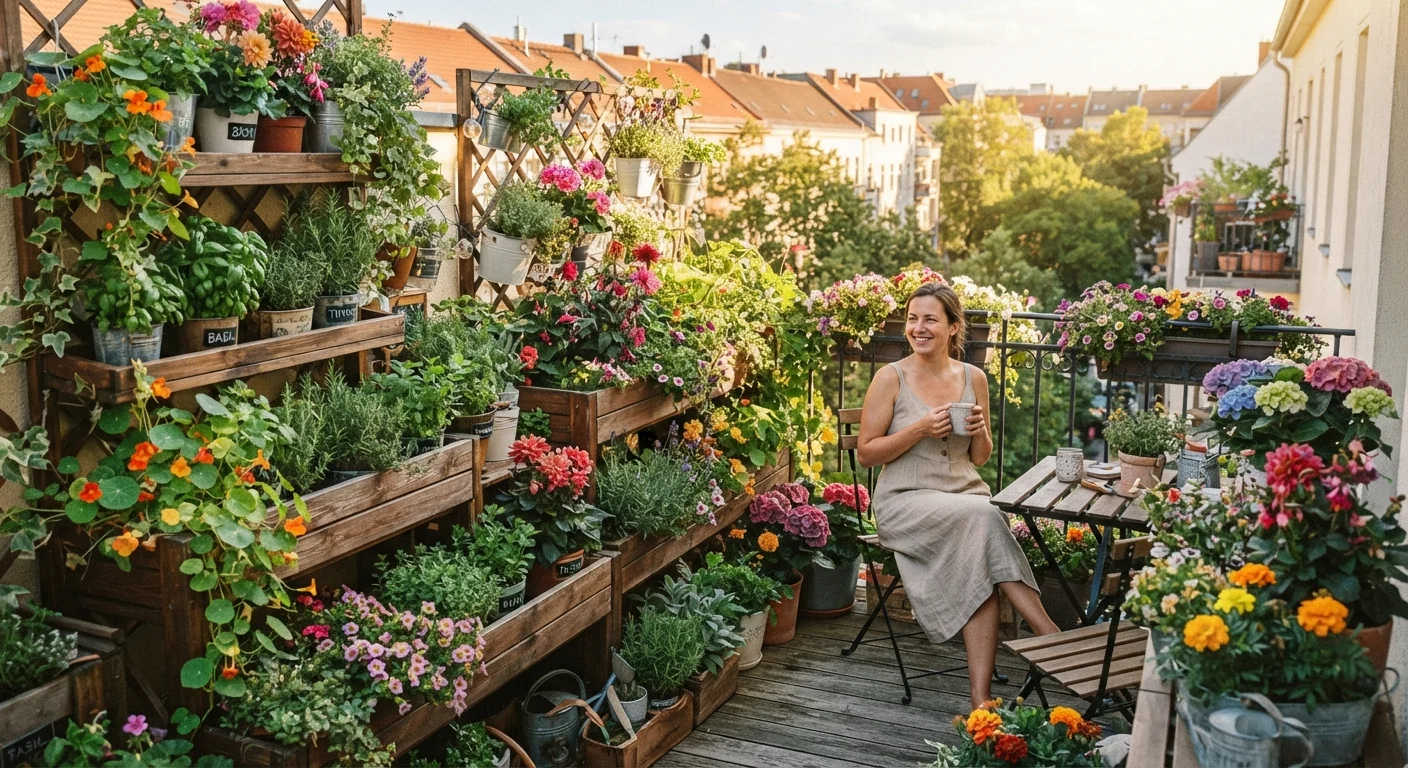
Walls and fences are underused real estate in almost every small outdoor space. Wall-mounted pocket planters, modular grid systems, and simple trellis frames shift growing area off the ground entirely, freeing up floor space while adding visual structure.
Climbing plants - pole beans, compact cucumbers, nasturtiums, and many annual vines - are natural partners for vertical structures. They grow upward rather than outward, making them well-suited to narrow beds or containers placed at the base of a wall. Even a single trellis panel against a fence can support a surprising harvest.
Walls and fences are underused real estate in almost every small outdoor space.
Use Containers Strategically, Not Just Decoratively
Containers are often treated as an afterthought - a pot here, a window box there. Used strategically, they become a flexible growing system. Grouping containers by size creates tiered planting arrangements that mimic the layers of a planted border. Larger pots at the back or center, smaller ones stepping down toward the edge, give depth to even a flat balcony surface.
Container selection matters beyond aesthetics. Deeper pots (at least 12 inches) support root vegetables and larger herbs. Fabric grow bags improve drainage and air pruning of roots compared to solid plastic. Understanding the trade-offs between raised containers and in-ground options is worth exploring - raised beds versus in-ground planting covers the key differences clearly.
Grouping containers by size creates tiered planting arrangements that mimic a planted border.
Select Compact and Dwarf Varieties Intentionally
Standard vegetable varieties were bred for open garden beds, not for the constraints of a balcony or courtyard. Compact and dwarf cultivars of tomatoes, peppers, squash, and even fruit trees have been developed specifically for container or small-space growing, offering proportionate yields from proportionate plants.
Herbs are arguably the highest-value crop for limited space - basil, chives, parsley, thyme, and mint produce continuously with minimal footprint and benefit immediately from being close to the kitchen. Leafy greens like lettuce, spinach, and arugula are equally productive in shallow containers and can be cut-and-come-again repeatedly through the season.
Herbs are arguably the highest-value crop for limited space, producing continuously with minimal footprint.
Incorporate Native and Low-Maintenance Plants for Ecological Value
Small spaces benefit from plants that do more than look good. Native plants - even a handful of native perennials tucked into containers - attract pollinators and support local insect communities without demanding constant attention. They're generally adapted to regional rainfall patterns and can be more forgiving of the variable conditions found on balconies and in courtyards.
The ecological case for natives isn't just environmental - it's practical. Fewer pest problems, lower watering needs, and reduced maintenance are real-world advantages in a space where every plant matters. Our article on the case for native plants outlines genuine trade-offs worth weighing before you choose.
Native plants attract pollinators and support local insects without demanding constant attention.
Manage Soil Quality as a Closed System
In a small container or raised bed garden, you control the soil entirely - which is both an advantage and a responsibility. Unlike open ground, containers can't draw on surrounding soil biology or moisture reserves, so what you put in the pot matters more than almost anything else.
A quality potting mix, refreshed or amended each season, forms the foundation. Compost - whether home-made or sourced - restores nutrients and supports microbial activity. If you're not already composting, even small-scale kitchen scrap composting is practical; our guide to home composting walks through the fundamentals accessibly. Avoid compacting container soil by overworking it, and be aware that overwatering is the most common way gardeners unintentionally degrade soil structure over time.
In a container garden, you control the soil entirely - which is both an advantage and a responsibility.
Design for Layered Height and Visual Interest
Even without width, a small garden can feel expansive when it has height variation. Tall grasses or structural plants at the back or corners, mid-height flowering perennials or bushy herbs in the center, and low-growing groundcovers or trailing plants at edges create a sense of density and depth that flat, same-height planting never achieves.
This approach also improves growing conditions. Taller plants provide partial shade for heat-sensitive crops below; trailing plants spill over container edges to reduce moisture evaporation from soil. Structure and function support each other naturally when you think in layers rather than in rows.
Taller plants provide partial shade for heat-sensitive crops below - structure and function support each other.
Work With Light, Not Against It
Light is the constraint most small-space gardeners underestimate. A balcony facing north, or a courtyard shadowed by adjacent buildings, limits what will thrive regardless of how well-designed everything else is. Mapping your space honestly - noting where direct sun falls and for how many hours - allows you to match plants to real conditions rather than ideal ones.
Shade-tolerant edibles (ferns, mint, some lettuces) and flowering plants (impatiens, begonias, hellebores) can fill genuinely shaded spots productively. Sun-demanding crops belong in whatever patch receives the most direct light. Reflective surfaces - a pale wall, light-colored containers - can redistribute brightness into shadowed corners, incrementally expanding what's possible.
Mapping your light honestly lets you match plants to real conditions rather than ideal ones.
Building a Space Worth Spending Time In
Productivity and beauty aren't competing goals in a small garden - they reinforce each other. A well-chosen mix of edibles and ornamentals, supported by healthy soil and intentional structure, tends to look good and perform well simultaneously.
Start Simple, Then Layer Complexity
If you're new to small-space gardening, resist the urge to fill every surface at once. Begin with three to five containers, choose plants matched to your actual light conditions, and observe how the space performs through one full season. Incremental adjustments based on real experience will outperform an elaborate first-year setup every time.
If you're growing edibles for the first time, the fundamentals covered in our vegetable garden starter guide translate directly to container and balcony setups. And for anyone managing soil in raised beds or deep containers, common soil health mistakes are worth knowing before they quietly undo your progress. Small spaces reward attention - and they repay it generously.