
Bodyweight vs. Weighted Exercise: Choosing the Right Resistance for Your Goals

Key Takeaways
- Bodyweight exercise builds functional strength and requires no equipment, making it highly accessible for beginners.
- Weighted training offers more precise load progression, which supports continued strength and muscle development over time.
- Neither approach is universally superior - both can be effective depending on your specific goals and circumstances.
- Many fitness routines combine both methods to take advantage of each approach's strengths.
- Consult a qualified fitness professional or healthcare provider before starting a new exercise program, especially with existing health conditions.
Our Verdict
Bodyweight and weighted exercise each have well-established benefits, and the evidence does not crown a single winner. Bodyweight training excels for accessibility, movement quality, and low-barrier entry, while weighted training provides a more controllable path to progressive overload for building mass and strength over time. Most people benefit from incorporating elements of both.
| Best for | Recommended |
|---|---|
| Beginners or those exercising at home without equipment | Bodyweight training |
| Those focused on maximising muscle growth or measurable strength gains | Weighted training |
| Travelers or anyone needing a flexible, portable routine | Bodyweight training |
| Intermediate to advanced exercisers seeking continued progression | A combination of both |
What Each Approach Actually Involves
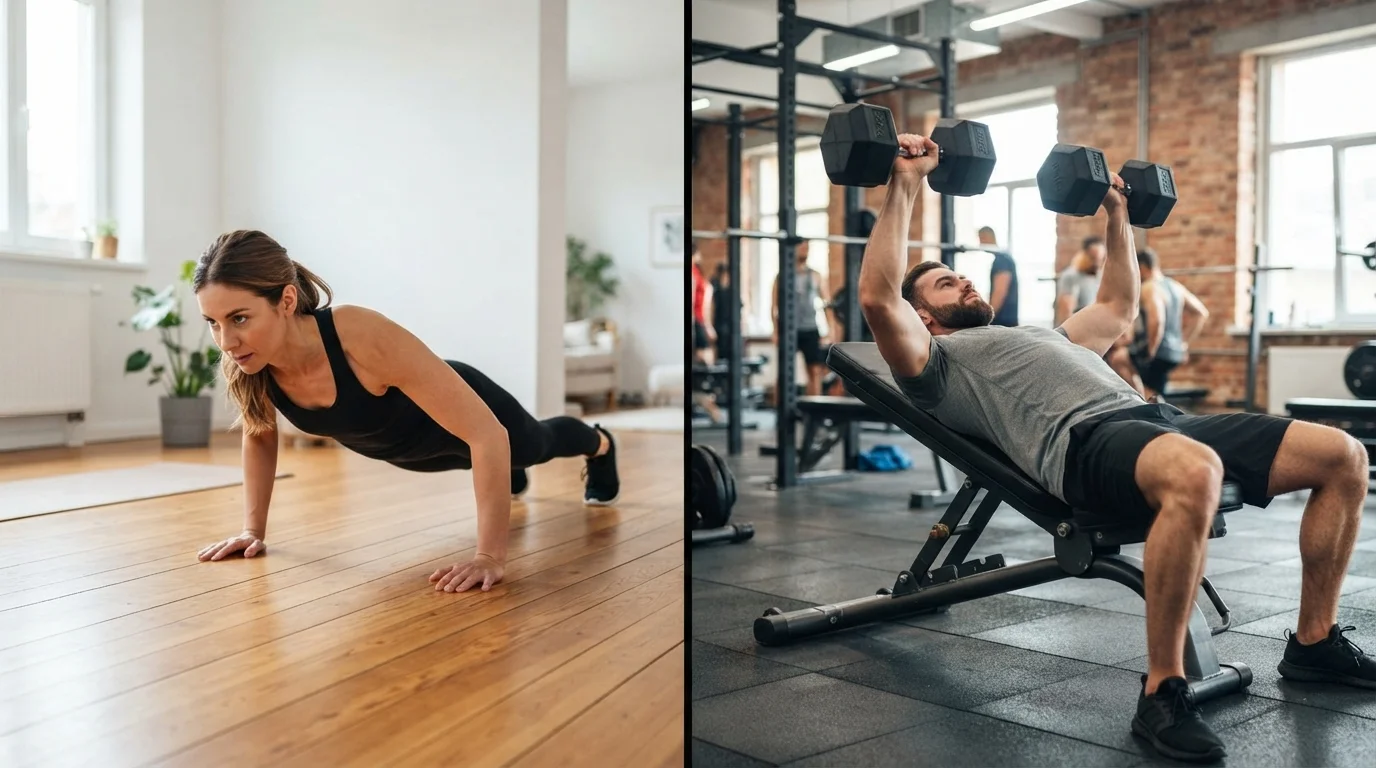
Bodyweight training uses your own body mass as resistance - think push-ups, squats, lunges, planks, and pull-ups. No gym membership or equipment is required, though tools like a pull-up bar or resistance bands can extend the options available. Weighted training adds external load through free weights (dumbbells, barbells, kettlebells) or machines, allowing you to adjust resistance in specific, measurable increments.
Both methods ask your muscles to work against resistance, stimulating adaptation. The primary difference is how that resistance is delivered and how easily it can be scaled. If you're just getting started with exercise in general, our beginner's guide to building a movement habit offers a useful foundation before diving into either approach.
How They Compare Across Key Dimensions
Choosing between these approaches is easier when you weigh them side by side across the factors that matter most to everyday exercisers.
| Bodyweight Training | Weighted Training | |
|---|---|---|
| Equipment needed | None required | Weights or gym access needed |
| Upfront cost | Very low to zero | Moderate to high |
| Ease of progression | Requires creativity | Straightforward (add weight) |
| Suitability for beginners | Excellent | Good with proper guidance |
| Muscle growth potential | Good, with limits over time | High, especially long-term |
| Portability | Very high | Limited |
| Functional movement benefit | Generally high | Varies by exercise choice |
| Learning curve | Moderate | Moderate to high |
Cost and equipment access remain among the most practical considerations. Bodyweight training can begin immediately, while weighted training typically requires gym access or a meaningful upfront investment in home equipment. Building a home exercise habit without dedicated space or gear explores this challenge in more depth.
Progression: The Central Challenge for Each Method
One of the most important concepts in resistance training is progressive overload - gradually increasing the demand on your muscles over time so they continue to adapt. Weighted training makes this straightforward: add weight incrementally. Bodyweight training requires more creativity to achieve the same effect.
With bodyweight exercise, progression typically comes through:
- Increasing repetitions or sets
- Reducing rest intervals
- Moving to more mechanically challenging variations (e.g., progressing from standard push-ups to archer push-ups)
- Adding tempo or pauses to increase time under tension
These approaches work well, but there are upper limits. Once you can perform dozens of repetitions of a given movement, further strength gains become harder to produce without adding external resistance or advancing to skills that require significant practice.
Combining Both Methods Works Well
Many fitness programs blend bodyweight and weighted exercises within the same session or week. For example, bodyweight movements like push-ups or lunges can serve as warm-ups, active rest, or accessory work alongside weighted lifts. This hybrid approach captures the portability and coordination benefits of bodyweight training while still allowing for measurable load progression.
Muscle Growth, Strength, and Functional Fitness
Research in exercise science generally supports the view that both bodyweight and weighted exercise can stimulate muscle growth and strength improvements, particularly for beginners. A 2019 review published in the Journal of Human Kinetics noted that resistance type mattered less than consistent application of progressive overload principles.
Where weighted training tends to have a clearer advantage is in building maximal strength and significant muscle mass, particularly for intermediate and advanced exercisers who have already adapted to basic bodyweight work. Bodyweight training, however, often develops coordination, body control, and joint stability that translates well to everyday movement - sometimes called functional fitness.
For context on how resistance training fits alongside cardiovascular work, see our comparison of cardio and strength training.
Which Approach Fits Your Situation?
There is no single correct answer - context matters considerably. Consider the following practical factors:
- Your current fitness level
- Bodyweight movements often provide an appropriate challenge for beginners and allow for safe technique development without the added complexity of load management.
- Your environment
- If gym access is limited or you prefer to train at home, bodyweight training is immediately workable. Small daily movement habits can also complement structured sessions - everyday movement habits that add up over time explores this idea.
- Your goals
- General fitness, mobility, and basic strength are well served by bodyweight work. If significant muscle hypertrophy or powerlifting-style strength is the aim, weighted training becomes increasingly important over time.
This article is for general informational and educational purposes only and does not constitute medical or fitness advice. Consult a qualified healthcare or fitness professional before beginning any new exercise program, particularly if you have existing health conditions or injuries.