

Key Takeaways
- You don't need a dedicated gym room - any cleared floor space works for effective bodyweight exercise.
- Habit consistency matters more than workout length; even 10-minute sessions provide meaningful benefit.
- Using existing furniture and household items as props can expand your movement options significantly.
- Anchoring exercise to an existing daily routine dramatically improves follow-through.
- Progress tracking, even informally, helps sustain motivation when a home environment offers few external cues.
What you will need
Why space and equipment aren't the real barriers
The most common reasons people delay starting home exercise are practical: I don't have a gym room, or I don't own any gear. These feel like genuine obstacles, but research on physical activity consistently shows that the primary barriers to exercise are psychological and structural, not material. The decision to begin - and to repeat - matters far more than the environment in which movement happens.
A cleared patch of floor is physiologically equivalent to a dedicated gym space for a wide range of effective movements. The human body responds to load, range of motion, and effort regardless of the setting. Functional fitness - training that develops strength and mobility for everyday life - is particularly well-suited to home environments because it emphasises natural movement patterns over specialised equipment.
If you're approaching exercise for the first time, reviewing a readiness checklist before starting can help you set realistic expectations and catch any health considerations worth discussing with a doctor.
What you will need
Step-by-step: Setting up a home exercise habit
The following steps are designed to be completed sequentially as a setup process, not a single workout. Work through them once to create a structure, then return to your habit daily. If you're brand new to exercise, starting exercise from scratch offers a grounded introduction to pacing and progression before you dive into regular sessions.
Identify your available space honestly
Walk through your home and look for spots where you can temporarily clear roughly 6 feet by 4 feet of floor space. This could be a section of bedroom floor beside the bed, a living room area once a coffee table is moved, or a kitchen stretch when not in use. You don't need permanent space - just reliable access to a spot you can clear in under two minutes.
The goal here is realistic assessment, not an ideal setup. A surface that is flat, non-slippery, and away from breakable objects is sufficient to begin.
Choose movement types that suit your space
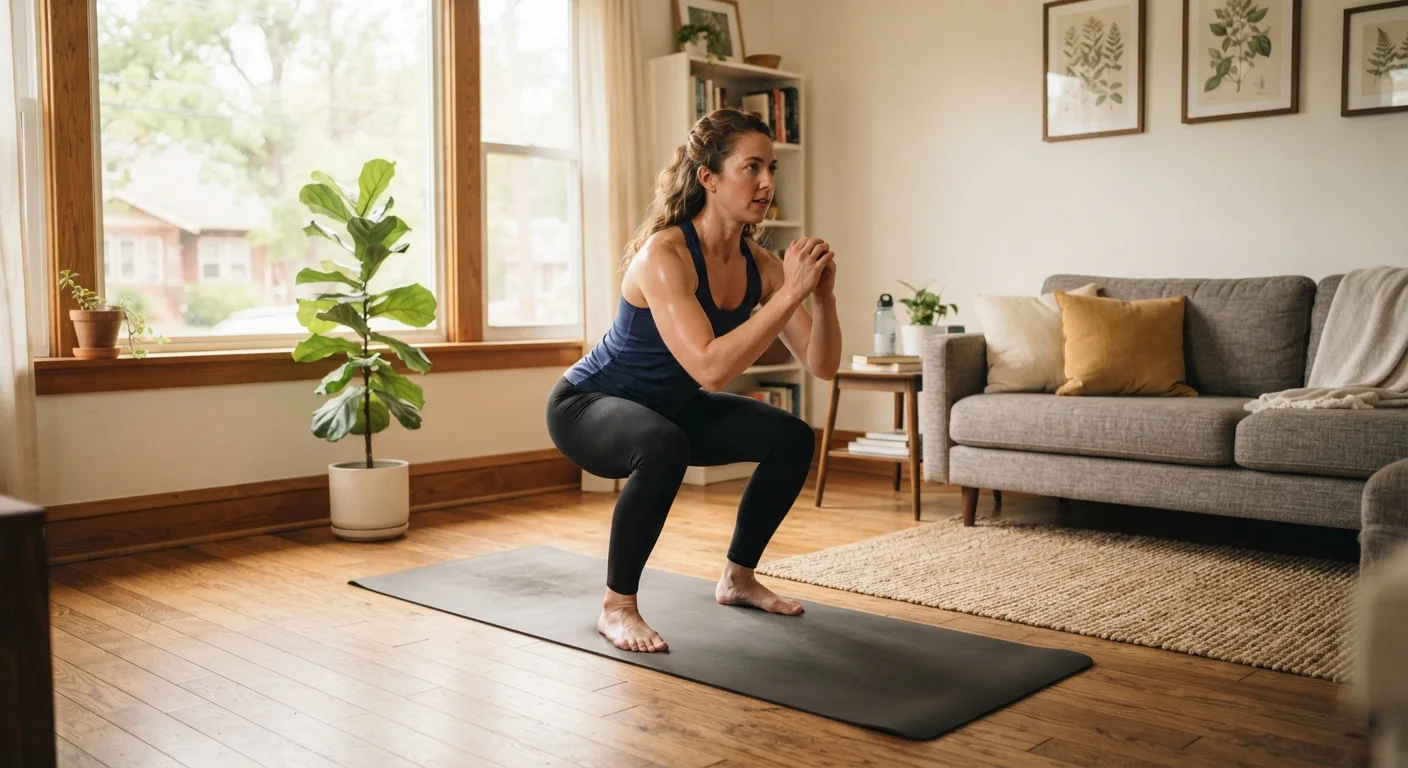
Not all exercises require the same footprint. Vertical movements - squats, standing marches, wall push-ups, calf raises - need almost no lateral room. Floor movements like planks, glute bridges, and supine leg raises need a body-length strip. Match your movement choices to the space you actually have.
Bodyweight exercises cover a wide range of intensity and muscle groups without requiring any equipment, making them ideal for space-constrained environments. Start with movements you already recognise so you can focus on consistency rather than learning new techniques.
Anchor your exercise to an existing routine
One of the most reliable strategies from habit formation research is habit stacking - attaching a new behaviour to one you already do reliably. Identify a consistent daily anchor: brewing morning coffee, finishing lunch, or the end of a work-from-home shift. Immediately before or after that cue, perform your exercise session.
This approach removes the decision of when to exercise, which is often the friction point that causes skipped sessions. See evidence-backed principles for long-term consistency for a deeper look at how habit structure influences exercise longevity.
Use furniture and household objects as props
A sturdy chair can anchor a seated leg raise, support a tricep dip, or serve as a step target for standing balance work. A wall provides resistance for isometric exercises like wall sits. A low, stable surface - a firm couch cushion or a bottom stair step - can modify push-up difficulty or aid balance training.
None of these substitutions require buying anything. What matters is that any prop you use is stable, rated to hold your weight if load-bearing, and positioned away from obstacles that could cause a fall.
Track progress in a simple, low-friction way
Without a gym environment, external cues like a class schedule or a trainer's presence are absent. A simple log - a notes app, a paper tally on the fridge, or a habit-tracking app - keeps momentum visible. Record the date, what you did, and one observation about how it felt.
This doesn't need to be complex. The act of logging signals to your brain that the session counts. Over weeks, a visible streak or accumulation of sessions becomes a motivator in itself. Small movement habits that add up over time explores how even brief, informal sessions contribute meaningfully to overall activity levels.
Shorter sessions are still sessions
A 10-minute session performed consistently five days a week delivers more cumulative benefit than a 45-minute session attempted sporadically. Physical activity guidelines in the US recognise that movement can be accumulated throughout the day in shorter bouts. Don't let limited time become a reason to skip entirely.
This article is for general informational and educational purposes only and is not a substitute for professional medical advice. If you have any health conditions, injuries, or concerns, consult a qualified healthcare professional before beginning any new exercise routine.