

Key Takeaways
- Financing spreads cost over time but adds total interest expense to the vehicle's price.
- Paying cash avoids interest but reduces your available liquid savings significantly.
- Your credit score, emergency fund health, and opportunity cost all factor into the smarter choice.
- Neither approach is universally superior - personal financial circumstances should guide the decision.
- Dealer incentives sometimes make low-rate financing more attractive than outright cash payment.
Option A
Auto Loan Financing
The structured, payment-based route to vehicle ownership.
Best for: Buyers who want to preserve liquid savings or build credit history while spreading the cost over time.
Option B
Cash Purchase
The debt-free, ownership-immediate approach.
Best for: Buyers with sufficient savings who want to eliminate interest costs and monthly payment obligations.
If you have limited savings or an emergency fund below three to six months of expenses
Auto Loan Financing
Draining savings to buy a car outright can leave you financially vulnerable. Financing preserves a cash cushion for unexpected expenses.
If you carry high-interest debt elsewhere and want to minimize total debt burden
Cash Purchase
Avoiding an auto loan means one fewer debt obligation, freeing cash flow to address higher-priority financial concerns.
If you are building or rebuilding your credit history
Auto Loan Financing
Responsibly managing an installment loan can positively contribute to your credit profile over time.
If you have strong savings and no high-interest debt
Cash Purchase
When your financial cushion is solid, paying cash eliminates interest costs and simplifies ownership from day one.
If the dealer is offering a manufacturer-subsidized low APR promotion
Auto Loan Financing
Very low promotional interest rates can make financing financially competitive with or even preferable to a cash purchase, depending on your investment alternatives.
What Each Approach Actually Means
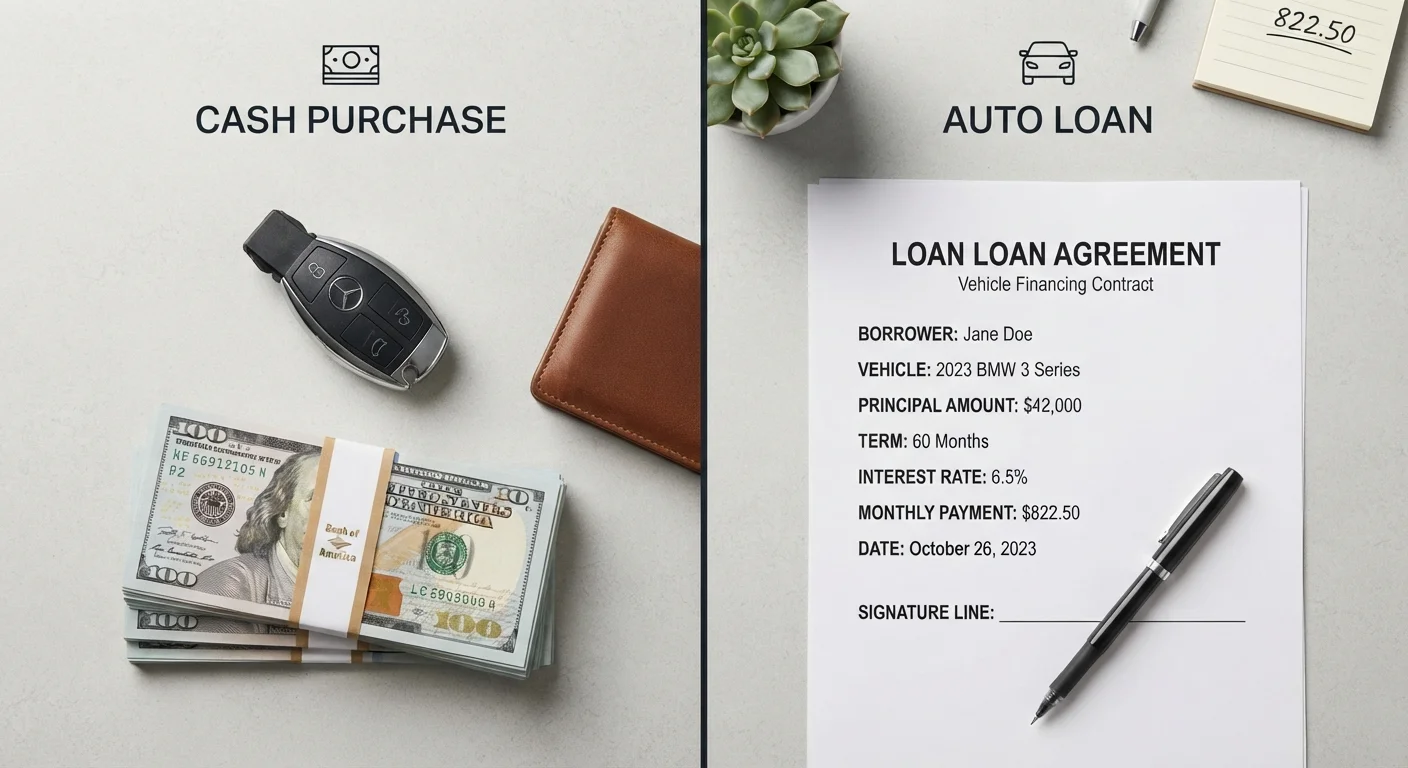
When you finance a car, a lender - typically a bank, credit union, or the dealership's financing arm - pays the seller on your behalf. You then repay the lender in monthly installments over an agreed term, plus interest. The interest rate, often called the APR, determines how much extra you pay above the vehicle's purchase price. Loan terms commonly range from 24 to 84 months.
A cash purchase means paying the full vehicle price upfront from your own funds, with no lender involved. You own the vehicle outright from day one, with no monthly payment and no interest accumulating.
Both routes get you the same car. What differs is how the transaction affects your bank account, your monthly cash flow, and your broader financial picture. For a fuller view of what car ownership costs beyond the purchase itself, see The True Cost of Owning a Car Beyond the Sticker Price.
| Criterion | Auto Loan Financing | Cash Purchase |
|---|---|---|
| Upfront cost | Low (down payment only) | Full vehicle price |
| Total cost over time | Higher (price + interest) | Lower (price only) |
| Monthly cash flow impact | Ongoing payment required | No monthly payment |
| Liquidity preserved | Yes - savings remain intact | No - savings are deployed |
| Credit profile effect | Builds installment credit history | No credit impact |
| Risk of negative equity | Possible on long-term loans | None |
| Flexibility at purchase | Can buy sooner with less saved | Requires full funds upfront |
The Real Cost of Financing: Interest Over Time
The most significant financial drawback of a loan is the total interest paid over the loan's life. For example, on a $25,000 vehicle financed at 7% APR over 60 months, a borrower would pay roughly $4,950 in interest - making the effective cost of the vehicle closer to $30,000. Longer loan terms reduce monthly payments but increase cumulative interest paid.
Your credit score heavily influences the APR a lender offers. Borrowers with stronger credit histories typically qualify for lower rates, reducing the interest burden. Understanding how credit and installment loans interact is covered in our Credit & Debt hub.
~85%
New vehicles purchased with financing
According to Experian's State of the Automotive Finance Market reports, the large majority of new vehicle transactions in the U.S. involve some form of financing.
60-72 mo.
Most common auto loan terms
Experian data consistently shows 60- and 72-month terms are the most frequently chosen, though longer terms increase total interest paid.
~$700+
Average monthly new car payment (U.S.)
Experian's automotive finance data indicates average monthly payments on new vehicles have risen substantially, reflecting higher vehicle prices and interest rates.
One notable exception: manufacturers occasionally offer subsidized financing - sometimes as low as 0% APR for well-qualified buyers. In these cases, the interest cost disappears entirely, making financing genuinely competitive with a cash purchase.
The Hidden Cost of Cash: Opportunity and Liquidity
Paying cash eliminates interest but introduces its own trade-offs. The most important is opportunity cost - the return you forgo by deploying savings toward a depreciating asset rather than keeping that money invested or liquid.
Equally important is liquidity risk. If purchasing the car absorbs most of your savings, you may be left without adequate reserves for emergencies, job loss, or unexpected repairs. Financial planners generally suggest maintaining three to six months of living expenses in accessible savings regardless of how a vehicle is purchased.
There is also the question of what else that money could do. If your savings are earning a return higher than a loan's APR, financing may cost less in real terms than spending the cash. This isn't guaranteed, and investment returns fluctuate - but it's a calculation worth considering. For strategies to build and protect savings, see our Saving Money hub.
How Each Choice Affects Your Financial Profile
An auto loan is an installment loan - a fixed debt repaid on a set schedule. When managed responsibly, it can contribute positively to your credit history by demonstrating consistent repayment behavior. This is particularly relevant for buyers who have a limited credit file or are working to strengthen one.
A cash purchase has no impact on your credit profile - for better or worse. It also eliminates the risk of becoming "upside down" on a loan (owing more than the vehicle is worth), which can happen if a car depreciates faster than the loan balance decreases, particularly on longer-term loans.
Monthly cash flow is another practical factor. A loan payment reduces take-home income available for other goals - savings, investments, or debt reduction. Paying cash preserves that monthly flexibility going forward, even if it reduces it sharply at the moment of purchase.
It's also worth considering how vehicle ownership length factors into the equation. Keeping a car longer vs. upgrading more often explores how ownership duration changes the financial math significantly.
This article provides general financial information for educational purposes only and does not constitute personalised financial or investment advice. Consult a qualified financial professional for guidance suited to your individual circumstances.