

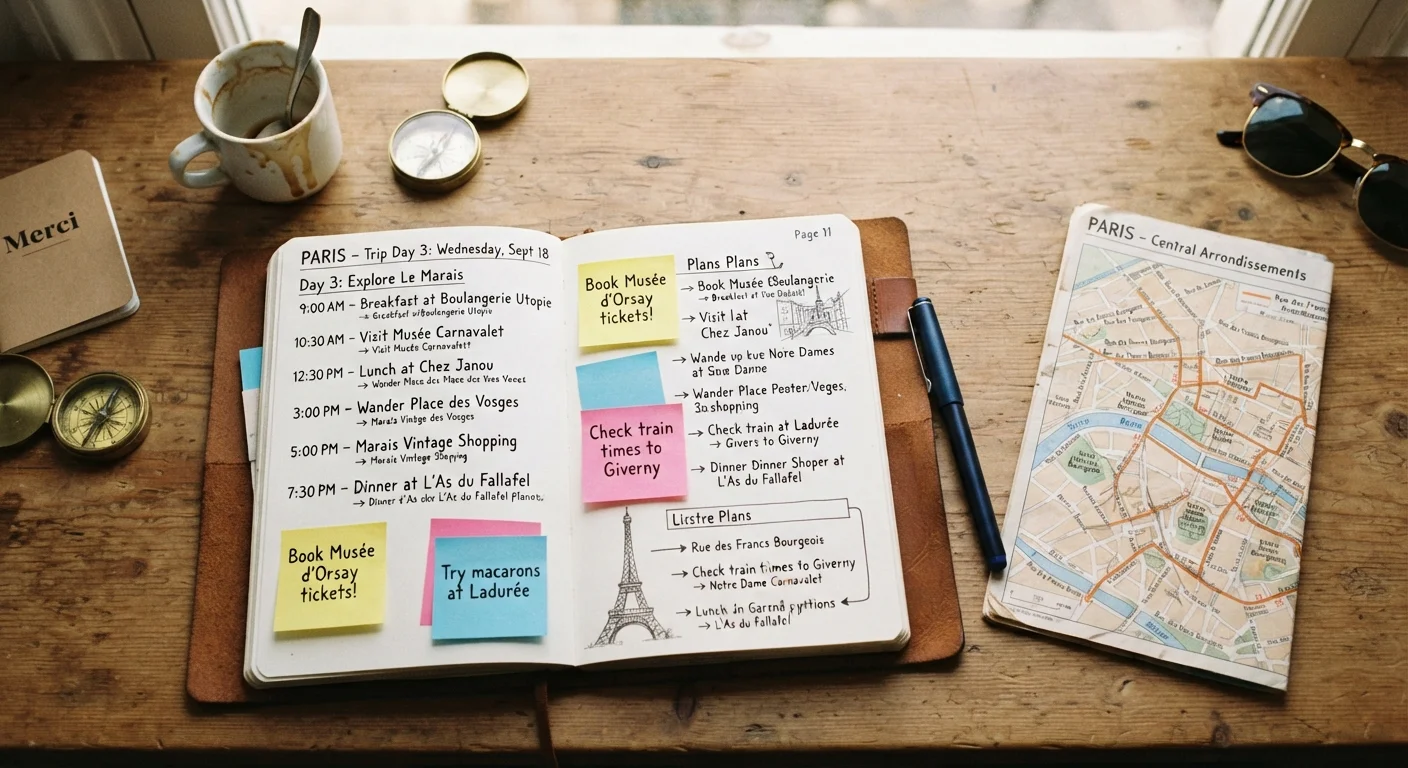
Key Takeaways
- Anchor each day around one or two fixed commitments, not a packed list of activities.
- Buffer time built into your schedule is what separates a plan you'll follow from one you'll abandon.
- Match activity intensity to your energy patterns — mornings, middays, and evenings each suit different tasks.
- A shared itinerary document reduces friction, especially for group travel.
- Reviewing your plan each evening takes five minutes and keeps the next day on track.
What you will need
Why Most Daily Plans Fall Apart
The problem with most travel itineraries isn't poor intention — it's unrealistic structure. Travelers routinely underestimate transit time, overestimate stamina, and schedule activities back-to-back with no room to breathe. By day two, the plan is already off the rails and the rest of the trip becomes improvised stress rather than enjoyable spontaneity.
A day-by-day plan works when it's built around how people actually travel: slower in the mornings, hungry at unpredictable times, occasionally delayed, and sometimes just wanting to sit somewhere and do nothing. For a deeper look at what every strong plan includes from the start, see The Anatomy of a Travel Itinerary.
The fix isn't to plan less — it's to plan smarter. That means fewer anchors per day, deliberate buffer time, and an honest read of your own travel style before you book a single activity.
What You'll Need Before You Start
Effective itinerary building doesn't require special software, but it does require a few inputs gathered in advance.
What you will need
Spreadsheet or notes app
Lay out each day of the trip in rows with space for morning, afternoon, and evening blocks.
Offline maps app
Estimate realistic transit times between locations without relying on connectivity.
Shared document platform
Keep all travelers synced on the same version of the itinerary in real time.
Destination tourism or official site
Confirm opening hours, entry requirements, and seasonal closures before committing to a schedule.
If you're traveling with others, a shared document eliminates the back-and-forth of coordinating on the fly. For strategies on keeping a group aligned, Group Trip Planning Without the Chaos covers the practical side of collaborative planning.
Building Your Day-by-Day Plan
Follow these steps in order. Each one builds on the last, and skipping ahead typically leads back to the overstuffed schedule you were trying to avoid.
Map your fixed commitments first
Before adding a single activity, place every non-negotiable time-bound event on the calendar: flight arrivals and departures, pre-booked tours, dinner reservations, and any ticketed events. These are your anchors. Everything else fits around them.
Mark arrival and departure days as half-days by default. Transit fatigue is real, and treating these as full activity days is one of the most consistent planning mistakes travelers make.
Assign one or two priority activities per day
For each full day, choose a maximum of two priority activities — things you'd be genuinely disappointed to miss. Write them into specific time blocks based on realistic transit and duration estimates, not optimistic ones.
This constraint forces you to rank what actually matters. Anything that doesn't make the top two per day goes onto a flexible list that you draw from when time genuinely opens up. For more on why cramming activities backfires, Why Overpacking Your Itinerary Ruins Trips is worth reading before you finalize your list.
Add explicit buffer time to each day
Between every activity block, add at least 30–45 minutes of unscheduled time. This buffer absorbs delays, longer-than-expected visits, slow service at restaurants, and the general unpredictability of travel. Without it, a single late taxi cascades into a ruined afternoon.
Also schedule at least one longer unstructured window per day — ideally 90 minutes to two hours — where there is nothing planned. This is where the most memorable travel moments tend to happen.
Sequence activities by energy and geography
Group activities that are geographically close to minimize unnecessary transit. Then sequence them according to energy: most physically or cognitively demanding activities in the morning when energy is typically higher, lighter activities and meals in the afternoon, and low-key or atmospheric experiences in the evening.
Check official sources or the destination's tourism authority for opening hours — many museums, markets, and sites have limited afternoon hours that aren't obvious until you're standing outside a closed door.
Build in a daily five-minute review habit
Each evening, spend five minutes checking the next day's plan. Confirm reservation times, check any hours that may have changed, and note what transit you'll need. This short habit prevents the scramble of discovering a problem in the morning when you have no time to solve it.
Adjust freely — if you're more tired than expected or found something worth extending your time on, shift tomorrow's lower-priority items accordingly. The plan serves the trip, not the other way around.
Match Your Plan to Your Travel Style
Some travelers prefer dense mornings and relaxed afternoons; others hit their stride after lunch. Before you finalize any day's structure, think honestly about when you're sharpest and most willing to navigate unfamiliar places. A plan built around your actual rhythm is far more likely to survive contact with a real trip.
Keeping the Plan Working Once You're There
A plan is only useful if you actually reference it. Build in a brief daily check-in — five minutes each evening to review the next day's anchor activities, note anything that needs advance confirmation (like a reservation time or a transit departure), and adjust if circumstances have changed.
Accept that some deviation is normal and not a failure. If a spontaneous detour costs you a lower-priority item on your list, that's the plan doing its job — protecting your must-dos while leaving space for the unplanned. The rigid alternative is a different trade-off entirely; Fixed-Date Bookings vs. Flexible Travel breaks down when each approach makes sense.
Also consider how your spending patterns interact with your daily plan. Unstructured days tend to cost more. When you know where you're going and roughly when you'll eat, you make fewer expensive last-minute decisions. Stretching a Travel Budget pairs well with a solid day-by-day structure.
Don't Let the Plan Become the Trip
An itinerary is a tool, not a contract. Travelers who treat every deviation as a failure tend to spend more energy managing the schedule than experiencing the destination. Build the plan carefully — then hold it loosely once you arrive.