

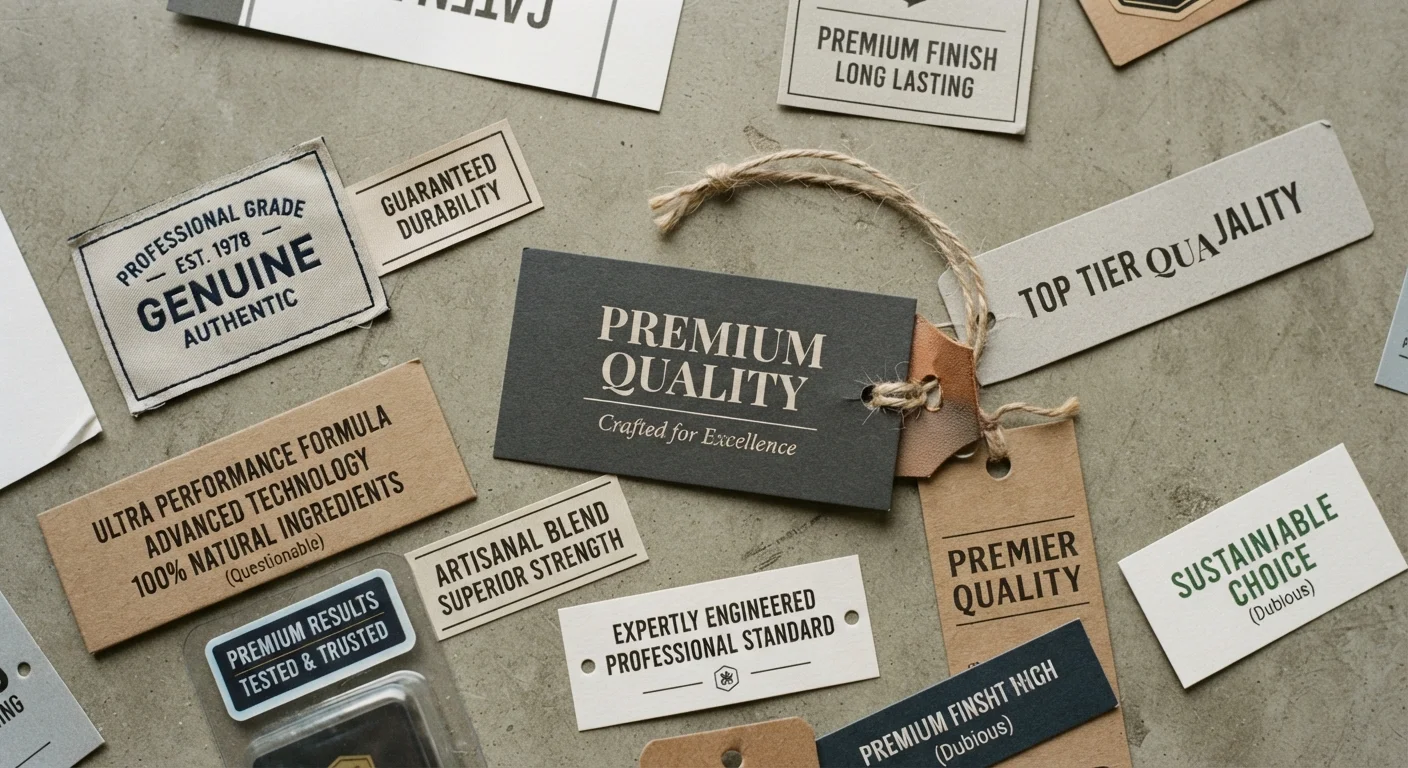
Key Takeaways
- Most quality words on packaging are marketing language with no legal definition or enforceable standard.
- Third-party certifications carry more weight than manufacturer self-descriptions.
- Material specifications, tolerances, and test data are more informative than adjectives alone.
- Regulated labels (UL, USDA Organic, NSF) signal independent verification; unregulated terms do not.
- A generous return policy or warranty often reveals more about real quality confidence than label copy.
Quality Claims on Product Labels
A quality claim is any word or phrase on packaging — such as 'premium,' 'professional grade,' or 'superior materials' — that implies a product is better than alternatives. Unlike safety certifications or nutrition facts, most quality claims are unregulated marketing language. No government body requires a product to meet a specific standard before it can call itself 'high quality.'
The Federal Trade Commission (FTC) oversees deceptive advertising in the U.S., but vague terms like 'quality' are generally considered puffery — subjective promotional language that is not legally actionable as a false claim.
Why 'Quality' Is a Marketing Word, Not a Standard
Walk through any store and you'll encounter it constantly: premium craftsmanship, superior quality, professional grade. These phrases feel meaningful, but they carry no enforceable weight. In the United States, no federal agency defines what a consumer product must do or be before it can claim to be 'high quality.' That gap between feeling and fact is worth understanding before you spend money on it.
The FTC governs deceptive advertising broadly, but courts and regulators have long recognized a category called puffery — vague, subjective boasts that no reasonable consumer is expected to take as a literal, provable claim. 'World's best' and 'unmatched quality' fall squarely into this bucket. Because they cannot be objectively measured, they are generally not actionable as false advertising.
That doesn't mean quality is unknowable. It means you need to look past the adjectives to the specifics underneath them.
One Exception Worth Knowing
For food and beverage products, some label terms are regulated. 'USDA Organic,' for example, requires certified compliance with the National Organic Program. 'Low sodium' and 'fat free' have specific FDA definitions. These are exceptions to the general rule — not evidence that quality adjectives elsewhere on the label carry similar authority. For more on food label literacy, see our guide on reading a nutrition label.
What Regulated Labels Actually Tell You
Some label elements are genuinely meaningful because they represent third-party verification. These are different in kind from self-applied marketing language.
- Safety and testing marks (e.g., UL Listed, NSF Certified, ASTM-compliant): An independent organization tested the product against documented criteria. The mark is only valid if the certifier's database confirms it for that specific product.
- USDA Organic / NON-GMO Project Verified: For food and agricultural products, these involve audited supply chains and documented standards — not just a claim.
- ISO references: ISO itself does not certify products, but manufacturers who reference ISO standards in their specs are pointing to publicly available, testable benchmarks you can look up.
A practical rule: if the label names an organization or standard number you can independently verify, it's worth investigating. If it only uses adjectives, treat it as atmosphere, not evidence. Our plain-language reference on common certifications and safety marks breaks down the most frequently seen marks across product categories.
~70%
Shoppers who believe 'natural' means regulated
Research published in peer-reviewed consumer behavior journals has found that a significant majority of shoppers mistakenly assume vague label terms like 'natural' carry legal definitions, when they generally do not in the U.S. context.
Puffery
Legal category for most quality adjectives
U.S. courts and the FTC classify subjective, unverifiable boasts as puffery — a category of speech that is broadly not actionable as false advertising, regardless of whether the claim is accurate.
Specifications Are More Honest Than Adjectives
Manufacturers who are confident in their product's measurable performance tend to publish numbers. Thread count, tensile strength, IP water-resistance rating, cycle life on a battery, load capacity — these are testable claims that can be verified by third parties or experienced directly by users.
When a label says 'durable construction' but lists no material specs, that's a signal the manufacturer isn't staking a verifiable claim. When a label says '600-denier polyester shell, 1,000-lb tested stitching,' those are checkable. The presence of specific, quantified specs doesn't guarantee quality, but it shifts accountability from feeling to fact.
This matters especially for products where failure has real consequences — tools, safety equipment, children's products, food storage. For those categories, look for standard references (ANSI, ASTM, EN numbers) rather than adjectives. If a product references a specific standard, you can read that standard's requirements yourself.
Signals Beyond the Label
The label is only one data source. Savvy shoppers triangulate it against other signals that manufacturers don't fully control.
Warranty terms: A manufacturer willing to repair or replace a product for two or more years is taking on real financial exposure. That exposure usually reflects genuine confidence in durability. Our article on reading warranty fine print explains the key clauses to check before they matter.
Return policies: Similarly, a seller who makes returns easy is less likely to be hiding known quality problems. Return policies as a quality signal explores this in more detail.
Independent test data: Consumer-facing testing organizations and independent labs don't have a financial stake in any particular product's success. Their methodology reports are often publicly available and far more informative than any packaging copy. See how manufacturer claims compare to independent testing for a fuller picture.
This article is for general informational purposes only. It does not constitute legal or consumer-protection advice. Verify specific regulatory requirements with the relevant federal or state agency.
“The word 'quality' on a label tells you what a manufacturer wants you to believe. The spec sheet tells you what they're willing to be held accountable for.”
— Smart Shopping Editorial Team, Consumer product evaluation researchers