

Key Takeaways
- Training begins on day one - every interaction teaches your dog something about expectations.
- Positive reinforcement (rewarding desired behavior) is the most research-supported training approach.
- Short, frequent sessions of 3-5 minutes outperform long, infrequent ones for most dogs.
- Consistency across all household members is essential for a dog to learn reliable cues.
- Adult dogs are fully capable of learning new behaviors - age is not a barrier to training.
Start here
Why Training Starts the Moment You Bring Your Dog Home
Understand the method
The Science Behind Positive Reinforcement
Learn the basics
Foundational Commands Every Dog Should Learn First
Sharpen your technique
Timing, Consistency, and Short Sessions
Avoid the pitfalls
Common Beginner Mistakes and How to Avoid Them
Put it all together
Building a Daily Training Routine
Why Training Starts the Moment You Bring Your Dog Home
Dogs learn from every interaction they have with their environment and the people around them. The moment your new dog steps through your door, they are already forming associations - about where they sleep, which behaviors earn attention, and what the household rules are. Waiting until a problem behavior appears before starting training means those early lessons are already being written without your input.
This applies equally to puppies and adult dogs. Whether you've adopted a rescue or brought home an eight-week-old puppy, establishing predictable routines and clear, kind communication from day one reduces confusion and builds trust. See our readiness checklist to confirm your environment and tools are in place before your first formal session.
Positive reinforcement
Adding something the dog values (such as a treat or praise) immediately after a desired behavior to make that behavior more likely to occur again.
Cue
A word, hand signal, or other signal that tells the dog which behavior to perform. Often called a "command" in everyday language.
Marker
A precise signal - usually a short word like "yes" or a clicker sound - used at the exact moment a dog performs a correct behavior to communicate that a reward is coming.
Luring
Using a treat held in the hand to guide the dog into a desired position or behavior, then rewarding once the behavior is complete.
Shaping
Rewarding successive small steps toward a final behavior, gradually raising the standard until the complete behavior is learned.
Recall
The behavior of a dog returning to the owner when called - one of the most important safety skills a dog can learn.
The Science Behind Positive Reinforcement
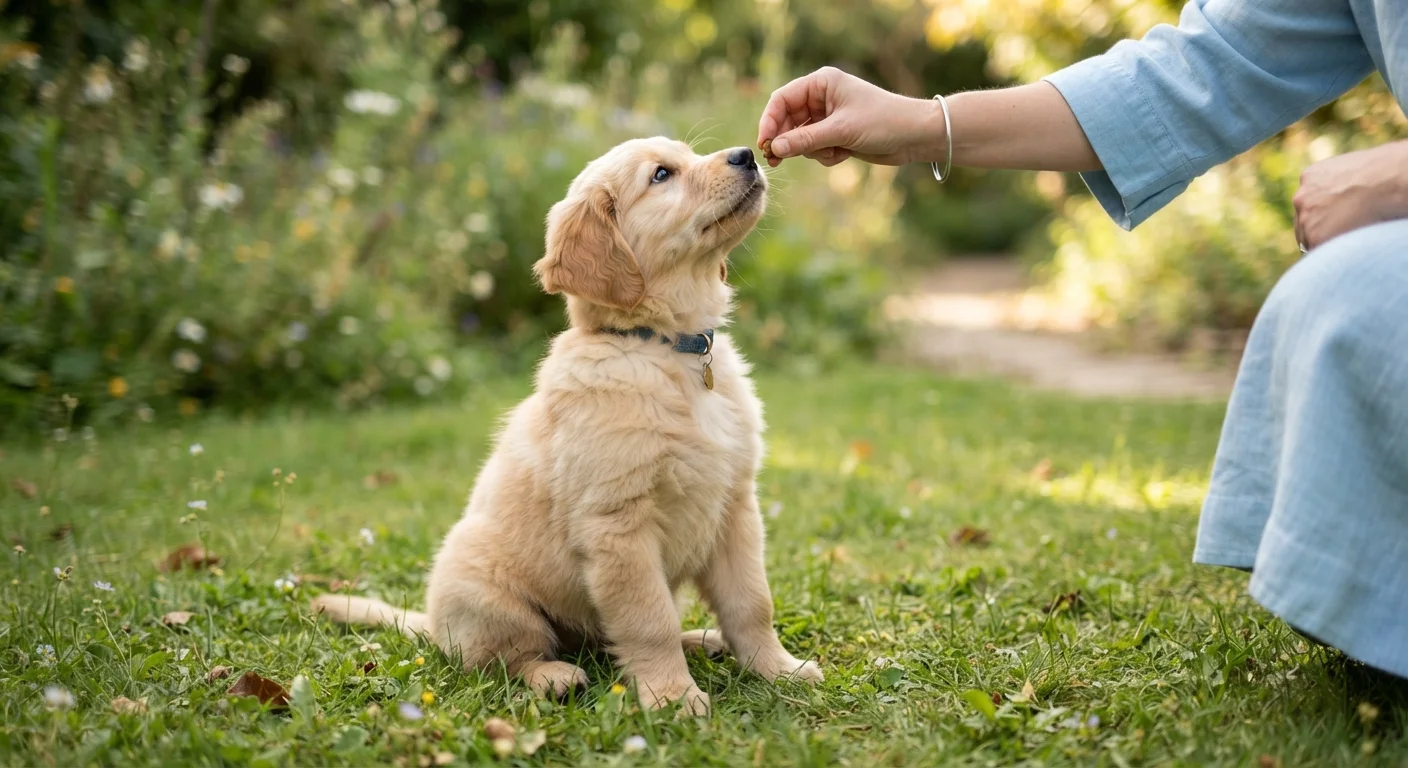
Positive reinforcement means adding something the dog values - a treat, praise, or play - immediately after a desired behavior, making that behavior more likely to happen again. This approach is grounded in well-established learning science and is endorsed by major veterinary and animal behavior organizations.
Its effectiveness stems from clarity: the dog learns that a specific action reliably produces a good outcome. There is no confusion, no fear, and no damaged relationship. For a fuller look at learning theory and how it applies across species, the complete overview of humane animal training covers the principles in depth.
Use Your Dog's Meals as Training Opportunities
Instead of delivering your dog's entire meal in a bowl, use a portion of their daily kibble as training rewards throughout the day. This keeps calorie intake balanced while dramatically increasing the number of practice repetitions you can fit in. High-value treats (small pieces of soft food) can be reserved for introducing new or challenging behaviors.
Foundational Commands Every Dog Should Learn First
A small set of reliable behaviors forms the backbone of a well-mannered dog. Prioritize these before moving on to more advanced skills:
- Sit - one of the easiest behaviors to teach and endlessly useful for managing greetings and impulse control.
- Stay - builds self-regulation and keeps a dog safe in unpredictable situations.
- Come (recall) - potentially the most important cue for safety; a dog that reliably returns when called can be kept out of danger.
- Leave it - teaches the dog to disengage from objects or food on the ground, preventing ingestion of hazards.
- Loose-leash walking - not a single command but a skill set; a dog that pulls on leash makes walks stressful for everyone.
Familiarizing yourself with the vocabulary used in modern training makes these lessons easier to follow. The key training terms reference explains concepts like luring, shaping, and reinforcement schedules in plain language.
Timing, Consistency, and Short Sessions
The single most important mechanical skill in dog training is timing. A reward delivered within one to two seconds of the desired behavior clearly communicates what earned it. A reward delivered five seconds later may accidentally reinforce whatever the dog was doing at that moment instead.
Consistency matters just as much. If one household member allows the dog on the sofa and another does not, the dog receives conflicting information and the rule loses meaning. Everyone in the home should use the same cues and follow the same rules.
Keep sessions short - typically three to five minutes - and end while the dog is still engaged and succeeding. Multiple brief sessions throughout the day outperform one long session. Use meal times as built-in training opportunities by asking for behaviors before placing the bowl down.
A Note on Marker Words vs. Clickers
A clicker is a small handheld device that makes a distinct click sound used as a precise behavior marker. A spoken word like "yes" works just as well for most pet owners and requires no extra equipment. Whichever you choose, use it consistently - and always follow it with a reward so the marker retains its meaning.
Common Beginner Mistakes and How to Avoid Them
New owners often encounter a handful of predictable stumbling blocks:
- Repeating cues - saying "sit, sit, sit" teaches the dog that the third repetition is the real cue. Say it once, prompt if needed, then reward.
- Rewarding too late - a slow reward marks the wrong behavior. Use a marker word ("yes!") the instant the behavior happens, then follow with the treat.
- Asking for too much too soon - build behaviors in small steps. A dog learning "stay" should succeed at two seconds before being asked to hold for thirty.
- Ending on failure - if a session stalls, simplify the task so the dog can succeed, reward that, then stop. Never end a session with repeated failure.
- Inconsistent rules - decide household expectations in advance and make sure everyone follows them.
Building a Daily Training Routine
Training doesn't require a dedicated class or a formal session every time. The most effective approach weaves short practice moments into everyday life: ask for a sit before the leash goes on, a down-stay before the food bowl is placed, a recall across the yard before coming inside.
Pair training habits with your dog's health routine - the first-year health guide outlines vet visits, vaccinations, and wellness checkpoints that naturally structure your calendar. Training and health check-ins reinforce each other: a dog that sits calmly for handling is easier to examine at the vet.
If progress stalls or you encounter challenging behavior, a certified professional trainer can assess your technique and the dog's responses in person. The goal is a relationship built on communication, not compliance - one that benefits both you and your dog for years to come.
This article is for general informational and educational purposes only. It does not constitute professional veterinary or behavioral advice. For concerns about your dog's health or significant behavioral issues, consult a licensed veterinarian or certified animal behavior specialist.