
Credit Utilisation: Why Spending Less Than Your Limit Matters More Than You Think

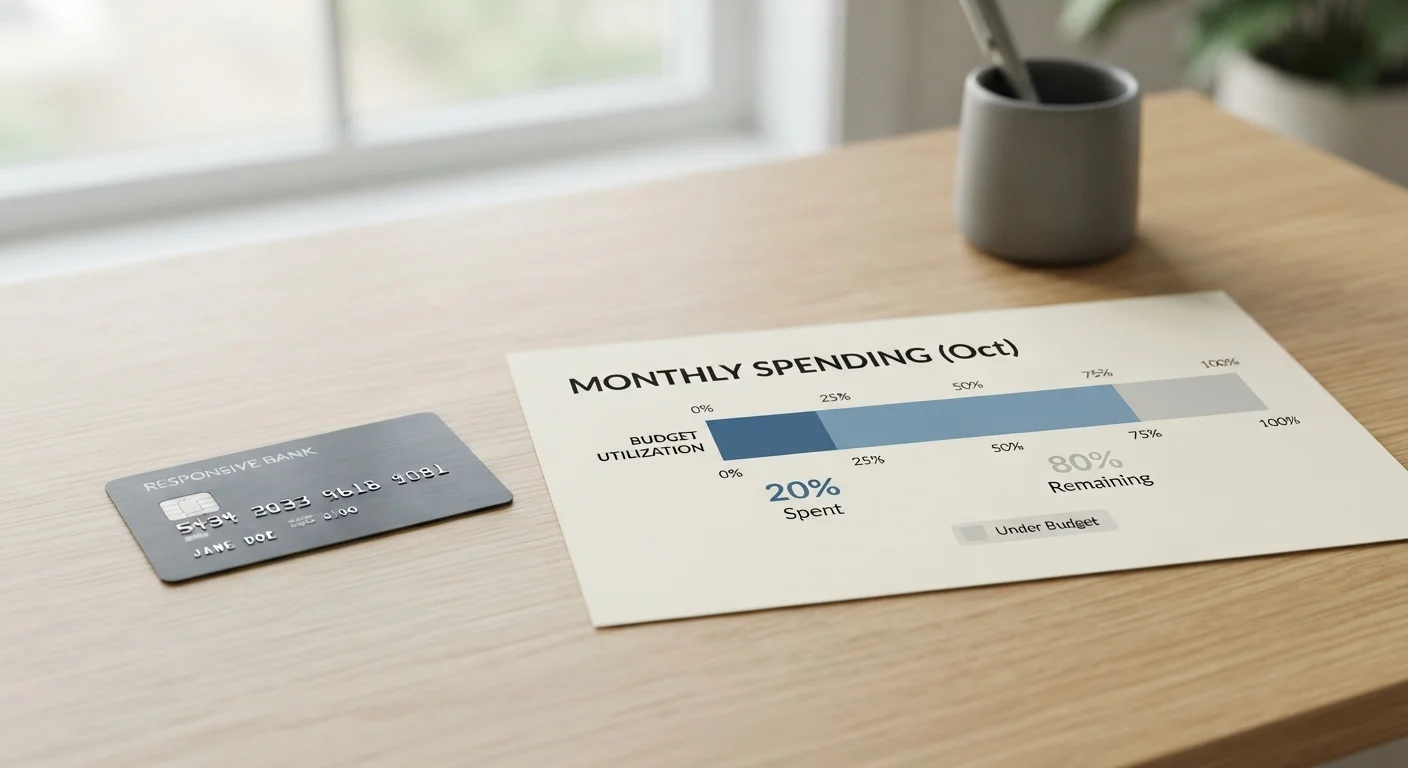
Key Takeaways
- Credit utilisation typically makes up about 30% of a FICO score, making it one of the most impactful factors.
- A utilisation rate below 30% is widely cited as a general guideline; lower is generally better.
- Utilisation is recalculated each time your card issuer reports your balance to the credit bureaus.
- Paying down balances or requesting a credit limit increase can both reduce your utilisation ratio.
- Closing a credit card raises your utilisation by reducing your total available credit.
Credit Utilisation
Credit utilisation is the percentage of your available revolving credit that you're currently using. It's calculated by dividing your total credit card balances by your total credit limits, then multiplying by 100. For example, if you have a $1,000 limit and carry a $300 balance, your utilisation is 30%. Lenders and credit scoring models use this figure to gauge how reliant you are on borrowed money.
Credit scoring models typically evaluate utilisation both at the individual account level and across all revolving accounts combined - so a single maxed-out card can affect your score even if your overall ratio looks fine.
What Credit Utilisation Actually Measures
When a lender reviews your credit profile, they're not only asking whether you pay on time - they're also asking how much of your available credit you're actively using. That's the core question credit utilisation answers.
The formula is straightforward: divide your total revolving balances by your total revolving credit limits, then multiply by 100. If you have two credit cards - one with a $2,000 limit and a $400 balance, another with a $3,000 limit and a $600 balance - your combined utilisation is $1,000 out of $5,000, or 20%.
This ratio matters because it signals financial behavior. A person consistently using 80% of their available credit may appear more financially stretched than someone using 15%, even if both pay on time. Scoring models interpret high utilisation as a sign of potential financial stress, which translates to higher perceived lending risk.
To understand exactly where utilisation fits among other score factors, see the five factors behind your credit score.
Why the 30% Guideline Exists - and Its Limits
You've likely heard that keeping utilisation under 30% is the goal. This guideline is widely shared by financial educators and consumer advocates, and it reflects a real pattern: people with scores in the highest ranges tend to have low utilisation ratios.
That said, 30% is not a hard threshold or a rule embedded in scoring models. It's a practical heuristic - a rough boundary that helps most consumers avoid the range where utilisation begins to meaningfully suppress scores. Crossing 30% doesn't trigger a sudden drop; rather, scores tend to decline gradually as utilisation climbs.
~30%
Share of FICO score tied to credit utilisation
According to FICO's publicly disclosed score factor weightings, amounts owed - which is primarily driven by credit utilisation - accounts for approximately 30% of a FICO score.
<10%
Utilisation typical among highest-scoring consumers
Industry data from FICO and consumer credit research consistently shows that consumers with scores above 800 tend to use a small fraction of their available credit, often in the single digits.
Monthly
How often utilisation typically resets
Most credit card issuers report balances to the major credit bureaus on a monthly cycle, meaning utilisation is not a permanent mark and can improve relatively quickly with balance paydowns.
Research and scoring data generally suggest that the lowest utilisation rates correlate with the strongest scores. For consumers actively working to improve their scores, targeting 10% or lower on each individual card - not just in aggregate - can make a meaningful difference.
It's also worth understanding what utilisation doesn't measure: it has no memory. Unlike a late payment, which can stay on your report for up to seven years, utilisation resets each reporting cycle. A high balance this month doesn't follow you indefinitely once you pay it down.
How Reporting Timing Affects Your Score
Many people assume that paying their balance in full each month means their utilisation shows as zero. In practice, that's not usually how it works.
Card issuers report your balance to the credit bureaus on a schedule - typically around your statement closing date, not your payment due date. So even if you pay in full and on time, the balance that gets reported may reflect charges you accumulated during the billing cycle.
Time Your Payments Strategically
If reducing your reported utilisation is a priority, consider paying down your card balance a few days before your statement closing date rather than waiting for the due date. Your issuer reports the balance at statement close, so a lower balance at that point translates directly into a lower utilisation figure on your credit report.
If you want to lower the balance your issuer reports, you have a few practical options: pay down your balance before the statement closes, or make multiple payments throughout the month rather than one lump sum at the due date.
This timing nuance is one of the widely believed credit score myths - the idea that paying in full automatically results in zero utilisation. The actual outcome depends on when your issuer reports.
Practical Ways to Manage Your Utilisation
Improving your utilisation ratio generally comes down to two levers: reducing your balances or increasing your available credit. Both change the ratio, though they have different implications.
- Pay down existing balances: The most direct approach. Prioritizing high-utilisation cards - not just the ones with the highest balances - can produce faster score improvements because each card's individual utilisation also matters.
- Request a credit limit increase: If your spending stays constant and your limit rises, your ratio falls. However, some issuers conduct a hard inquiry when processing limit increase requests, which can cause a small, temporary score dip. Ask your issuer whether the request involves a hard pull before proceeding.
- Avoid closing unused cards: Closing a card removes its limit from your available credit, which can raise your overall utilisation even if the card carried no balance. This connects directly to habits that quietly damage your credit score.
- Spread spending across cards: If you use multiple cards, distributing balances can prevent any single card from hitting a high utilisation ratio, even if total spending stays the same.
For a broader picture of responsible credit management, managing credit responsibly over the long term covers evidence-informed habits that support a healthy credit profile over time.
This article is for general informational and educational purposes only and does not constitute personalized financial or credit advice. Consult a qualified financial professional for guidance specific to your situation.