

Key Takeaways
- Solid hardwood is milled from a single piece of wood and can be sanded and refinished multiple times over decades.
- Engineered hardwood uses a real wood veneer over a plywood core, giving it greater resistance to moisture and temperature swings.
- Solid hardwood should not be installed below grade or over radiant heat systems due to expansion and contraction risks.
- Engineered hardwood is generally compatible with basements, slab subfloors, and radiant heating when the product specifies it.
- Both types can look virtually identical from the surface; the key differences lie in construction and long-term performance.
- The number of times either type can be refinished depends on the thickness of the wear layer - check this before purchasing.
Option A
Solid Hardwood Flooring
The time-honored, refinishable classic.
Best for: Dry, climate-controlled rooms where long-term refinishing potential and resale appeal matter most.
Option B
Engineered Hardwood Flooring
The dimensionally stable, moisture-tolerant modern option.
Best for: Spaces with humidity fluctuations, below-grade installations, or subfloors where solid wood would be prone to warping.
If you want a floor you can refinish repeatedly over 50+ years
Solid Hardwood Flooring
Solid hardwood's full-thickness planks can typically be sanded and refinished many more times than engineered options, extending the floor's life considerably with proper maintenance.
If you're installing in a basement, over concrete, or in a humid climate
Engineered Hardwood Flooring
Its cross-ply plywood core resists the expansion and contraction that causes solid wood to gap, buckle, or cup in moisture-prone environments.
If you have radiant floor heating
Engineered Hardwood Flooring
Engineered hardwood is more dimensionally stable under the temperature cycles radiant systems create, though you should always confirm compatibility with the specific product's guidelines.
If resale value and traditional craftsmanship are priorities
Solid Hardwood Flooring
Real estate markets in many US regions place a premium on solid hardwood floors, and the ability to refinish them to like-new condition over decades supports long-term home value.
If you want a floating DIY installation without nailing or gluing
Engineered Hardwood Flooring
Many engineered products use click-lock systems that make them accessible for confident DIYers without specialized tools, whereas solid hardwood typically requires nail-down installation over wood subfloors.
How Each Type Is Built
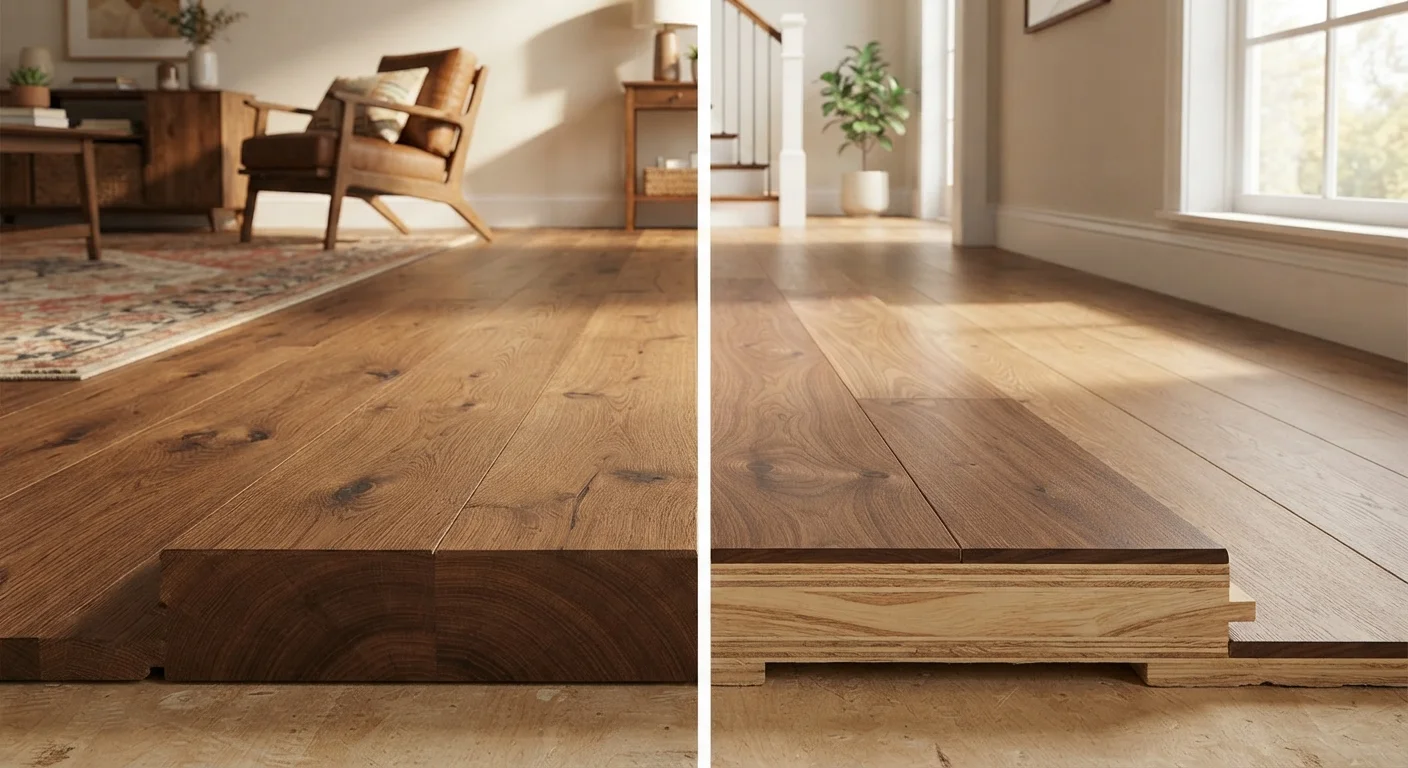
Understanding the construction of each floor type is the foundation of choosing wisely. Solid hardwood is exactly what it sounds like - a plank milled from a single piece of wood, typically ¾ inch thick. Every layer, from top to bottom, is the same species. That full thickness is what allows the floor to be sanded back and refinished over many decades.
Engineered hardwood, by contrast, is manufactured with a top layer - called the wear layer - of real hardwood veneer bonded over multiple layers of cross-ply plywood or high-density fiberboard. This layered construction gives engineered hardwood its key advantage: the grain of each layer runs perpendicular to the next, which dramatically reduces the wood's tendency to expand and contract with changes in temperature and humidity.
Neither construction is inherently inferior. They're engineered (literally, in one case) for different conditions.
| Criterion | Solid Hardwood | Engineered Hardwood |
|---|---|---|
| Construction | Single solid wood plank | Hardwood veneer over plywood core |
| Typical thickness | ¾ inch standard | ⅜ to ¾ inch varies by product |
| Moisture tolerance | Low - avoid high humidity areas | Moderate - better for humid spaces |
| Below-grade installation | Not recommended | Generally suitable with moisture barrier |
| Radiant heat compatibility | Generally not recommended | Often compatible - check product specs |
| Refinishing potential | High - 4 to 8+ times typical | Limited - depends on wear layer thickness |
| Installation methods | Nail-down or staple-down only | Nail, glue, or floating click-lock |
| DIY friendliness | Moderate - requires specific tools | Easier - floating option is beginner-friendly |
| Lifespan (maintained) | 80-100+ years possible | 25-50 years typical |
Moisture, Stability, and Where Each Floor Can Go
Moisture is the single biggest factor separating these two flooring types in practice. Solid hardwood is hygroscopic - it absorbs and releases moisture from the air, causing it to expand in humid conditions and contract when the air dries out. In well-maintained, climate-controlled main-floor rooms, this movement is manageable. But solid hardwood should not be installed below grade (basements) or directly over concrete slabs, where ground moisture can cause serious warping or cupping.
Engineered hardwood handles moisture variation far better. Its plywood core is dimensionally stable enough to tolerate installation in basements, over concrete with a proper moisture barrier, and in kitchens - areas where solid wood would be risky. That said, engineered hardwood is not waterproof. Prolonged standing water will still damage it, and it should never be installed in full bathrooms or laundry rooms.
~3%
Typical moisture content range for acclimated hardwood
The Wood Flooring Manufacturers Association (NWFA) generally recommends wood be within 2-4% of the subfloor's moisture content before installation to prevent movement.
2-6 mm
Engineered hardwood wear layer thickness range
Industry product specifications consistently show that wear layer thickness is the primary determinant of how many times an engineered floor can be refinished.
¾ inch
Standard solid hardwood plank thickness
This has been the industry standard for nail-down solid hardwood installation over wood subfloors in residential construction for decades.
If your home has radiant floor heating, engineered hardwood is generally the recommended choice. The repeated heating cycles that push air moisture up and down can cause solid wood to develop gaps or cracks over time. Always verify with the specific product's technical documentation before proceeding.
Refinishing, Longevity, and What to Expect Over Time
One of the most common questions homeowners ask is: how many times can this floor be refinished? For solid hardwood, the answer depends on the plank thickness and how much material each sanding session removes, but a ¾-inch solid plank can typically withstand four to eight refinishing sessions over its lifetime - meaning a well-maintained solid floor can last 80 to 100 years.
Engineered hardwood's refinishing potential is directly tied to the thickness of its top wear layer. Thinner wear layers of 1-2 mm may support only one light sanding; thicker layers of 4-6 mm can handle two or three refinishes. When evaluating engineered options, the wear layer thickness is the single most important spec to check.
Check the Wear Layer, Not Just the Label
When shopping for engineered hardwood, look past marketing language and find the wear layer thickness in the product's technical specifications. A 2 mm wear layer and a 6 mm wear layer are very different products in terms of long-term refinishing potential. Some manufacturers list this clearly; others require you to request the spec sheet. It's worth asking before committing to a product for a large space.
In practical terms, most homeowners refinish their floors far less often than the material would allow. Regular cleaning, area rugs in high-traffic zones, and furniture pads go a long way toward preserving the finish between refinishing sessions - for either floor type.
Installation: What DIYers Need to Know
Installation method is where these two flooring types diverge most sharply for the home DIYer. Solid hardwood is almost always installed using a nail-down or staple-down method, which requires a pneumatic flooring nailer, a wood subfloor (not concrete), and a dry, acclimated environment. It's a manageable project for experienced DIYers but has a steeper learning curve than many expect.
Engineered hardwood offers more flexibility. Depending on the product, it can be nailed down, glued down, or installed as a floating floor using a click-lock system. The floating method - where planks interlock and rest over an underlayment without fasteners - is particularly beginner-friendly and is suitable over concrete with an appropriate moisture barrier.
Regardless of which type you choose, proper acclimation is essential. Most manufacturers recommend letting planks sit in the installation space for 48-72 hours to adjust to the room's temperature and humidity. Skipping this step is one of the most common causes of post-installation gapping and buckling. Always follow the manufacturer's acclimation and subfloor preparation guidelines specific to your product.